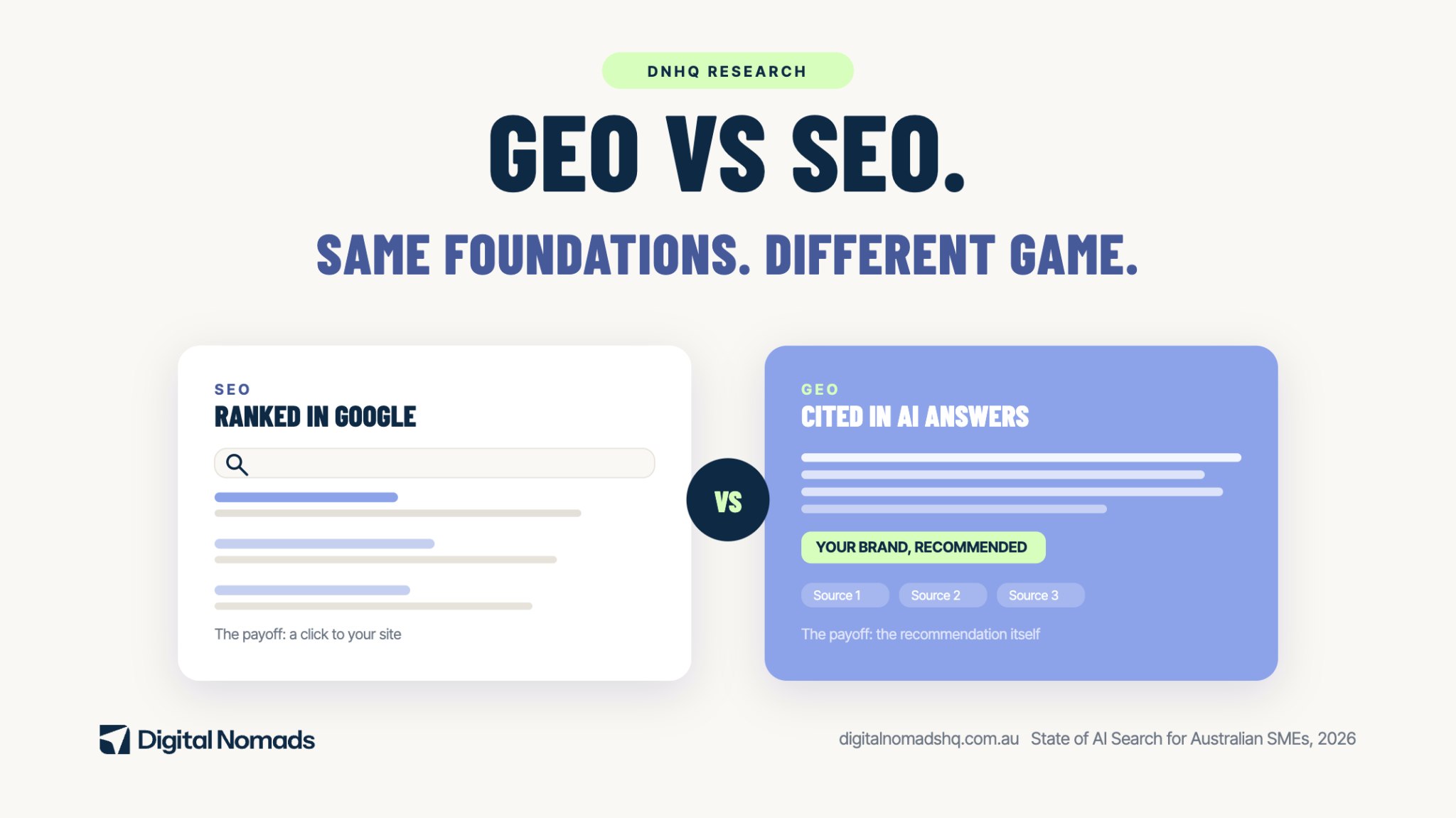
GEO (generative engine optimisation) is the practice of earning citations and recommendations inside AI-generated answers from tools like ChatGPT, Perplexity, Gemini and Google’s AI Overviews.
SEO (search engine optimisation) is the practice of earning rankings in traditional search results.
They share most of their foundations, but they differ in what you optimise, where you appear, and how you measure success. In 2026, Australian businesses need both, run as one strategy.
That’s the short answer.
Here’s the long one, backed by the largest study of AI search ever conducted on Australian search results.
Our take
Most articles comparing GEO and SEO are written by software companies selling visibility tools, quoting global data from early 2025.
We approach it differently.
We’re a full-service agency that has spent eight years doing SEO for over 1,000 Australian businesses, from Sunshine Coast trades to national brands.
We built our own AI search audit platform, Amalfi, in-house, and we run prompt tracking across every major AI engine as part of our Searchlight SEO framework. In 2026 we published the State of AI Search for Australian SMEs, analysing 116,918 Australian search results across 18 industries.
So when we compare GEO and SEO, we’re not summarising other people’s blog posts. We’re reporting what we see in the data and in client accounts every week.
What is SEO?
SEO is the process of improving your website and its authority so it ranks higher in traditional search results, primarily Google, and earns organic clicks.
The core work has been stable for years: keyword research, content that satisfies search intent, technical health, internal linking, schema markup, and earning links and mentions from other reputable sites.
The output is a ranking. The payoff is a click through to your website, where your page does the selling.
What is GEO?
GEO is the process of improving your content and your brand’s presence across the web so that AI engines cite, quote and recommend you inside their generated answers.
When someone asks ChatGPT “who’s the best conveyancer in Brisbane” or Google shows an AI Overview for “how much does a new roof cost in Queensland”, the engine synthesises an answer from sources it trusts.
GEO is the work of becoming one of those sources, and ideally the named recommendation.
You’ll also hear AEO (answer engine optimisation) and LLMO (large language model optimisation).
In practice these overlap almost entirely with GEO.
AEO leans towards direct answer formats like featured snippets and voice results, LLMO towards the mechanics of how language models retrieve content.
We treat them as one discipline with one workstream, and so should you.
Anyone selling them to you as three separate retainers is selling you the same work three times.
The numbers: why this stopped being optional
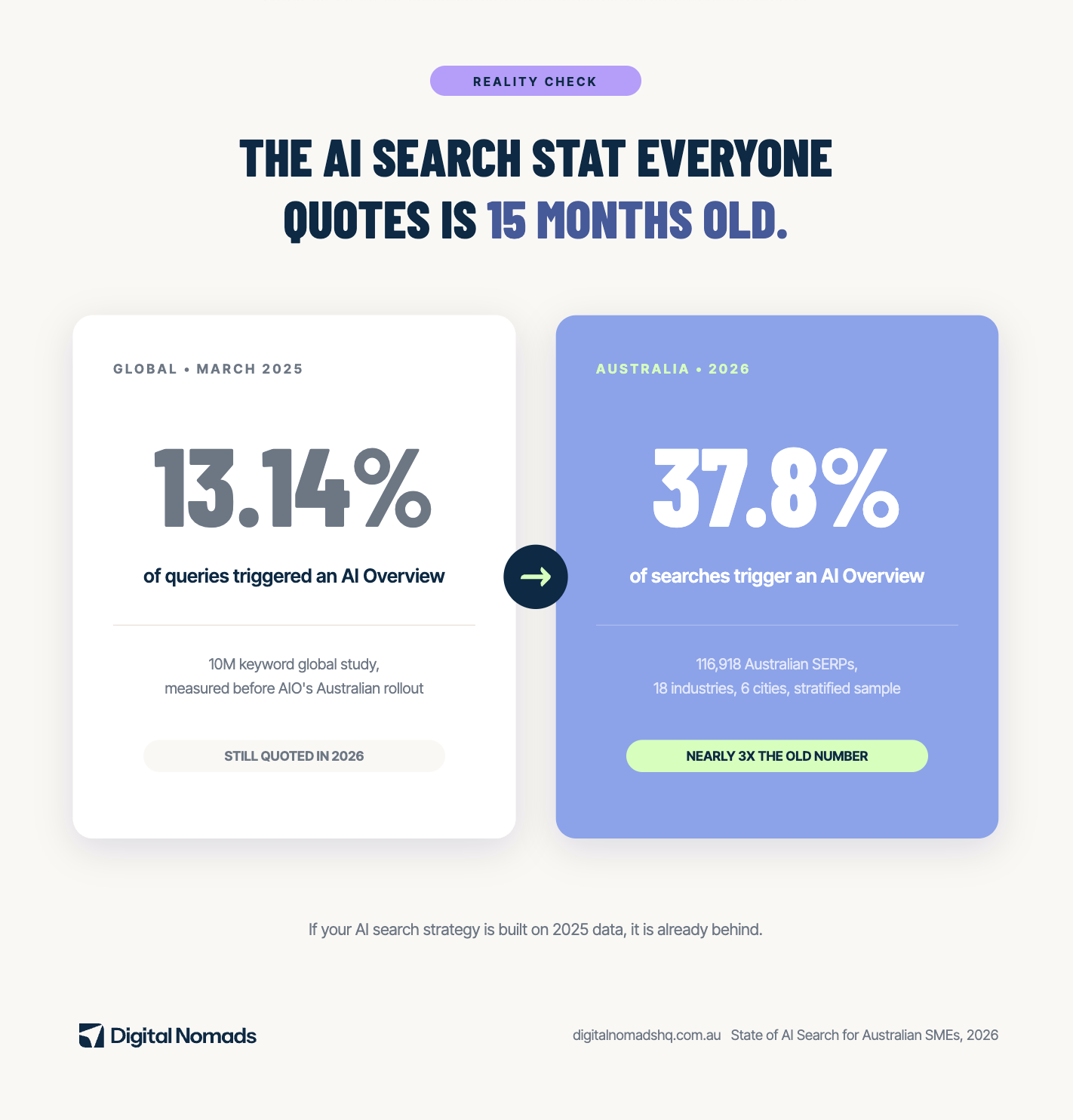
Semrush’s widely cited study of 10 million keywords found around 13 per cent of queries triggered AI Overviews in March 2025, roughly double the rate from just two months earlier.
That figure is now badly out of date.
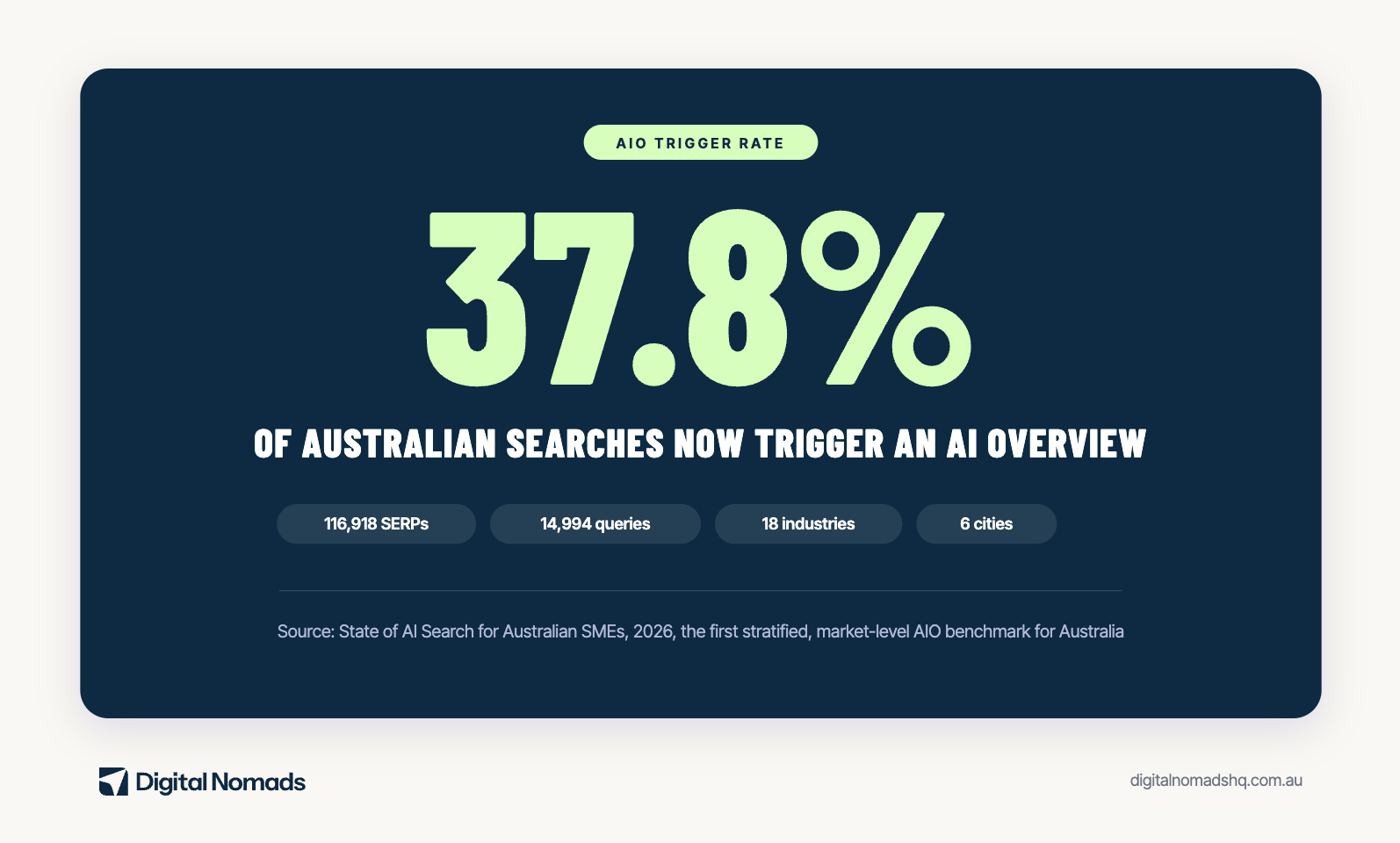
Our own research across 116,918 Australian SERPs found AI Overviews triggering on 37.8 per cent of queries by 2026.
Nearly three times the number most articles are still quoting, and measured on Australian results rather than a global blend.
Around that headline number, the wider shifts are compounding:
Ahrefs found that when an AI Overview appears, click-through rates on the top organic results fall by more than half. Position one is worth less when it sits below an answer.
Bain & Company research suggests around 80 per cent of searchers now resolve a large share of their queries without clicking anything at all.
ChatGPT reportedly handles billions of prompts a day, and the majority of them are search behaviour by another name. Those buyers never see a results page.
Gartner has forecast traditional search volume falling by roughly a quarter through 2026 as AI assistants absorb query share.
The part that should interest you most is what our study found about your competitors:
AI visibility across Australian SMEs is patchy, inconsistent and mostly accidental. Almost nobody is doing this deliberately yet.
The gap between businesses optimising for AI answers and businesses ignoring them is the widest it will ever be, and it compounds, because AI engines reinforce the sources they already trust.
Early movers get an unfair advantage that latecomers pay to claw back… and as of July 26, the demand to be present in AI seems to be every scope call our agency is having.
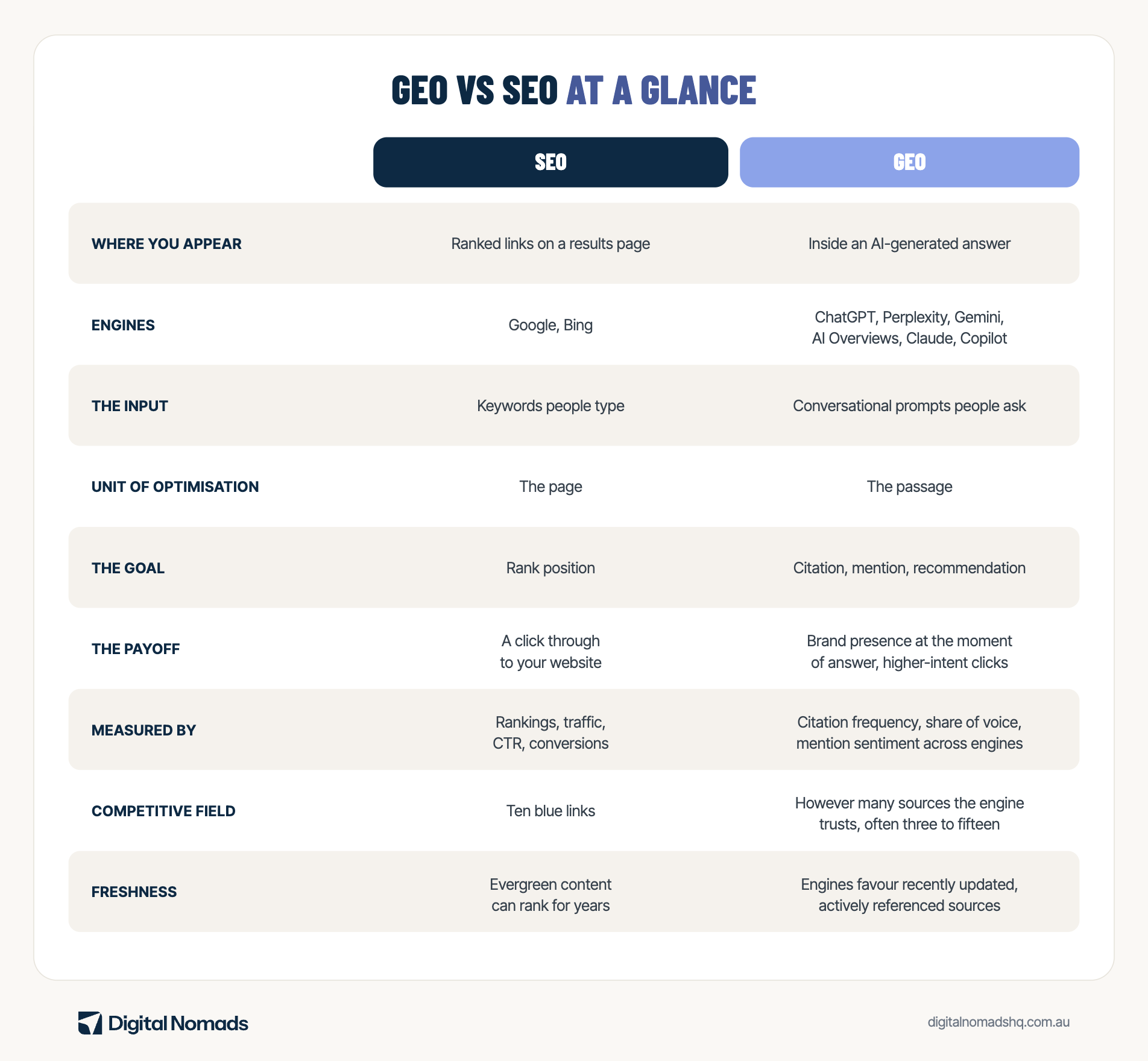
GEO vs SEO: the comparison table
SEO | GEO | |
Where you appear | Ranked links on a results page | Inside an AI-generated answer |
Engines | Google, Bing | ChatGPT, Perplexity, Gemini, Claude, AI Overviews, AI Mode, Copilot |
The input | Keywords people type | Conversational prompts people ask |
Unit of optimisation | The page | The passage |
The goal | Rank position | Citation, mention, recommendation |
The payoff | A click to your site | Brand presence at the moment of answer, plus fewer but higher-intent clicks |
Measured by | Rankings, traffic, CTR, conversions | Citation frequency, share of voice, mention sentiment across engines |
Competitive field | Ten blue links | However many sources the engine trusts, often three to fifteen |
Freshness | Evergreen content can rank for years | Engines favour recently updated, actively referenced sources |
The five differences that actually change your strategy
1. Rankings vs citations
SEO is a zero-sum contest for ten positions.
GEO is a contest for inclusion in a synthesised answer that might cite a handful of sources or name brands without linking to them at all.
You’re optimising to be referenced, not just ranked, which means content needs to be worth quoting, not just worth crawling.
2. Pages vs passages
Google ranks pages.
Language models extract passages.
A 2,000 word page can win in traditional search on overall relevance and authority, but in generative search, the specific paragraph that answers the question has to stand on its own: self-contained, factual, clearly structured and quotable out of context.
Answer-first openings, tight definitions and question-based headings have gone from nice formatting to load-bearing strategy.
3. Keywords vs prompts
Keyword research tells you what people type into Google.
It tells you almost nothing about the conversational, multi-part questions they ask AI assistants. “SEO agency Brisbane” and “I run a plumbing business in Brisbane doing about $2m a year, who should I talk to about getting more leads” are different problems with different winners.
This is why we built prompt tracking directly into Amalfi rather than bolting it onto rank tracking: you need to know the prompts your buyers actually use and whether you appear in the responses, engine by engine.
4. One engine vs many
SEO has been a Google monoculture for twenty years. GEO is fragmented across engines with different retrieval systems, source preferences and update cycles.
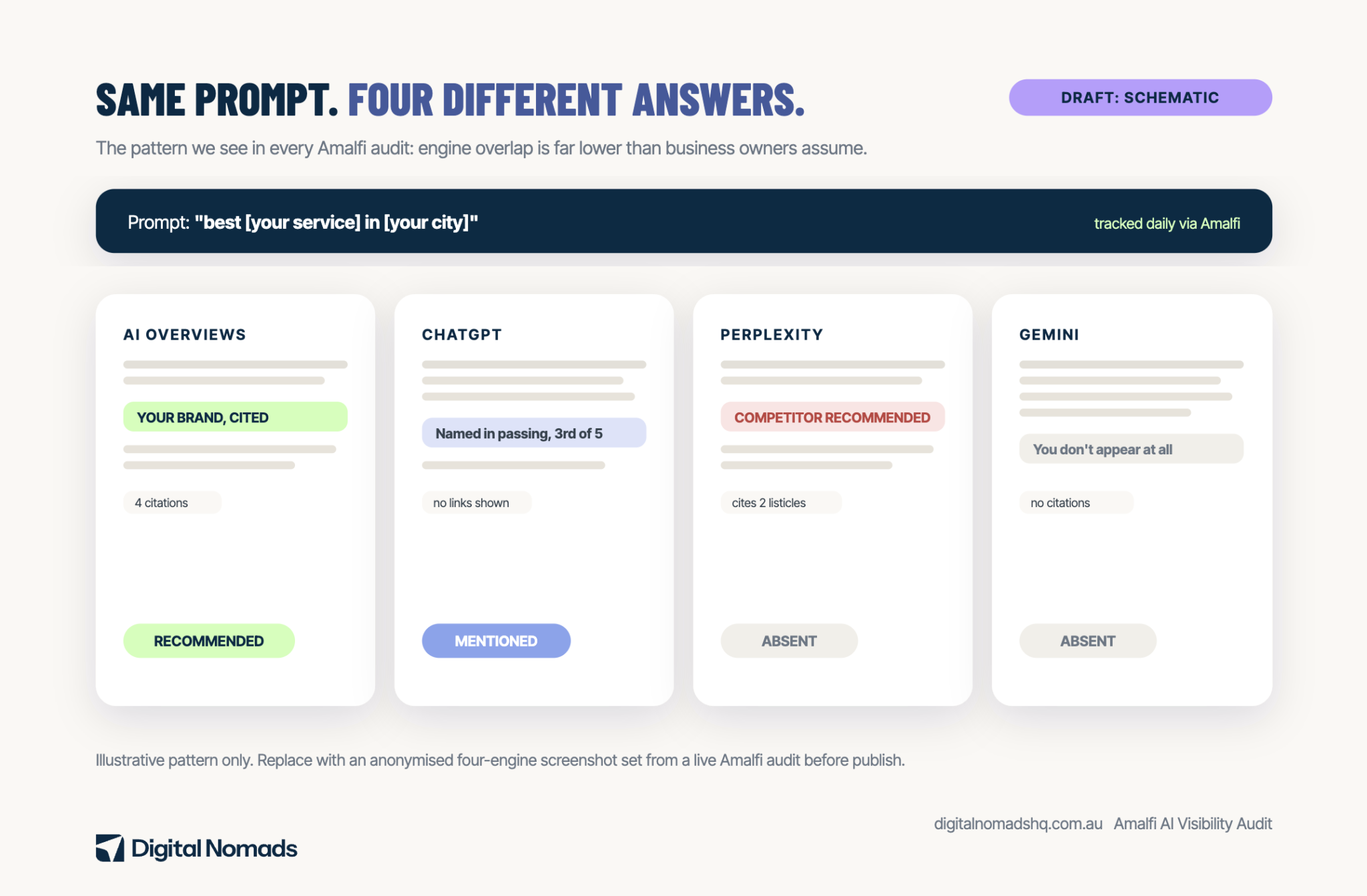
Semrush demonstrated this neatly in their own testing: the same query put to AI Overviews, Perplexity, ChatGPT and Gemini produced different recommendations, different sources and different formats, with some engines citing transparently and others citing nothing at all.
We see exactly the same pattern in every Amalfi audit we run.
It’s common for an Australian business to be recommended by one engine, mentioned in passing by a second, and completely invisible to the other three, for the same commercial prompt.
Overlap between engines is far lower than most business owners assume, which is why measuring one engine and extrapolating is a mistake.
5. Your website vs your whole footprint
Traditional SEO is heavily site-centric.
Generative engines lean on the entire web: reviews, directories, industry publications, Reddit threads, comparison articles, Wikipedia-tier reference sources and structured databases.
Your AI visibility is shaped by everything the internet says about you, not just what your own site says.
Digital PR, consistent business information, and earning mentions in the places engines already trust have moved from supporting acts to core infrastructure.
What stays the same
Before anyone convinces you to torch your SEO program, understand how much carries over.
Generative engines don’t conjure answers from nowhere.
They retrieve, rank and synthesise from largely the same web that Google indexes, using many of the same trust signals.
Crawlable, technically sound websites.
Clear site architecture.
Content that genuinely answers the question with real expertise behind it.
Authoritative mentions from other trusted sites.
Accurate, consistent business information everywhere you’re listed.
Original research nobody else has.
If your SEO foundations are weak, your GEO results will be weak.
There is no shortcut where you skip the unglamorous work and prompt-engineer your way into ChatGPT’s recommendations.
Strong SEO is the entry ticket. GEO is the extra distance.
Where to put your budget: a starting framework
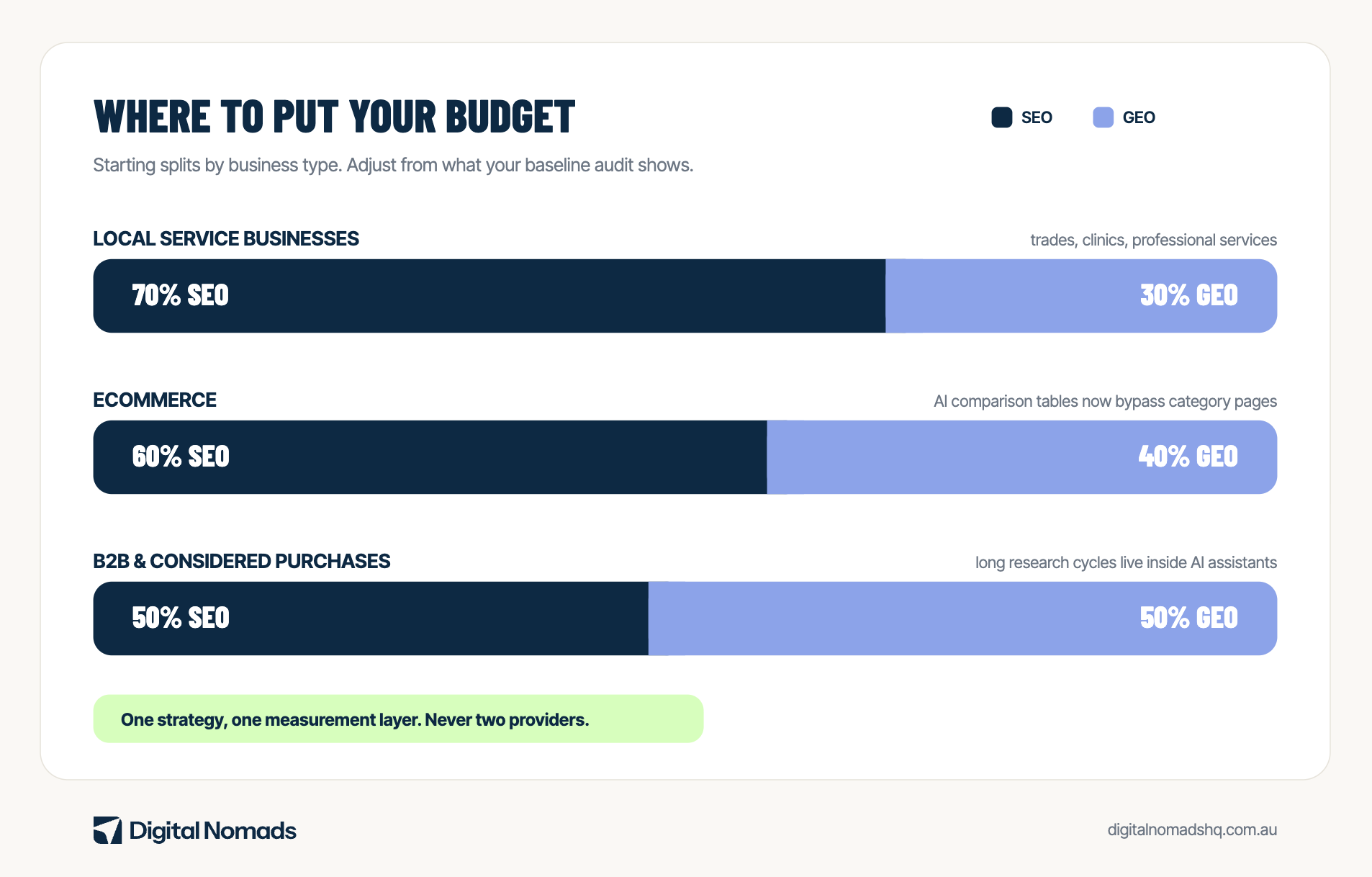
Local service businesses (trades, clinics, professional services).
Roughly 70/30 SEO to GEO.
Local packs, reviews and maps still drive the bulk of enquiries, but local commercial queries trigger AI answers at high rates and buyers increasingly ask assistants for direct recommendations. Your Google Business Profile, review velocity and consistent citations do double duty across both.
Roughly 60/40.
Product and category rankings still pay the bills, but AI engines now build comparison tables and “best of” recommendations that bypass your category pages entirely. Being the cited source in those comparisons, and being present in the third-party listicles engines lean on, is where the 40 goes.
B2B and considered purchases.
Closer to 50/50.
Long research cycles are exactly where buyers use AI assistants most, and a single “which providers should I shortlist” prompt can make or end your deal before you know it existed. Original research, digital PR and entity clarity carry disproportionate weight here.
How we run it at DNHQ
For transparency, here’s the sequence behind our AI SEO engagements, because a comparison article that ends in “it depends” isn’t worth your time.
Baseline
An Amalfi audit measuring where you currently appear across AI Overviews, ChatGPT, Perplexity, Gemini and Copilot for the prompts mapped to your revenue, benchmarked against the competitors taking your citations. Most businesses have never seen this data and are guessing.
Foundations
Technical SEO, crawl access for AI agents, entity clarity and schema markup, so engines can reliably understand who you are, what you do and where you operate.
Extraction-ready content
Restructuring priority pages with answer-first openings, question-based headings, self-contained passages, and tables and definitions where they earn their place. Every important page should have sections a language model can lift cleanly.
Authority everywhere
Original data, digital PR, reviews and credible third-party mentions. Publishing research nobody else has is the single most reliable citation earner we’ve found, because engines need sources for claims and unique data makes you the source. It’s the exact play behind our own State of AI Search report.
Measurement that matches the medium
Prompt tracking alongside rank tracking through Searchlight, with citation share of voice treated as seriously as keyword positions.
How we run it at DNHQ
For transparency, here’s the sequence behind our AI SEO engagements, because a comparison article that ends in “it depends” isn’t worth your time.
Baseline
An Amalfi audit measuring where you currently appear across AI Overviews, ChatGPT, Perplexity, Gemini and Copilot for the prompts mapped to your revenue, benchmarked against the competitors taking your citations. Most businesses have never seen this data and are guessing.
Foundations
Technical SEO, crawl access for AI agents, entity clarity and schema markup, so engines can reliably understand who you are, what you do and where you operate.
Extraction-ready content
Restructuring priority pages with answer-first openings, question-based headings, self-contained passages, and tables and definitions where they earn their place. Every important page should have sections a language model can lift cleanly.
Authority everywhere
Original data, digital PR, reviews and credible third-party mentions. Publishing research nobody else has is the single most reliable citation earner we’ve found, because engines need sources for claims and unique data makes you the source. It’s the exact play behind our own State of AI Search report.
Measurement that matches the medium
Prompt tracking alongside rank tracking through Searchlight, with citation share of voice treated as seriously as keyword positions.