TL;DR:
We no longer have to guess. Sworn DOJ testimony and the 2024 Content Warehouse leak revealed what Google’s systems actually track, and some of it contradicts a decade of official messaging.
Ranking is a staged pipeline, not a flat checklist: relevance (the ABC signals) → a site-wide quality score (Q*) → machine learning re-rankers → NavBoost, which re-ranks on 13 months of click data.
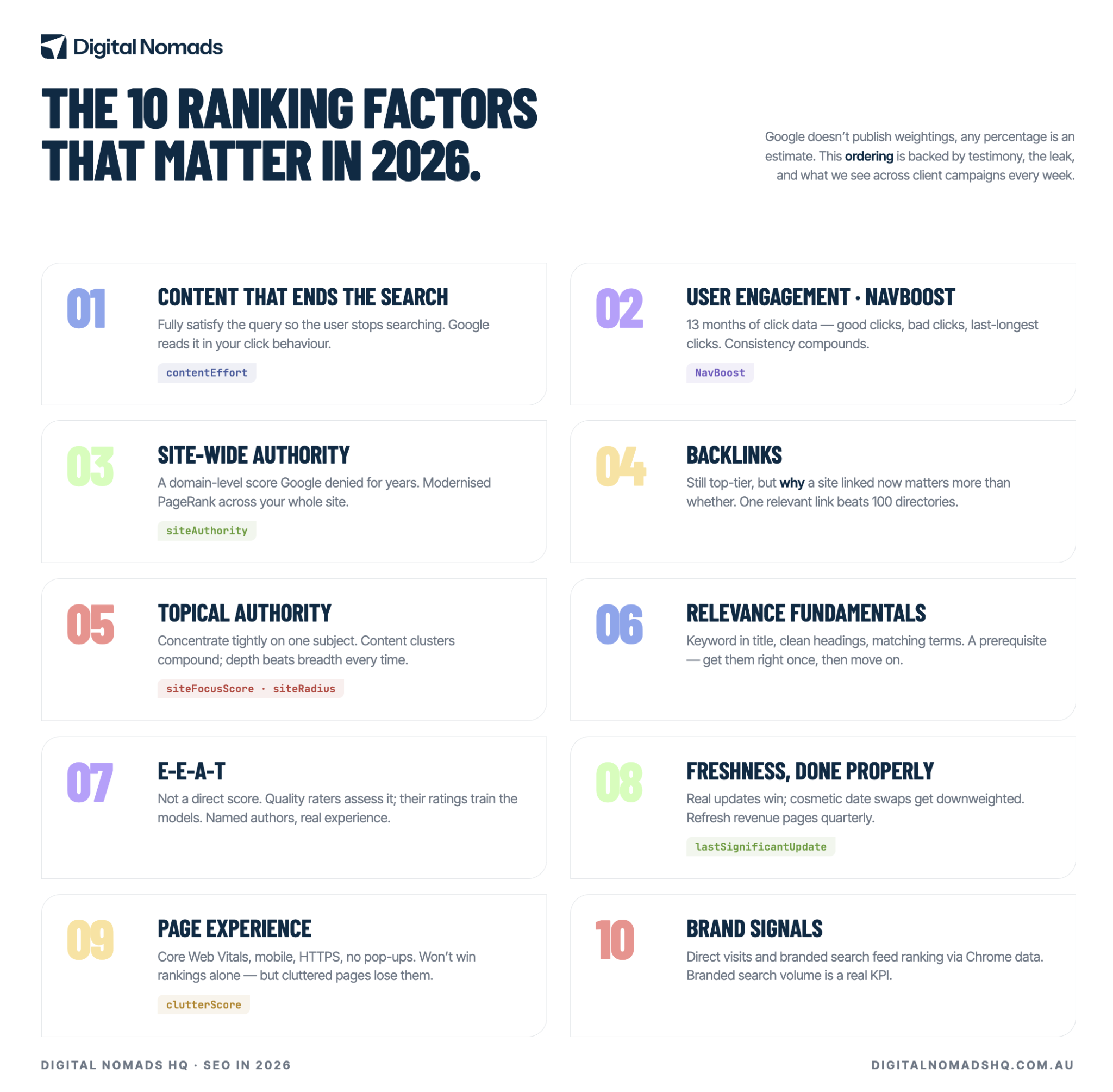
The 10 factors that matter: content that ends the search, user engagement via NavBoost, siteAuthority, link relevance over volume, topical authority, relevance fundamentals, E-E-A-T (as quality-rater training data), genuine freshness, page experience, and brand signals.
Demotions cancel out good work. Named attributes punish bad clicks, anchor mismatch, cluttered pages, site-level spam and keyword-stuffed domains.
The zombies are dead: keyword density, exact-match domains, social shares, word count and “AI-content penalties” are not real factors.
The deciding factor for 2026 is net new information gain. Publish what didn’t exist before you published it (your own data, first-hand experience, original research) because that is the one category AI can’t rewrite.
Ranking no longer equals visibility. AI Overviews triggered on 37.8 per cent of Australian SME queries in DNHQ’s State of AI Search report, and citability is now its own discipline.
Most articles about Google ranking factors are recycled guesswork.
The same list of 200 signals. Copied from a 2013 blog post. Republished every January with a new date in the title.
That era is over.
Between 2023 and 2025, two things happened that changed SEO forever:
Google’s most senior search engineers testified under oath in the US Department of Justice antitrust trial. And in May 2024, internal API documentation leaked, exposing more than 14,000 attributes that Google’s ranking systems track for every page on the web.
Which means we no longer have to guess what Google measures.
We know.
And some of it directly contradicts what Google told us for over a decade.
In this guide, you’ll learn exactly what the evidence shows, how Google’s ranking pipeline really works, and the 10 factors that matter most right now.
Let's dive in.
How we know what we know
Here’s the thing about ranking factor claims: not all of them are equal.
There are three tiers of evidence. And before you build strategy on any claim, you need to know which tier it sits in.
Tier one: official confirmations.
Google has publicly confirmed only a handful of signals.
HTTPS. Mobile friendliness. Core Web Vitals. Helpful, people-first content.
Useful? Sure. But it’s a tiny fraction of the pictur
Tier two: sworn testimony.
The DOJ trial put Google’s search leadership on the stand.
And lying under oath was not an option.
This is where we learned that user clicks directly influence rankings. That Google maintains a site-wide quality score. That Chrome browser data feeds the algorithm.
All things Google spent years denying.
Tier three: the 2024 API leak.
The Content Warehouse leak named the internal attributes behind those systems.
siteAuthority. navBoost. contentEffort. siteFocusScore. chromeInTotal.
The leak doesn’t tell us how each attribute is weighted.
But it confirms what’s being measured.
Bottom line?
When testimony and leaked documentation agree, you can treat a signal as real. That standard shapes everything below.
Ranking is a pipeline, not a checklist
The biggest misconception in SEO is that Google scores your page against a flat list of 200 items.
It doesn’t.
Ranking is a staged pipeline. And each factor bites at a specific stage.
Stage one: relevance.
First, Google works out whether your page is about the query at all.
Court exhibits revealed the internal shorthand for this: the ABC signals.
Anchors (what other pages say about you through links).
Body (the words on your page). Clicks (whether users who land on your page actually stay there).
These combine into a topicality score.
Stage two: quality.
Every site carries a largely static, query-independent quality score.
Internally, it’s called Q*.
It acts as a site-wide modifier. A strong Q* lifts every page you publish.
A weak one caps them.
PageRank still exists, by the way. But it’s now just one input into this broader score.
Stage three: machine learning re-rankers.
Systems like RankBrain and RankEmbedBERT refine results, especially for long-tail queries with little click history.
But here’s the detail most people miss: these models are trained partly on scores from Google’s human quality raters.
In other words, the Quality Rater Guidelines aren’t a suggestion. They’re training data.
Stage four: NavBoost.
After users interact with results, a system called NavBoost re-ranks based on 13 months of aggregated click data.
How important is it?
Google’s own engineers described it as one of the strongest signals in the entire system.
More on this in a minute.
Because it changes how you should think about SEO entirely.
The takeaway: a page can be perfectly relevant and still fail at stage two. It can pass quality and still get demoted at stage four.
That’s why single-lever SEO doesn’t work anymore.
The 10 ranking factors that matter in 2026
Quick note before we start: Google doesn’t publish weightings.
So any percentage you see out there is an estimate.
But the ordering below is backed by testimony, the leak, and what we see across client campaigns every single week.
1. Content that ends the search
The strongest pages do one thing extremely well:
They fully satisfy the query. So the user stops searching.
And Google measures this directly through click behaviour.
If people read your page and go back to the results, that’s recorded. If your page is the last one they visit, that’s recorded too.
The leak also revealed an attribute called contentEffort. It’s an estimate of how much genuine work went into a page.
Thin rewrites of what already ranks? They score poorly.
Original data, first-hand experience and real depth? They score well.
2. User engagement through NavBoost
NavBoost is essentially a giant table of query and click data spanning 13 months.
It tracks good clicks (the user stayed). Bad clicks (the user bounced back to the results). And last longest clicks (the result that ended the session).
Two practical implications here.
First: your title and meta description are ranking assets.
They earn the click that starts the record.
Second: the 13-month window rewards consistency.
A viral spike decays as old clicks roll out.
Pages that satisfy users month after month keep accruing signal.
Slow and steady actually wins this one.
3. Site-wide authority
The leak confirmed an attribute called siteAuthority. A domain-level score Google denied having for years.
It works like a modernised PageRank applied to your entire site. And it explains a pattern every SEO has seen:
A mediocre page on a strong domain outranking a superior page on a weak one.
Can you hack it? No.
It builds through editorial links, digital PR, original research worth citing, and time.
4. Backlinks
Still a top factor. But the game has completely changed.
Google’s systems now evaluate why a site linked to you. Not just whether it did.
Which means one contextual link from a relevant, authoritative publication outweighs a hundred generic directory links.
The most reliable link strategy in 2026? Publish something journalists and industry writers genuinely want to reference.
Original studies and proprietary intelligence earn links that cold outreach never will.
5. Topical authority
The leaked attributes siteFocusScore and siteRadius measure how tightly your site concentrates on a subject.
And how far individual pages stray from that core.
Here’s why that matters: sites that go deep on one territory consistently beat generalists in competitive results.
It’s why content clusters work.
Fifty connected pages on one discipline build a compounding advantage that fifty scattered posts never will.
Depth beats breadth. Every time.
6. Relevance fundamentals
Keyword in the title tag.
Clear heading structure.
Terms on the page that match how people actually search.
Do these carry less weight than a decade ago? Yes.
But they remain a prerequisite.
Fall below the threshold and nothing else gets the chance to matter.
Pro tip: get them right once, then move on. There’s no compounding return from endlessly tweaking on-page elements.
7. E-E-A-T
Experience, expertise, authoritativeness and trust.
E-E-A-T isn’t a direct score. But it’s algorithmically real through a very specific pathway:
Human quality raters assess pages against these criteria. And their assessments train the machine learning models that rank you.
In practice, that means named authors with verifiable credentials.
First-hand experience visible in the content. Accurate claims. And a consistent presence across the web that confirms your business is what it says it is.
8. Freshness, done properly
Google rewards genuinely updated content in topics that move.
It also detects fake freshness.
The leaked lastSignificantUpdate attribute suggests cosmetic date swaps get downweighted. So changing “2025” to “2026” in your title does nothing.
A real update means meaningful change: new data, new sections, removed fluff. Roughly a third of the page should move.
For most sites, a quarterly refresh cycle on the pages that drive revenue is the right cadence.
9. Page experience
Core Web Vitals. Mobile usability. HTTPS. No intrusive pop-ups.
These are table stakes rather than growth levers. But the leak revealed something interesting:
Attributes like clutterScore let Google demote a poor experience at indexing. Before a single user has suffered it.
Bottom line?
Clean, fast pages don’t win rankings on their own. But slow, cluttered ones lose them regardless of how good the content is.
10. Brand signals
Testimony confirmed that Chrome browser data feeds ranking through popularity signals.
Sites people visit directly, return to, and search for by name accrue a real advantage.
Google’s own search liaison put it plainly: if you feel like you haven’t developed your brand, develop it.
Which makes branded search volume a legitimate SEO KPI. Because it feeds the systems that decide where you rank.
The signals that push you down
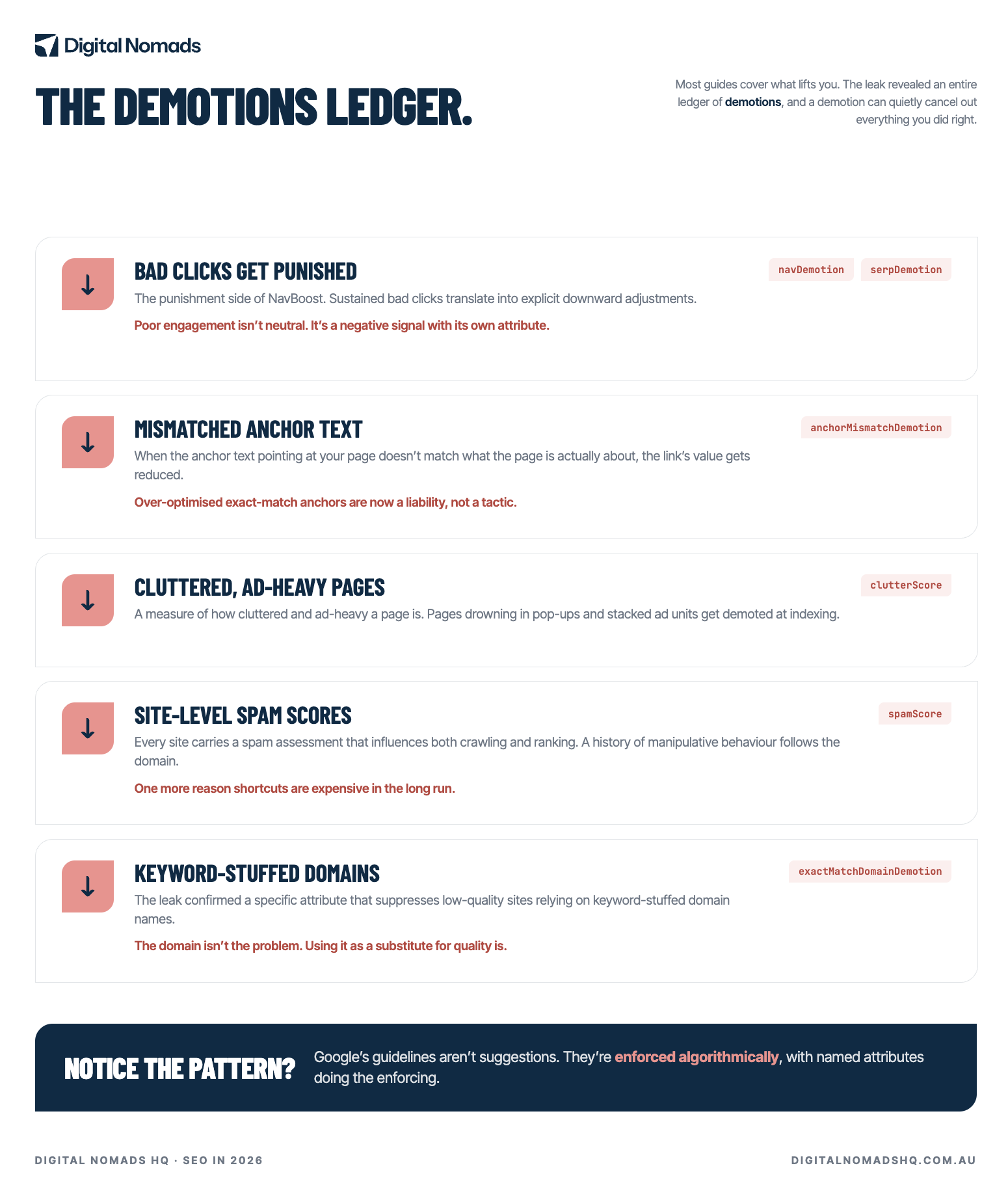
Most ranking factor guides only cover what lifts you.
But the leak revealed an entire ledger of demotions. And they matter, because a demotion can quietly cancel out everything you did right.
navDemotion and serpDemotion.
The punishment side of NavBoost. Sustained bad clicks translate into explicit downward adjustments.
Poor engagement isn’t neutral. It’s a negative signal with its own attribute.
anchorMismatchDemotion.
When the anchor text pointing at your page doesn’t match what the page is actually about, the link’s value gets reduced.
Translation: over-optimised exact-match anchors are now a liability, not a tactic.
clutterScore.
A measure of how cluttered and ad-heavy a page is. Pages drowning in pop-ups and stacked ad units get demoted at indexing.
Site-level spam scores.
Every site carries a spam assessment that influences both crawling and ranking. A history of manipulative behaviour follows the domain.
One more reason shortcuts are expensive in the long run.
Exact-match domain demotion.
The leak confirmed a specific attribute that suppresses low-quality sites relying on keyword-stuffed domain names.
The domain isn’t the problem.
Using it as a substitute for quality is.
Notice the pattern?
Google’s guidelines aren’t suggestions.
They’re enforced algorithmically, with named attributes doing the enforcing.
Second-tier signals worth knowing
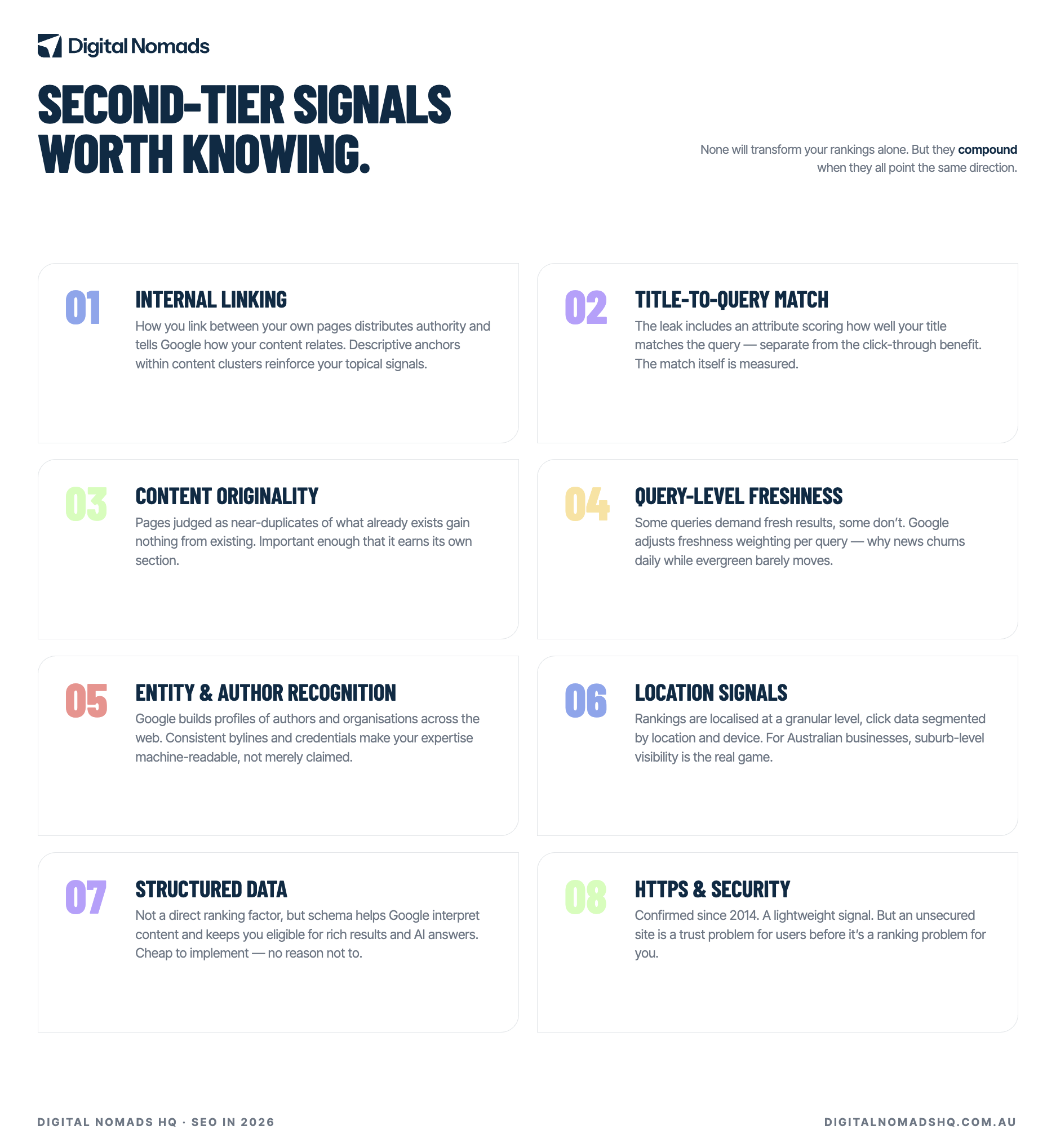
Internal linking. How you link between your own pages distributes authority and tells Google how your content relates. Descriptive anchors within content clusters reinforce your topical signals.
Title-to-query match. The leak includes an attribute scoring how well your title matches the query. That’s separate from the click-through benefit. The match itself is measured.
Content originality. Pages judged as near-duplicates of what already exists gain nothing from existing. This one is important enough that it gets its own section below.
Freshness at the query level. Some queries demand fresh results and some don’t. Google adjusts freshness weighting per query. It’s why news topics churn daily while evergreen results barely move for years.
Entity and author recognition. Google builds profiles of authors and organisations across the web. Consistent bylines and credentials make your expertise machine-readable instead of merely claimed.
Location signals. Rankings are localised at a granular level, with click data segmented by location and device. For Australian businesses, this is why national rankings mean little and suburb-level visibility is the real game.
Structured data. Not a direct ranking factor. But schema helps Google interpret your content and keeps you eligible for rich results and AI-generated answers. It’s cheap to implement, so there’s no reason not to.
HTTPS and security. Confirmed since 2014. A lightweight signal. But an unsecured site is a trust problem for users before it’s a ranking problem for you.
None of these deserve months of your attention.
Together, they’re the difference between a site where every signal agrees and one where good content fights its own foundations.
What stopped mattering
Just as important as the real factors are the zombies that refuse to die.
Keyword density.
Not a thing.
Top-ranking pages use their target term sparingly. And stuffing actively hurts.
Exact-match domains.
No inherent advantage. See the demotion above.
Social share counts. – Not a direct signal.
Word count.
Not a factor.
An 800-word page that ends the search beats a 3,000-word page that pads it.
AI-generated content penalties.
Google doesn’t penalise content for being AI-generated. It penalises content for being thin, generic and experience-free.
Which, to be fair, describes most of it.
Information gain: the factor that 2026
Here’s our take.
And it’s the one insight we’d put above everything else in this article.
Net new information gain is becoming the most important content concept in SEO.
What stopped mattering
Generative AI can now rewrite anything that already exists.
Instantly. At zero cost.
Every known fact, every published framework, every “ultimate guide” can be paraphrased a thousand different ways before lunch.
Which means the web is filling up with content that adds precisely nothing. Same information. Different words.
And Google can see it.
The leaked contentEffort attribute estimates how much genuine work went into a page.
Originality is scored.
Near-duplicates of the existing consensus gain nothing from existing.
So the question that decides whether your content ranks in 2026 is brutally simple:
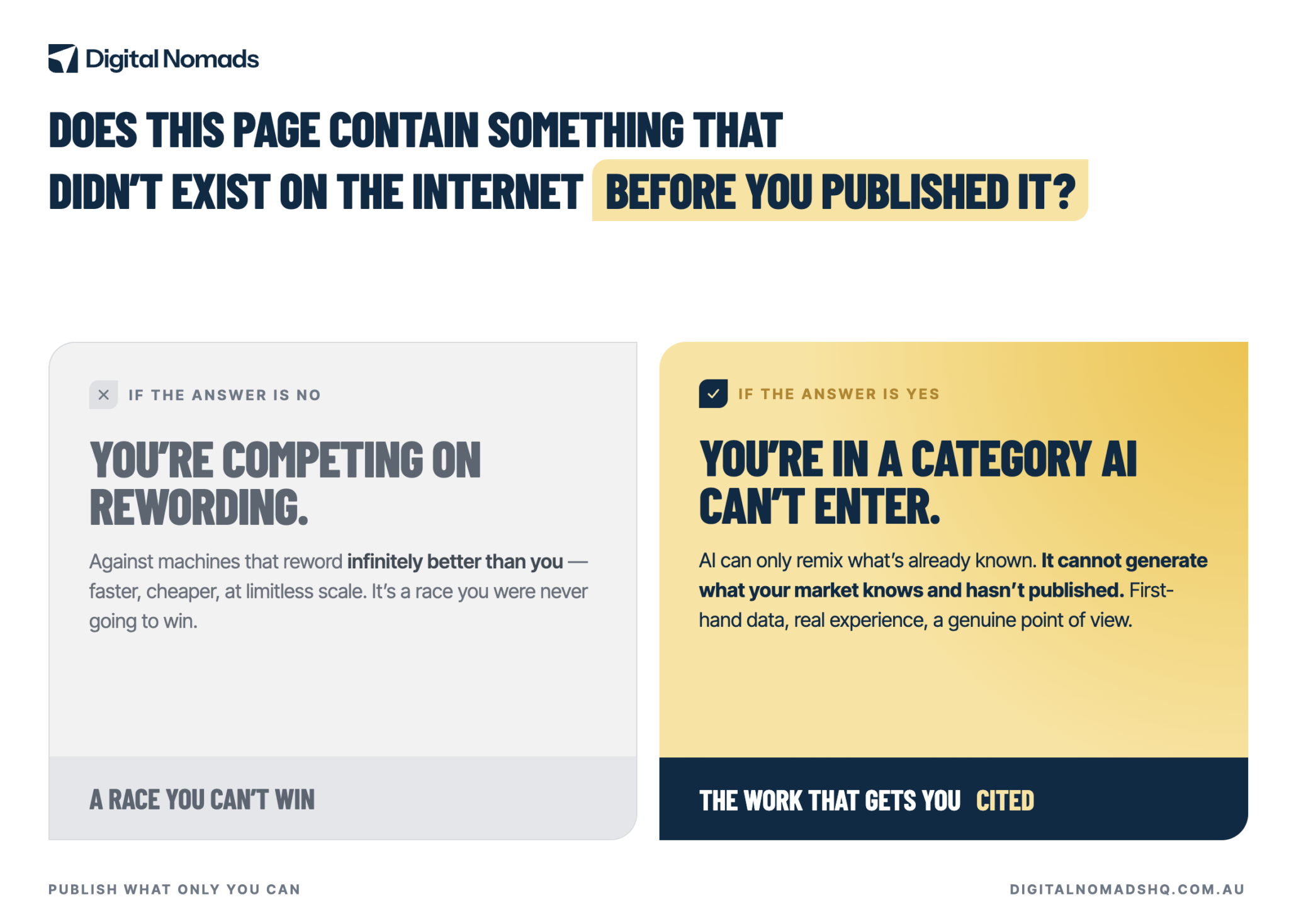
Does this page contain something that didn't exist on the internet before you published it?
If the answer is no, you’re competing on rewording. Against machines that reword infinitely better than you.
If the answer is yes, you’re competing in a category AI can’t enter. Because AI can only remix what’s already known. It cannot generate what your market knows and hasn’t published.
Here's the part most businesses miss
You’re already sitting on net new information.
You just haven’t treated it as content.
Your own numbers.
Client results, internal benchmarks, pricing observations, conversion patterns. Aggregated and anonymised, this is data nobody else can publish.
Your first-hand experience. What actually happened when you implemented the thing everyone else only describes. The failures included. Especially the failures.
Questions your market asks that nothing answers.
Every sales call and support ticket contains queries the existing content ignores. Answer those and you’ve created information gain by definition.
Original research. Surveys, testing, analysis. It’s the reason we built our State of AI Search report on 116,918 real Australian search results instead of quoting overseas studies. Nobody could rewrite it, because the data didn’t exist anywhere else.
The strategic shift is this: stop asking “what should we write about?” and start asking “what do we know that isn’t on the internet yet?”
The first question produces the ten-thousandth article on a topic.
The second produces the one that gets cited. By journalists, by other sites, and increasingly by the AI systems answering your customers’ questions.
We didn't just write this. We tested it on ourselves.
Every claim above is one we ran on our own site first.
Over the past two years we rebuilt Digital Nomads HQ around a single rule: publish only what ends the search, and only what didn’t already exist on the internet.
Original research.
First-hand campaign results.
Answers to the questions our market actually asks.
Week after week.
Here’s what happened.
Estimated monthly organic traffic went from roughly 2,500 in July 2024 to more than 35,000 in July 2026. That’s over 14 times the traffic in 24 months, on a domain in one of the most competitive niches there is: digital marketing itself.
But the number we watch closest is the pink line.
Our presence in AI Overviews went from zero to more than 800 keywords over the same window.
That’s the proof that matters in 2026, because it’s the metric ranking alone can no longer buy. We didn’t just climb the classic results. We became the source the AI answers cite.
None of it came from a loophole. It came from the playbook on this page, applied patiently to our own site, with information gain as the layer that made everything else compound.
Which brings us to the final point.
The catch: ranking no longer equals visibility
Here’s the uncomfortable truth to end on.
Everything above determines where you sit in the classic organic results. It increasingly does not determine whether you appear in AI-generated answers.
AI Overviews now appear across a large share of Australian searches. And the overlap between top-ranking pages and AI-cited sources has collapsed.
In other words: ranking first is no longer a guarantee of being the source an AI answer cites.
The two disciplines share foundations. Authority, topical depth and trust help both.
But citability has its own mechanics: extractable structure, clear claims, schema, and presence across the sources AI systems retrieve from.
This is exactly why we built Amalfi, our AI search audit platform. Our clients kept asking the question rankings alone can no longer answer: when someone asks an AI about your industry, do you show up?
Our 2026 State of AI Search report found AI Overviews triggering on 37.8 per cent of Australian SME queries across 18 industries.
That number is only going one direction.
Where to start
If your rankings have stalled, the evidence points to a clear order of operations:
Fix the prerequisites first. Titles, technical health, page experience.
Then concentrate your content on the territory you want to own. Not spread thin across ten territories you don’t.
Invest in pages that genuinely end the search. And refresh them properly, on a schedule.
Build authority through work worth citing. Not links worth buying.
And measure branded search alongside keyword rankings. Because Google does.
None of this is fast. All of it compounds.
The sites winning in 2026 aren’t the ones that found a loophole. They’re the ones the evidence now confirms Google was trying to reward all along.