TL;DR
Bing Webmaster Tools just became the easiest free way to see whether AI is citing your business.
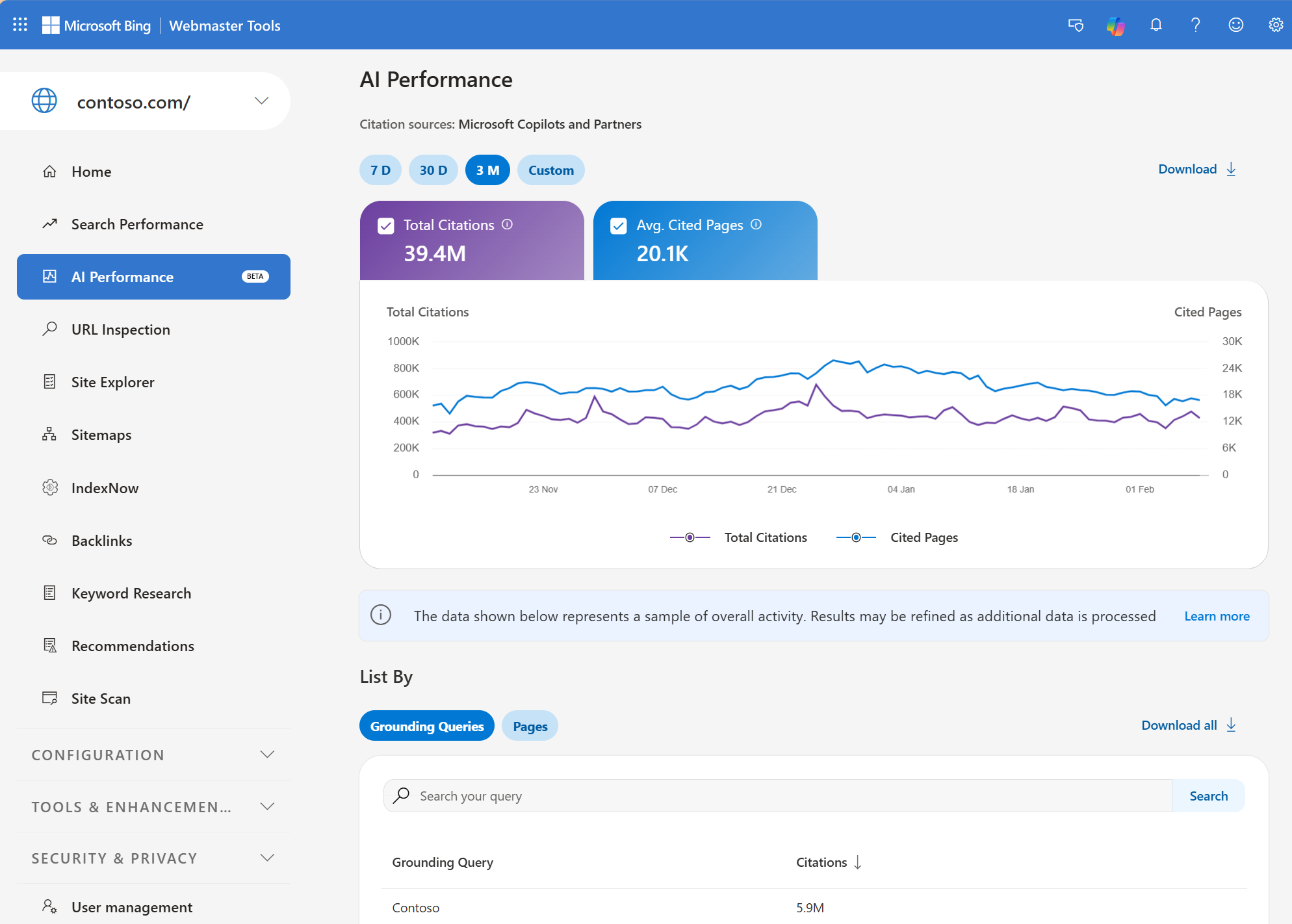
The June 2026 update added Intents (the intent behind citations), Topics (your citations grouped by theme), Citation Share (your share of citations for a query) and Compare (change over time), built on the AI Performance report that covers Copilot, Bing and partner AI.
It’s global and free, and on reporting depth it’s well ahead of Google’s new Search Console AI report, which is thinner (no query or click data) and only in a UK preview.
When we pulled our own data, Bing showed 15,152 AI citations across 478 queries and that we hold 65% of the citations for “Google Ads management companies Australia.” Beyond AI, Bing Webmaster Tools is a genuinely useful, underused free SEO platform (search performance, URL inspection, keyword research, backlinks, site scans). Bottom line: set it up, it takes minutes and it’s now the best free glimpse of your AI visibility.
Most Australian businesses set up Google Search Console and never give Bing a second thought. In 2026, that is a mistake, and Microsoft just made it a bigger one.
On 16 June, Bing Webmaster Tools added four new features to its AI Performance report: Intents, Topics, Citation Share and Compare.
Together they make Bing Webmaster Tools one of the only free, first-party tools that shows you whether AI is actually citing your business, and that is the question every business is now asking and almost nobody can answer.
Here is what Bing added, why it matters more than the logo suggests, how it leaves Google’s new reporting behind, and the full set of reasons every Australian business should have Bing Webmaster Tools set up.
First, the bigger picture: why Bing matters in 2026
Bing is not just Bing anymore. Bingbot feeds the Bing index and Microsoft Copilot, the AI assistant with hundreds of millions of monthly users, plus a set of partner AI experiences.
So when Bing reports on how your content appears in AI answers, it is reporting on a real and growing slice of the AI web, not a rounding error.
And measurement is the hard part of AI search. Classic rank trackers cannot see whether an AI answer cited you. Until recently, almost nothing could, for free. That is the gap Bing is now filling.
What Bing just added to the AI Performance report
Intents: the context behind a citation
Bing now classifies the queries that triggered your citations (it calls them grounding queries) into intent categories: Informational, Commercial, Navigational, Learn and Solve, Research, Creation, Local and more.
So instead of just seeing which queries cited you, you see the kind of need behind them.
An ecommerce site might find it is being cited mostly in commercial, comparison-style queries; an educator might find it surfaces in research and learning queries. That tells you which experiences AI is putting you in, and where to deepen content.
Topics: visibility by theme, not just keyword
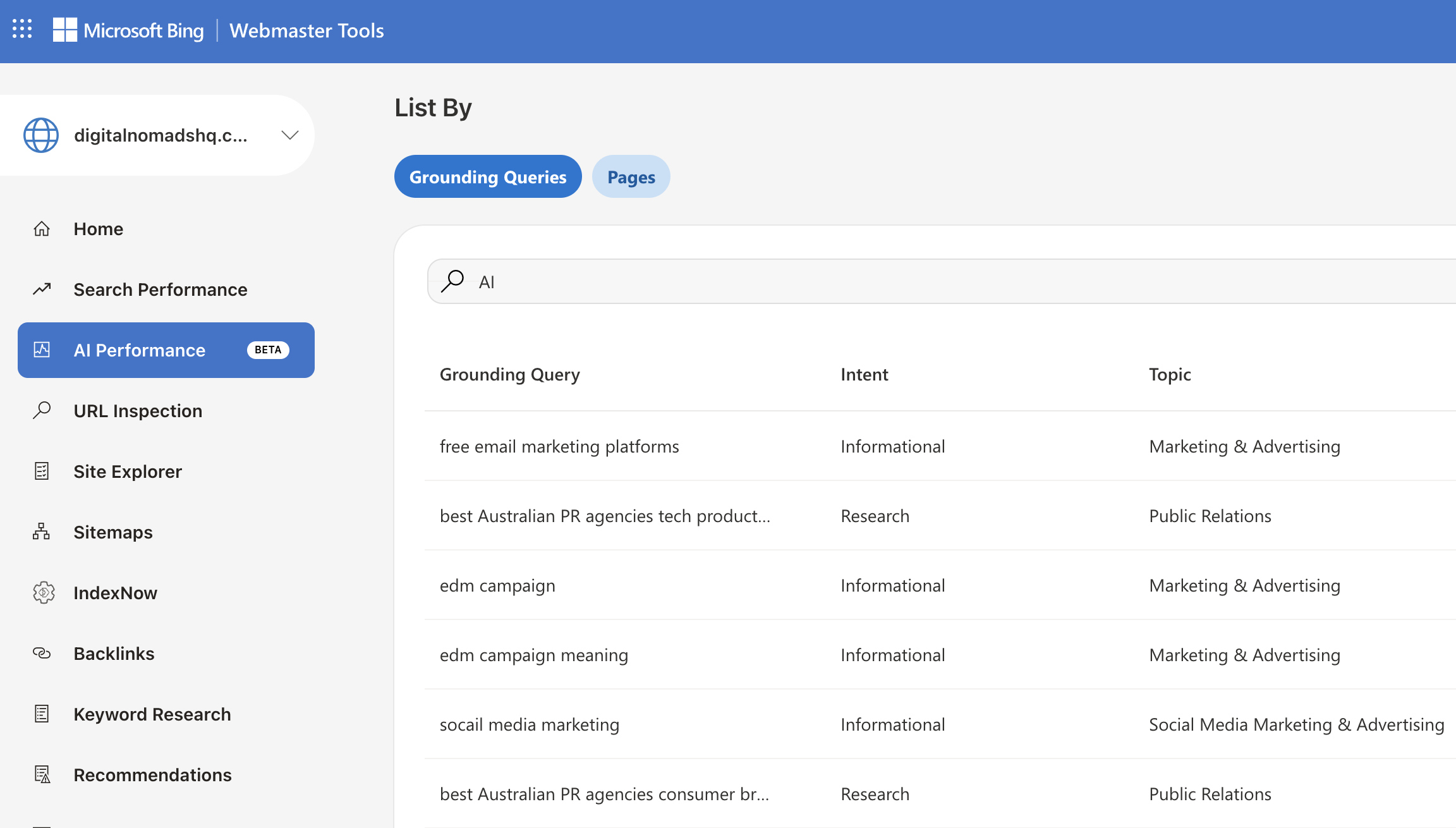
AI systems reason in themes, not isolated keywords. Topics groups your grounding queries into thematic clusters, so “solar panels,” “solar energy efficiency” and “residential solar installation” might roll up into a Solar Energy topic.
You can finally see which subject areas are driving your AI citations, spot emerging areas of authority, and find topical gaps, in the same thematic way content teams actually plan.
Citation Share: how much of the answer space you own
Total citation counts tell you how often you appear.
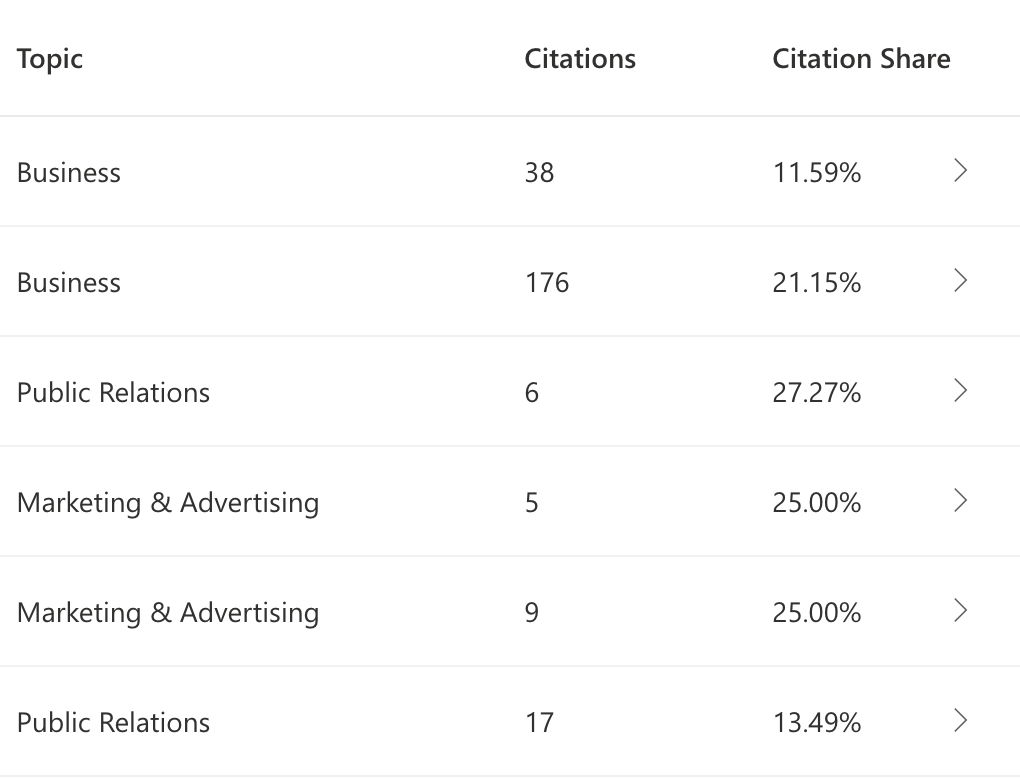
Citation Share tells you how much of the citation space you hold for a given query: if a query produced ten citations across all sites and three were yours, your Citation Share is 30%.
It is the closest thing yet to a share-of-voice metric for AI answers. Bing is clear that it is observational, not a ranking or a competitive scoreboard, and it does not expose competitor domains, but it shows where your presence is strong and growing versus where it is fragmented across many sources.
Compare: how it is changing over time
Compare overlays a previous period on the current view, the last 30 days against the prior 30, or custom ranges, so you can see whether your AI citation activity is rising or falling, and tie shifts to content updates, seasonality or broader changes.
This is what turns a snapshot into a trend you can actually manage.
Why this matters for your business
We have been saying all year that the hard part of AI search is not the theory, it is the measurement. You cannot improve what you cannot see. Our own State of AI Search research exists because AI visibility was invisible to standard tools. Bing has now handed every business a free way to see part of it.
Used well, these reports tell you which themes AI already trusts you on, which intents you are winning, where your citation share is climbing, and where it is slipping. That is a content-strategy input you could not get for free a month ago. For any business serious about being cited in AI answers, it belongs in your monthly reporting now.What it looks like in practice: our own AI data
We did not just read the announcement.
We pulled our own AI Performance data to see what it actually reveals, and the picture is genuinely useful.
In the latest period, Bing recorded 15,152 AI citations of our content across 478 grounding queries. We hold a 20% or greater share of the citation space on 173 of those queries, with a median citation share of around 16%.
That alone turns “we hope AI is citing us” into a measured number.
The Intents view showed that roughly 62% of those citations come from informational queries, with commercial and local intents, the ones closest to a sale, making up a smaller slice.
That is an immediately actionable signal: our educational content and free tools are doing the heavy lifting in AI answers, and lifting commercial-intent visibility is the clear opportunity.
The Topics view showed AI cites us most in Marketing and Advertising, Business and Public Relations, telling us exactly which themes AI already treats us as an authority on, and where our coverage is thinner.
And Citation Share surfaced the wins worth knowing. We hold roughly 65% of the AI citations for “Google Ads management companies Australia,” and strong share on terms like “digital marketing consultant” and “best Google Ads agencies Australia.”
A month ago, none of that was visible for free.
How this compares to Google (Bing is well ahead)
Google launched its own generative AI performance report in Search Console on 3 June 2026, covering AI Overviews, AI Mode and Discover. It is a welcome first step, but as a reporting tool it is far thinner than Bing’s, and barely available.
Google’s report shows impressions, pages, countries and devices over time.
That is essentially it.
There is no query-level data, and no click data yet (Google says clicks are coming, with no date).
And as of now it is rolling out only to a subset of UK site owners, so most Australian businesses cannot even open it.
Bing, by contrast, gives you the grounding query that triggered the citation, the intent behind it, the topic cluster, your citation share, and a compare-over-time view, globally, today.
Put simply, Bing is telling you why and how much. Google is telling you, roughly, how often, in the UK.
To be fair to Google, its report covers the bigger surface.
AI Overviews and AI Mode reach far more people than Copilot, so even limited Google data is a window into the platform that matters most, and Google uniquely lets you opt your content in or out of grounding its AI features. It is early, and more metrics will come.
The full features and benefits of Bing Webmaster Tools
- Search Performance. Impressions, clicks, queries and pages for your Bing traffic, the Bing equivalent of Search Console, and a second data source most competitors ignore.
- URL Inspection and indexing. Check how Bing sees a page, and submit URLs for indexing. With IndexNow, you can push new and updated pages to Bing (and other participating engines) instantly rather than waiting to be crawled.
- Site Explorer and Crawl Control. See how Bing crawls your site structure, and control crawl rate and behaviour, useful for larger or technically complex sites.
- Free keyword research. Bing’s keyword tool gives real search-volume data at no cost, a handy cross-check against paid tools.
- Backlinks report. A free view of your backlink profile and your competitors’, no subscription required.
- SEO reports and site scan. Automated on-page SEO checks that flag technical and on-page issues across your site.
- Sitemaps and robots testing. Submit sitemaps and test your robots file, the housekeeping that keeps you properly indexed.
- AI Performance, now with Intents, Topics, Citation Share and Compare. The new layer that shows how you appear across Copilot and Bing’s AI answers.
How to get started
Setup is quick, and you do not have to start from scratch.
- Create a free account at Bing Webmaster Tools with a Microsoft, Google or email login.
- Add and verify your site, or import it directly from Google Search Console in a couple of clicks, which carries your sites and sitemaps across.
- Submit your sitemap and, ideally, set up IndexNow so new pages get picked up fast.
- Once data builds, open the AI Performance report and explore Intents, Topics, Citation Share and Compare for your site.
Final thoughts
Bing Webmaster Tools has become one of the most useful free tools in an Australian marketer’s kit, and the June update is the reason to finally pay attention. It will not replace your Google reporting or a dedicated AI-visibility platform, but it is free, fast to set up, and it answers a question that mattered to no one two years ago and matters to everyone now: is AI citing my business?
For more on the measurement side, see our guide to measuring AI search visibility, and how we approach AI SEO and SEO more broadly.
If you want help reading those reports, or a fuller picture of your visibility across Google and AI search, run a free AI visibility audit or talk to our team.
Frequently asked questions
Is Bing Webmaster Tools free?
Yes, completely free. You create an account, verify your site (or import it from Google Search Console), and you have access to all of its reporting, including the new AI Performance features.
What are the new AI features in Bing Webmaster Tools?
Four, added on 16 June 2026 in preview: Intents (the intent category behind queries that cite you), Topics (your citations grouped into thematic clusters), Citation Share (your share of all citations for a query), and Compare (citation activity over time). They build on the AI Performance report that launched earlier in 2026.
Does this show my visibility in ChatGPT and Google AI Overviews?
Not directly. Bing’s report covers Microsoft Copilot, Bing and select partner AI experiences. That is a meaningful slice of the AI web, but not Google’s AI Overviews or ChatGPT specifically, so treat it as one view and pair it with other measurement for the full picture.
What is a grounding query?
In AI answers, grounding is the source material the system uses to support and cite its response. A grounding query is the query context Bing associates with a citation of your content. The new Intents and Topics features classify those grounding queries by intent and theme.
Is Google’s Search Console AI report as good as Bing’s?
Not yet. Google’s generative AI performance report (launched 3 June 2026) shows impressions, pages, countries and devices for AI Overviews, AI Mode and Discover, but no query-level data and no clicks yet, and it is rolling out only to a subset of UK site owners. Bing offers grounding queries, intents, topics, citation share and compare, globally, today. Google covers the bigger surface, so use both, but on reporting depth Bing is well ahead right now.
Should an Australian business bother with Bing if most traffic comes from Google?
Yes. Bing’s audience skews higher-value, it costs nothing to set up, it gives you a second independent data source, and it is now the easiest free way to see part of your AI search visibility. Even if Bing is a small share of your search traffic, the AI insight alone is worth the few minutes it takes.