TL;DR:
To get cited in AI search, make your business a clearly identifiable entity (consistent details everywhere, named authors, sameAs schema), write answer-first content with facts a model can quote, expert quotes and statistics lift AI visibility 30–41%, publish original data only you have, keep pages server-rendered and open to AI crawlers, and earn mentions on the sources AI trusts most: reviews, listicles, Reddit, YouTube and LinkedIn.
Then measure it monthly.
The engines barely overlap in what they cite (ChatGPT reads Bing, Perplexity runs its own index, AI Overviews read Google), so track your mention rate per engine like market share. There are no shortcuts, llms.txt included.
Entity, citable content, measurement. That is the whole job.
SEO used to have one job. Rank, get the click.
That job just got cut in half.
Today, most searches get answered before anyone clicks a thing. Google’s AI Overviews show up on close to half of all results. AI Mode passed a billion users in its first year, and its queries run about three times longer than a typed search. Pew found 60% of Americans already read the AI summary in their results. ChatGPT, Perplexity and Gemini answer millions of questions a day by reading the web and writing the answer themselves.
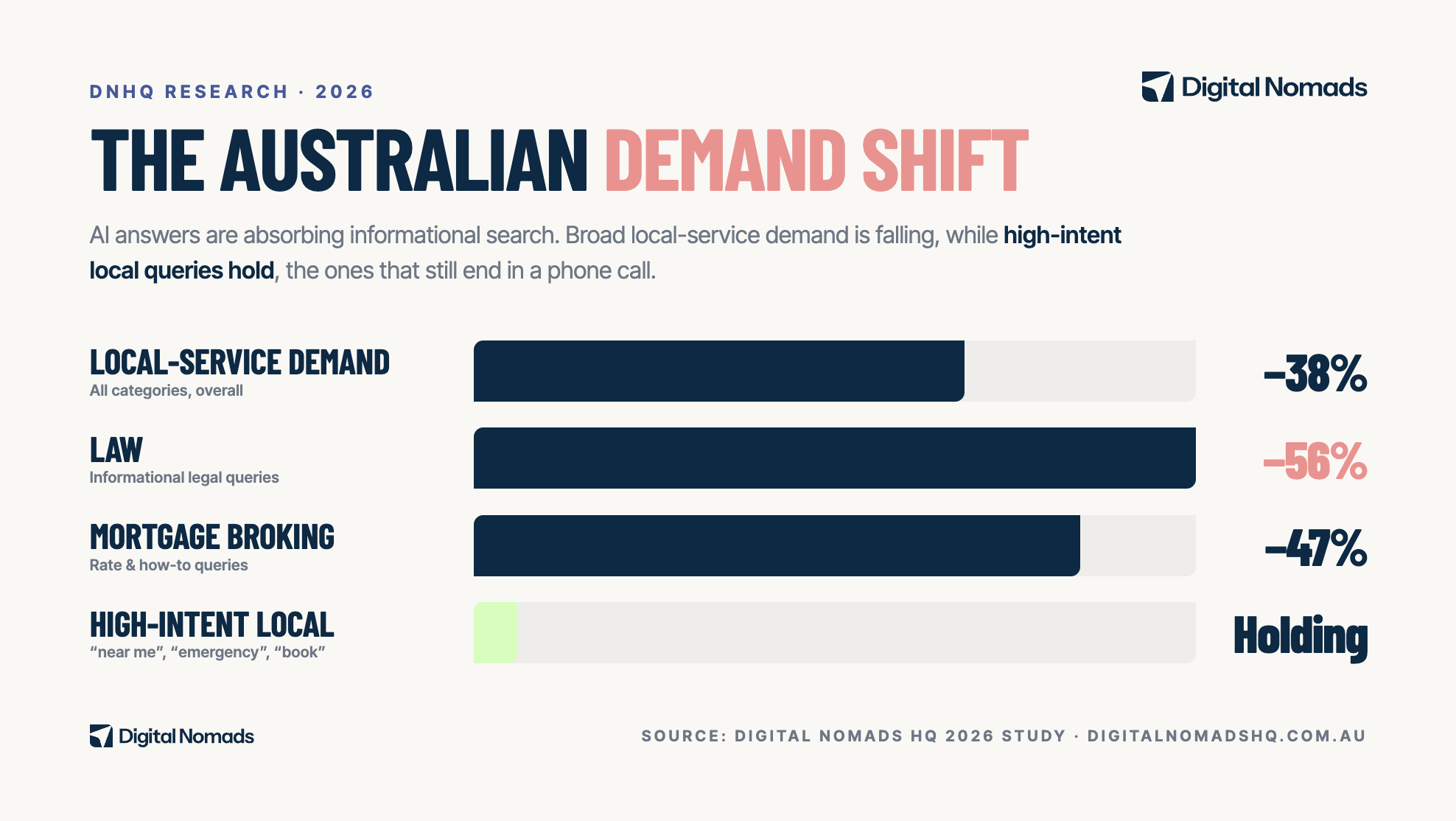
We pulled the numbers ourselves. Across 116,918 Australian search results, an AI Overview already sat on 37.8% of commercial searches. And local-service search demand fell 38% in early 2026 as AI swallowed the queries people used to type, repeat and click.
So the question changed.
It is not “do we rank?” anymore. It is “when the AI writes the answer, does it mention us, or our competitor?”
That is AI SEO. This guide breaks down exactly how it works, what actually moves the needle in 2026, and the hyped tactics you can safely ignore. It is built for Australian businesses, but the mechanics work anywhere.
First, what AI SEO actually is
The category has too many names. AI SEO. GEO (generative engine optimisation). AEO (answer engine optimisation). LLMO.
They all mean the same thing: getting your business named and cited in AI-generated answers, instead of just ranking in the blue links underneath them.
We call it AI SEO because that is the plain-English version. The discipline underneath is GEO.
Here is the distinction that matters. Classic SEO optimises a page to rank in a list.
AI SEO optimises your content, and your whole digital footprint, so that when a model writes an answer, it pulls from you and names you as the source.
| Classic SEO | AI SEO |
Goal | Rank a page in a list of results | Get named inside the answer |
Unit of competition | The page | The passage, and the entity behind it |
How you win | Keywords, links, search intent | Citable passages, entity trust, third-party mentions |
What you hold | A position | A mention rate, across many generated answers |
Measured by | Rankings, organic traffic | Citations, mentions, share of voice per engine |
That last row matters more than it looks. AI answers are not a fixed leaderboard.
Ask the same question five times and you can get five differently worded answers, drawing on different sources. There is no position one in ChatGPT.
What you are building is a mention rate, how often you get named across all the answers in your category. It moves like market share, not like a ranking.
One more thing to clear up, because you will hear it. Google’s official line is that its AI features have no special requirements, and that GEO sold as a separate discipline “is SEO.”
Half true.
The eligibility is the same: indexed, crawlable, snippet-worthy. But what wins is weighted differently.
Passages over pages. Entities over keywords. Mentions over links alone. Same sport, different scoring.
So it is not a replacement for SEO. Most of the foundations overlap. But to optimise for it, you first need to know how the machines actually pick their sources.
How AI engines choose what to cite
This is the part most guides skip.
It is also the part that makes everything else make sense.
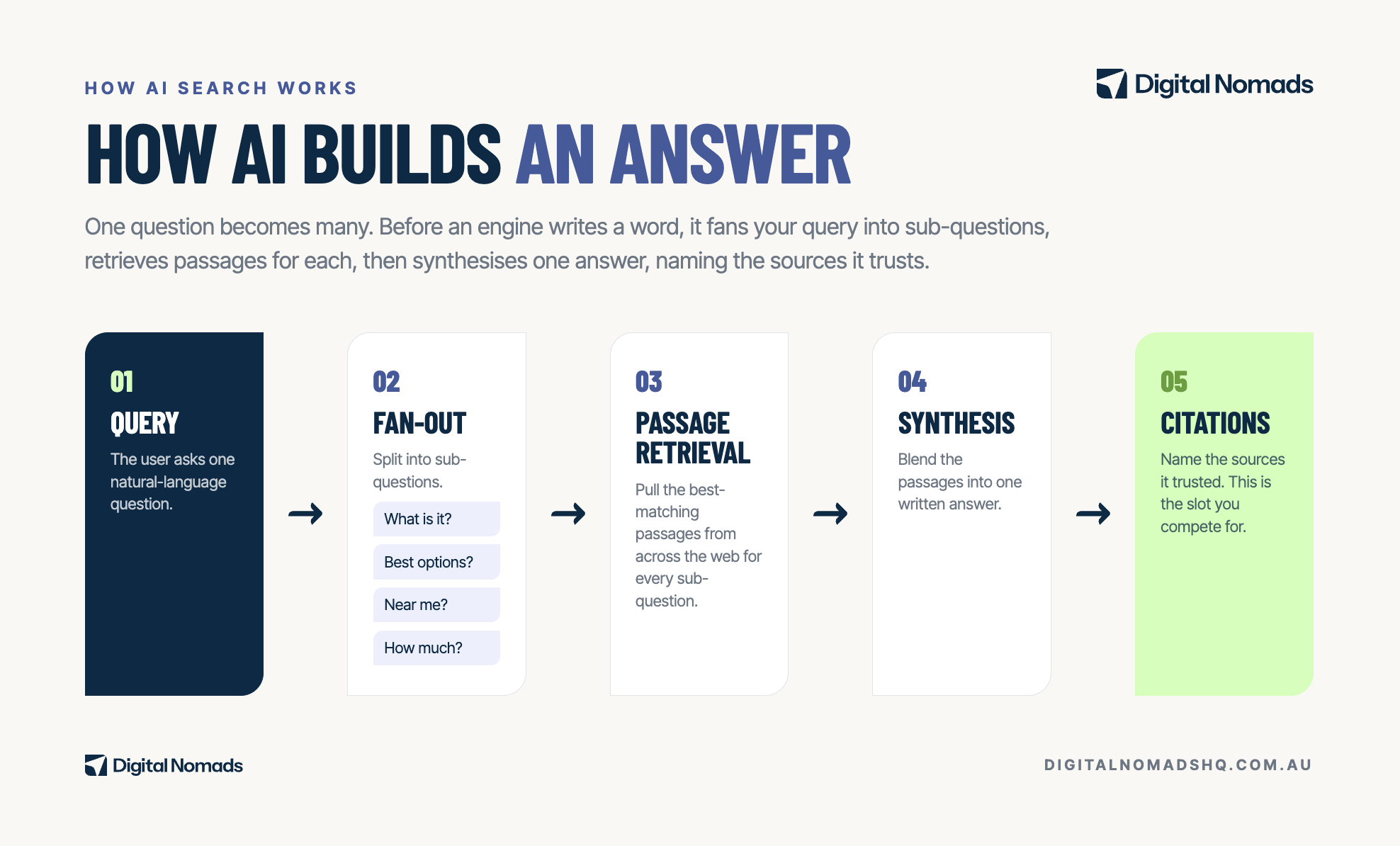
Ask an AI engine a question and it does not just match keywords. It runs a process. Roughly like this:
It fans your question out. Google calls this query fan-out. Instead of running one search, the engine breaks your question into a bunch of related sub-questions and runs them all at once.
Ask “best way to reduce cost per lead for a Brisbane plumber” and it quietly fires off separate searches on lead generation, local advertising and the trade.
It grabs passages, not pages.
Using retrieval-augmented generation (RAG), it pulls the specific paragraphs that answer each sub-question and feeds them to the model. It is taking the passage that answers the question, not ranking your whole site.
It merges everything into one answer. Then it names the sources it leaned on most.
Three things fall straight out of that. And they shape the entire playbook.
One: passages win, not pages. Answer a specific question cleanly, in a self-contained block, and you get retrieved and quoted.
Bury the answer three paragraphs into an “ultimate guide” and you get skimmed over.
And because of query fan-out, the page that answers the whole cluster of sub-questions, not just the head term, gets pulled into more of those searches at once.
Two: authority breaks the tie.
When several sources could answer a sub-question, the model leans on the ones with real authority, genuine expertise signals, and backing from other reputable sites.
That is E-E-A-T (experience, expertise, authoritativeness, trustworthiness) doing exactly its job. AI engines also lean hard on news and established media.
Not every AI engine reads the same web
Here is who reads what:
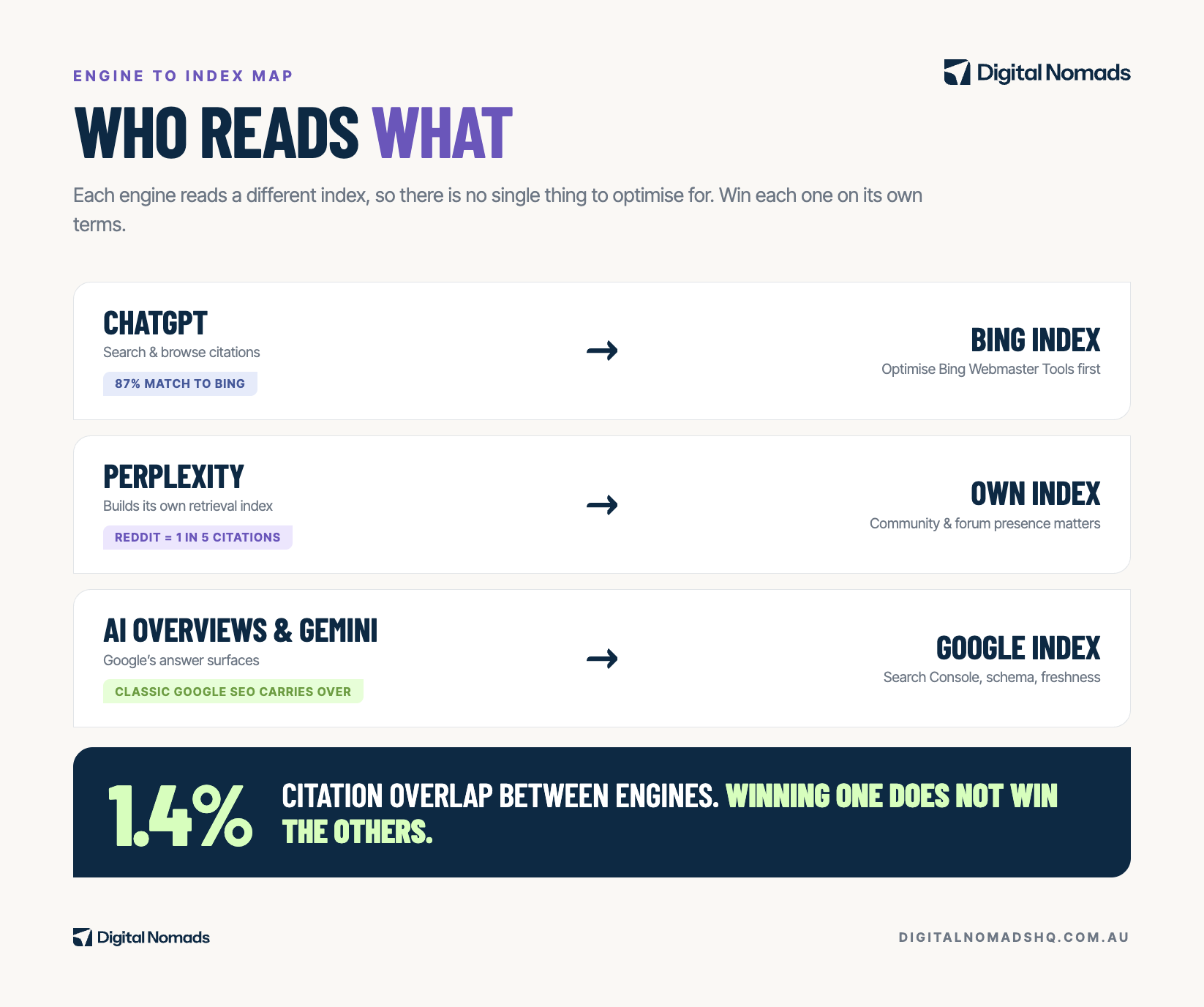
Google AI Overviews, AI Mode and Gemini run on Google’s index. Your existing Google SEO is the ticket in. Google’s stated bar: the page must be indexed and eligible to show a snippet.
ChatGPT leans on Bing. One analysis found 87% of ChatGPT search citations matched Bing’s top results. If you have ignored Bing Webmaster Tools for a decade, it just became a real channel, and its reporting now shows how often Copilot and Bing AI cite you.
Perplexity runs its own crawler and index, and leans harder on community sources than anyone. On Perplexity, Reddit alone accounts for as much as one in five citations.
The practical read: you do not need a separate strategy per engine. You need foundations every engine can read, your site verified in both Google Search Console and Bing Webmaster Tools, and a real presence on the community platforms the engines trust.
Which brings us to the playbook.
The AI SEO playbook: 7 things that actually work
1. Build a clear, trusted entity
AI models think in entities, the real-world thing your brand is, not strings of keywords. Before they will confidently cite you, they need to know who you are.
That means a consistent identity everywhere: same business name and details across the web, a strong About page, named people with real credentials, and schema that links your site to your profiles (the sameAs property).
It means genuine third-party mentions, because an entity the web talks about is one the model trusts. And it means reviews and consistent sentiment that back up what you claim.
If your brand qualifies, add presence in the places machines treat as ground truth: Wikipedia, Wikidata, recognised industry databases. They feed the knowledge graphs the models lean on. Hard to earn, worth it if you can.
This is the most underrated part of AI SEO. Most businesses pour everything into content and ignore the entity foundation that decides whether the content gets trusted at all.
2. Write content built to be cited
Entity sorted?
Now the content has to be retrievable. Format matters as much as substance now.
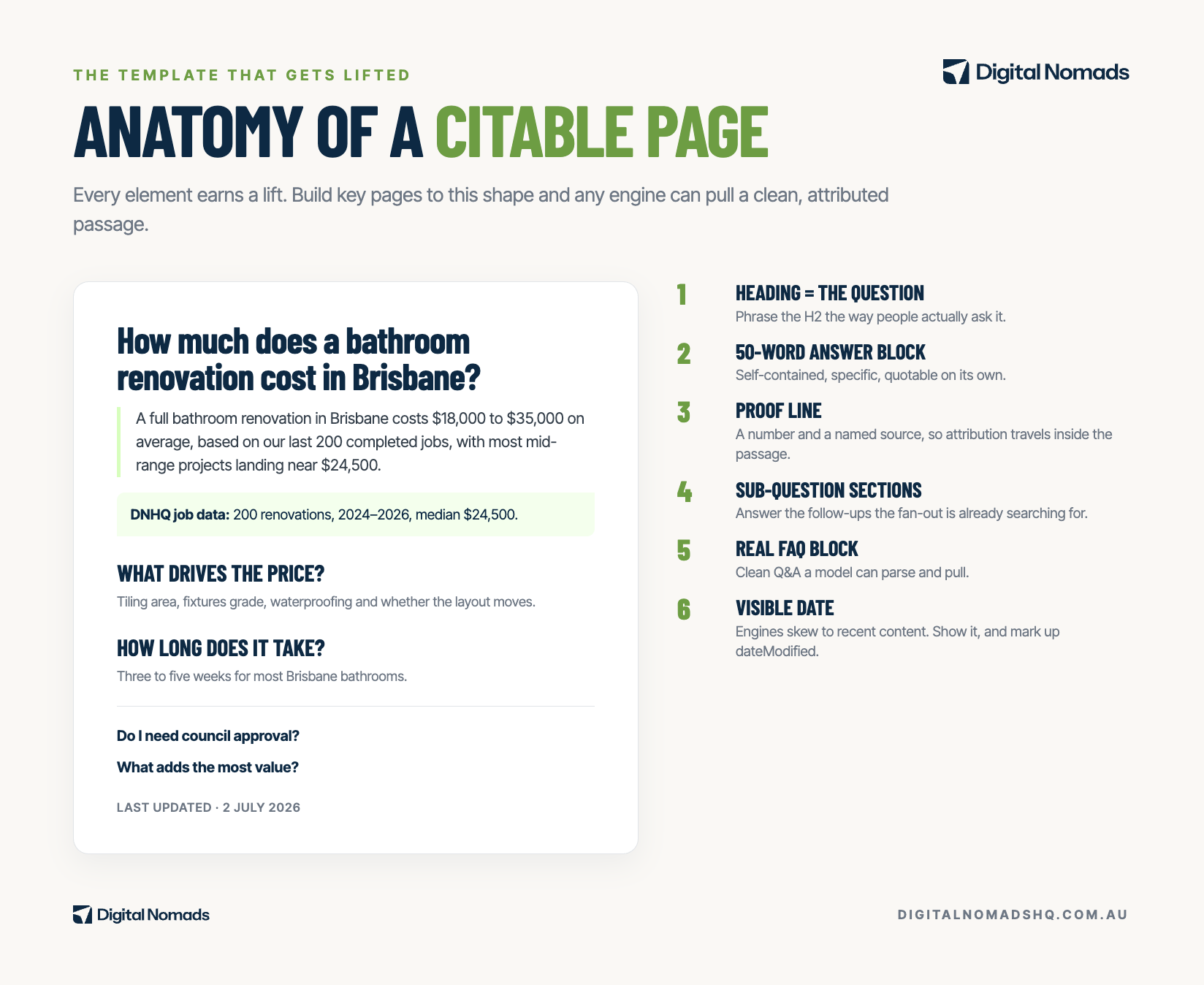
Lead with the answer. Put the direct response at the top of each section, then expand. Answer-first is what gets lifted into AI responses. Bury it and it never gets pulled.
Pack in facts.
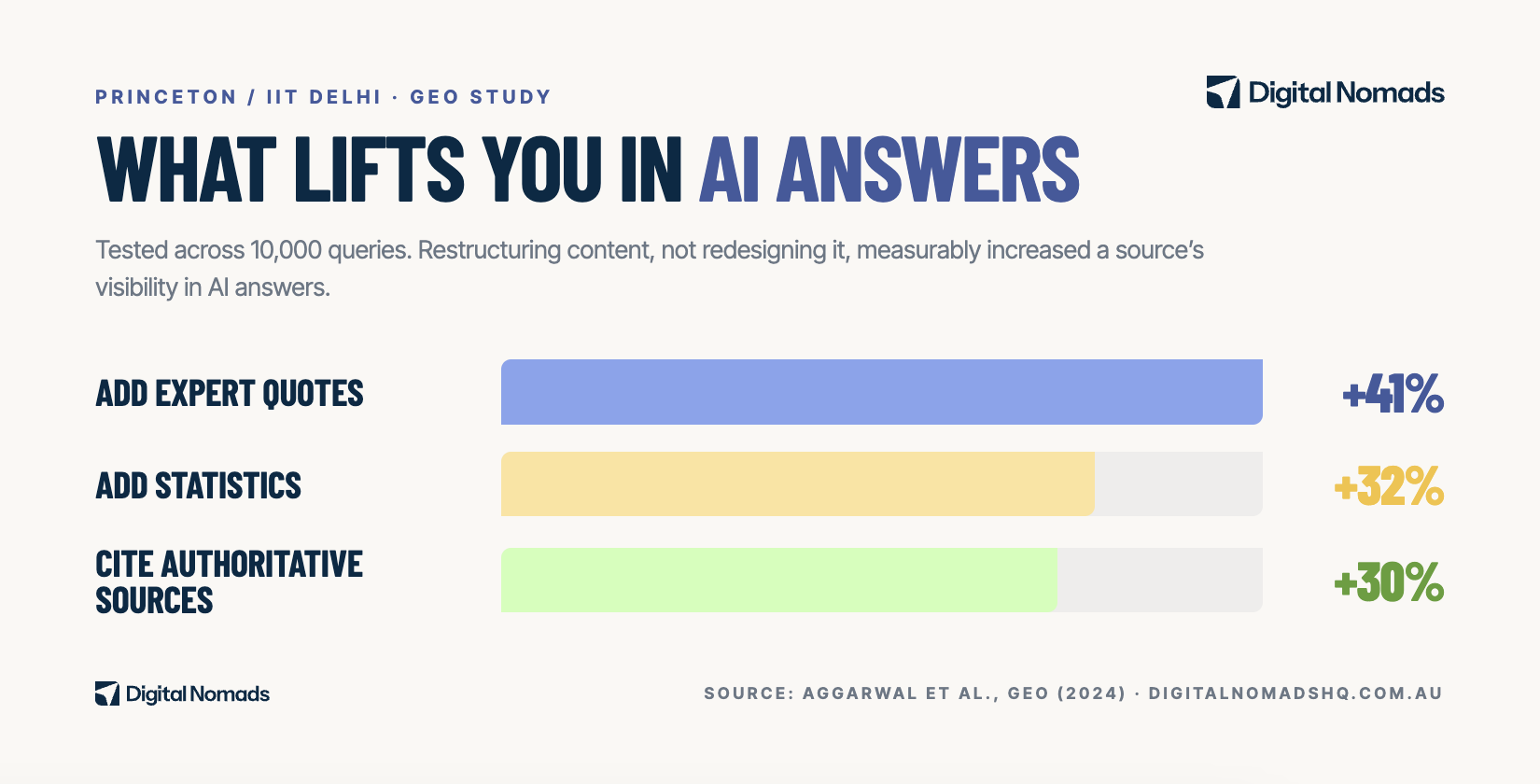
This is not vibes, it is measured. The academic study that coined the term GEO, out of Princeton and IIT Delhi, tested content changes across 10,000 queries.
Adding expert quotes lifted a source’s visibility in AI answers by up to 41%.
Adding statistics, around 32%. Citing authoritative sources, around 30%. No redesign, just restructuring. Concrete, attributed, extractable content wins.
Answer the whole question.
Cover the main query and the follow-up sub-questions someone would ask next, the ones the fan-out is already searching for. Be the complete source, not a fragment.
Format for extraction.
Clear headings. Short paragraphs. Lists, tables, definitions, real FAQ blocks. All easier for a model to parse and pull a clean passage from.
Write how people ask.
AI queries are longer and more conversational than typed searches. Match that, not clipped keyword phrases.
Keep it fresh.
AI engines skew hard toward recent content; the large majority of AI Overview citations come from pages published or updated within the last two years. Stale pages age out of answers faster than they ever aged out of rankings. Update your key pages on a schedule, and show it, with visible dates and dateModified schema.
3. Publish data nobody else has
The most reliable citation magnet on the internet is a fact that only exists on your site.
Models need something concrete to quote, and someone to attribute it to.
Original research, surveys, benchmarks, price data, a genuine “state of the industry” number. Publish the number your category needs, and every engine answering that question has one source to name: you.
It does not have to be a 100,000-result study.
A trade business that publishes “the average cost of a bathroom renovation on the Sunshine Coast, from our last 200 jobs” owns a fact no national publisher can match. This guide’s own authority runs on our research. That is the play, and it is open to any business willing to count something real and publish it.
4. Make it machine-readable with structured data
Structured data (schema markup) translates your content into something machines understand precisely.
Use the types that fit your pages: Organisation, Article, FAQ, Product, Review, Breadcrumb. Keep the markup accurate and matched to what is on the page, and pair it with clean semantic HTML.
It is not a magic ranking lever, and now there is data on that too.
Ahrefs tested schema at scale: pages with markup do get cited more, but adding schema to already-cited pages changed nothing.
The markup travels with well-built sites rather than causing citations by itself. Treat it as hygiene. It removes ambiguity, and ambiguity is what gets you left out of an answer.
5. Get the technical access right for AI crawlers
A whole new layer of technical SEO showed up in the last two years: managing how AI crawlers reach your site. AI bot traffic is up more than 300% since early 2025, driven by GPTBot (OpenAI), ClaudeBot (Anthropic), Google-Extended and PerplexityBot.
Decide on purpose how those bots interact with your content, do not leave it to a default. Many sites block AI crawlers in robots.txt without realising it.
Make sure your important content is server-rendered, so a crawler sees it without running JavaScript; a bot that only gets a blank shell cannot cite you. And keep pages fast and accessible, because the same technical health that helps Google now decides whether AI can read you.
6. Show up in the sources AI pulls from, especially the ones people write
Here is the uncomfortable bit.
AI answers get built from the whole web, not just your site. So part of AI SEO happens off your site entirely.
When an engine answers “best [your service] in [your city],” it pulls from directories, review platforms, industry publications, and the listicles that rank for that query.
Not on those sources? Not in the answer.
And the sources AI trusts most are not the ones brands control.
Across one 30-million-citation analysis, the most-cited domains in AI answers were Reddit, YouTube and LinkedIn, in that order.
Semrush’s 325,000-prompt study found LinkedIn cited in 14.3% of ChatGPT answers and 13.5% of Google AI Mode answers. For professional and B2B queries, LinkedIn is the most-cited domain outright.
The play is participation, not spam. Genuine answers in the subreddits and forums where your category gets discussed.
Real expertise published on LinkedIn under named people, not just the company page. Video answering the questions your buyers actually ask, because YouTube gets read too. Astroturfing gets spotted, by the platforms and increasingly by the models. Showing up authentically and consistently does not.
7. Measure it, because you cannot improve what you cannot see
This is where almost everyone is flying blind.
Classic rank tracking tells you nothing about whether ChatGPT or an AI Overview is citing you.
You need to track AI visibility directly.
Where you are cited.
Where competitors are cited instead. For which queries. Across each engine. And how it moves over time.
The tooling caught up in the last year.
Purpose-built trackers, Semrush’s AI Visibility Toolkit, Ahrefs Brand Radar, Profound, Peec and others, monitor citations and share of voice across engines. Bing Webmaster Tools now reports Copilot and Bing AI citations natively. And in GA4, referrals from chatgpt.com, perplexity.ai and gemini.google.com are real sessions you can segment and attribute. Pick one tracker plus GA4, and baseline yourself this month. Without measurement, AI SEO is guesswork. With it, it becomes a process you can actually run.
The hyped tactics you can ignore (for now)
A complete guide should tell you what to skip, not just what to do.
Exhibit A: llms.txt. A proposed file that is meant to point AI models at your best content.
The hype is loud.
The reality moved in mid-2026, so here is the honest, current read.
In June 2026 Google updated its docs to clarify it does not use llms.txt for Search or its AI features. No positive effect, no negative effect.
But it softened the tone, from discouraging the file to, basically, “use it if you want.” John Mueller compared it to the old keywords meta tag: harmless, but not a ranking lever. Google has even started checking for the file in Chrome’s new Lighthouse agentic-browsing audits, as a discoverability signal for AI agents, not a ranking factor.
Bing is warmer on it. Bingbot honours llms.txt, with early reports of faster ingestion for listed URLs, and Bing Webmaster Tools now shows how often Copilot and Bing AI cite you. But independent data still shows the AI bots that matter barely request the file.
So the verdict, with a 2026 nuance: add an llms.txt if you like. It is cheap, low-risk, and Bing and AI agents may use it. Just do not believe anyone selling it as a Google ranking lever. Entity authority, citable content and measurement are still where the visibility comes from.
Same goes for anyone promising “AI SEO hacks,” secret prompts, or a shortcut into ChatGPT. There isn’t one. The brands getting cited have real authority and genuinely useful, well-structured content. That is the whole trick. It is not a hack.
The Australian angle most businesses are missing
Here is what our research turned up that should change how Aussie businesses think about this.
Demand did not just move online. It moved into the answer.
Across six Australian markets and 21 industries, local-service search demand fell 38% in 2026, in lockstep with AI Overviews scaling.
The research-heavy categories fell hardest. Law down 56%.
Mortgage broking down 47%.
Because those are exactly the questions AI answers well.
But the high-intent, local, ready-to-buy searches held up.
AI will happily summarise “how much can I borrow.” It will not risk recommending the wrong tradie or booking the wrong clinic. So the most defensible visibility in Australia sits right where local intent meets genuine authority. And most Australian businesses have done nothing to claim it yet.
That is the opportunity. The brands that build AI visibility now, while the field is wide open here, become the default the day everyone else wakes up.
What comes next: answers that act
One more shift worth watching, because it changes what “visibility” means again.
The engines are becoming agents.
Google spent I/O 2026 wiring agents into Search, and AI Mode can already research, compare and move toward booking and buying on a user’s behalf. OpenAI is testing ads inside ChatGPT.
When an AI does not just recommend a provider but books one, being the source it trusts stops being marketing and becomes distribution.
Everything in this guide, the entity work, the machine-readable content, the third-party trust, is the same foundation agents will use to decide who gets the job. Build it once, it pays twice.
Feeling like a lot? Start here. In order.
- Baseline what AI says about you today. Ask ChatGPT, Gemini and Perplexity the questions your customers ask, including “best [your service] in [your city].” Note who gets named, who gets cited, and what they say about you. That is your scoreboard.
- Fix your entity foundation. Consistent details, a real About page, named authors, schema with sameAs. Nothing else works without this.
- Map your query fan-out. Run your core customer question through Google AI Mode and ChatGPT. Note the sub-questions each one fans out into. Then make sure your content answers that whole cluster, not just the head term.
- Make your key pages answer-first, with verifiable facts, clean formatting, and a visible update date.
- Publish one piece of original data your category would have to cite.
- Check AI crawlers can actually reach and render your content. Verify Bing Webmaster Tools while you are there; it is ChatGPT’s window onto your site.
- Get listed, reviewed and genuinely active on the third-party sources your category’s answers are built from, including Reddit, LinkedIn and YouTube where it fits.
- Start measuring AI citations, so you improve against data, not hope.
The bottom line
AI SEO is not a new trick bolted onto the old job. It is the old job, done for a results page that now writes its own answers.
The fundamentals still matter. But the goal moved, from ranking in a list to being the source a machine quotes.
The winners will not be the ones chasing hacks. They will be the recognisable, trusted, well-structured brands that Google and the AI engines both reach for when they build an answer. In a year where AI is rewriting search in front of us, and rewriting it in Australia right now, becoming that source is the highest-return work you can do.
Want to know whether AI search currently cites your business or your competitors? Run a free AI visibility audit, or talk to our AI SEO team about getting your brand into the answers.
Frequently asked questions
What is the difference between AI SEO and traditional SEO?
Traditional SEO optimises a page to rank in the list of results. AI SEO, also called GEO, optimises your content and digital footprint so AI engines like Google’s AI Overviews, ChatGPT, Perplexity and Gemini cite you when they write an answer. The foundations overlap, but AI SEO leans harder on entity authority, citable content and machine readability, because the goal is to be inside the answer, not just beneath it.
How do AI engines decide which sources to cite?
They fan your question out into related sub-questions, run them all at once, retrieve the specific passages that answer each (a process called retrieval-augmented generation), then merge them into one answer and name the sources they relied on most. That rewards content that answers questions cleanly in self-contained blocks, comes from a trusted entity, and is easy for a crawler to reach and parse.
What is query fan-out, and why does it matter for AI SEO?
Query fan-out is the technique Google’s AI Mode, and other AI engines, use to answer a question. Instead of one search, they break it into several related sub-questions, run them at once, then synthesise the results. It matters because you no longer win by ranking for one head keyword. You win by answering the whole cluster of sub-questions a query fans out into, so your content gets pulled into more of those searches. The move: run your key questions through AI Mode and ChatGPT, see what they fan out into, and cover it.
Which AI engine should I optimise for first?
Start with Google’s AI Overviews and AI Mode, because they sit on top of the search behaviour you already have, and they run on your existing Google SEO. Then ChatGPT, whose search citations track Bing’s index closely, so verify your site in Bing Webmaster Tools. Then Perplexity, which rewards community presence like Reddit. But the URLs each engine cites barely overlap, so the durable answer is: build the foundations every engine reads, entity, citable content, crawler access, then measure per engine.
Does AI SEO work for local businesses?
It is arguably most valuable there. Our Australian data shows research-style queries collapsing into AI answers while high-intent local searches hold up. AI engines are cautious about recommending the wrong local provider, so they lean on strong local signals: consistent business details, reviews, local directories and genuine third-party mentions. A local business with a clean entity and real reviews can beat national brands inside AI answers for local queries.
Do I need an llms.txt file?
It is no longer a flat no, but it is not a priority either. As of mid-2026 Google says it does not use llms.txt for Search or its AI features, so it has no ranking or visibility effect, though it softened to fine to use it if you want, and now even checks for it in Chrome’s Lighthouse agentic-browsing audits. Bing is more supportive: its Bingbot honours the file and shows faster ingestion of listed URLs. It is cheap and low-risk to add, and Bing and AI agents may use it, but treat anyone selling it as a Google ranking lever with caution. Your time is still better spent on entity authority, citable content and measurement.
How long does AI SEO take to work?
Months, not days, because it rides on authority and trust building up across the web. Structural and content fixes can start changing how you are represented fairly quickly, but becoming a consistently cited source compounds over time. The brands that started early are already the defaults in their categories.
Can I measure whether AI is citing my business?
Yes, just not with classic rank trackers, which only see the blue links. You need tools built to monitor AI answers directly, such as Semrush’s AI Visibility Toolkit, Ahrefs Brand Radar or Profound, tracking where you are cited, where competitors are cited instead, and across which engines and queries. Add GA4 to see the sessions AI engines refer. Measuring it is what turns AI SEO from guesswork into a process.