Most articles answering this question hand you a tidy list of services and stop there.
This is not one of those.
After running more than 300+ SEO campaigns across Australia, here is what a good SEO agency actually does, day to day, and the part almost every explainer still gets wrong: the job changed in 2026.
Google now answers a large share of searches itself, before anyone clicks a single result.
An agency still selling nothing but “we’ll get you to number one” is selling a service that, on its own, no longer does what it used to.
So this is the honest version.
What the work really involves, how we do it, and what separates an agency built for search in 2026 from one still working off the 2021 playbook.
First, what SEO actually is now
SEO, search engine optimisation, has always meant improving how visible your website is in search.
For two decades that came down to one thing: rank high in Google’s organic results so people click through to you.
That is still half the job.
The other half is new.
Google now answers a large share of searches itself, with an AI Overview that summarises the web at the top of the page.
We ran the numbers: across 116,918 Australian search results we analysed, an AI Overview appeared on 37.8% of commercial searches.
On informational queries it is far higher. The click you used to earn by ranking is increasingly satisfied before it happens.
So modern SEO is two jobs at once.
Rank in the organic results, and become the source the AI cites when it writes the answer.
A good agency does both.
Most still only do the first, because their tools and their thinking were built for a results page that is quietly disappearing.
What a good SEO agency actually does
1. Technical SEO, the foundation
Before a single piece of content goes live, your site has to be something Google can crawl, understand and trust.
That means site speed, mobile performance, a logical structure, clean indexation, and structured data.
We start every engagement with a full technical audit, because a brilliant content strategy sitting on a broken foundation ranks for nothing.
Fix the plumbing first.
2. Keyword and intent research
This is where most of the value is won or lost, and where the biggest mistake gets made.
The highest-volume keyword is rarely the one that pays.
We have learned across hundreds of accounts that the terms worth targeting are the ones carrying real buying intent, often lower in volume and far higher in value.
We map keywords to what the searcher actually wants and what stage of the decision they are at, not to a vanity traffic number.
3. On-page optimisation
Titles, headings, internal linking, page structure and the on-page content itself, all aligned to the intent behind the query.
Done properly, this is quiet, unglamorous work that compounds.
It is also where a lot of “SEO” begins and ends at weaker agencies. For us it is table stakes, not the whole service.
4. Content that earns rankings and citations
This is the area that has changed most.
The generic “ultimate guide to X” that agencies churned out for a decade is now the single most exposed type of content there is.
Our research found that when a blog post ranks first for a query, an AI Overview sits above it on the large majority of searches, summarising the answer so the user never clicks. Generic explainer content is now AI training data, not a traffic driver.
So we build content differently: original data, a genuine point of view, real depth, and the structure that makes it citable.
The goal is content the AI cannot simply summarise away, content good enough that the AI quotes you as the source.
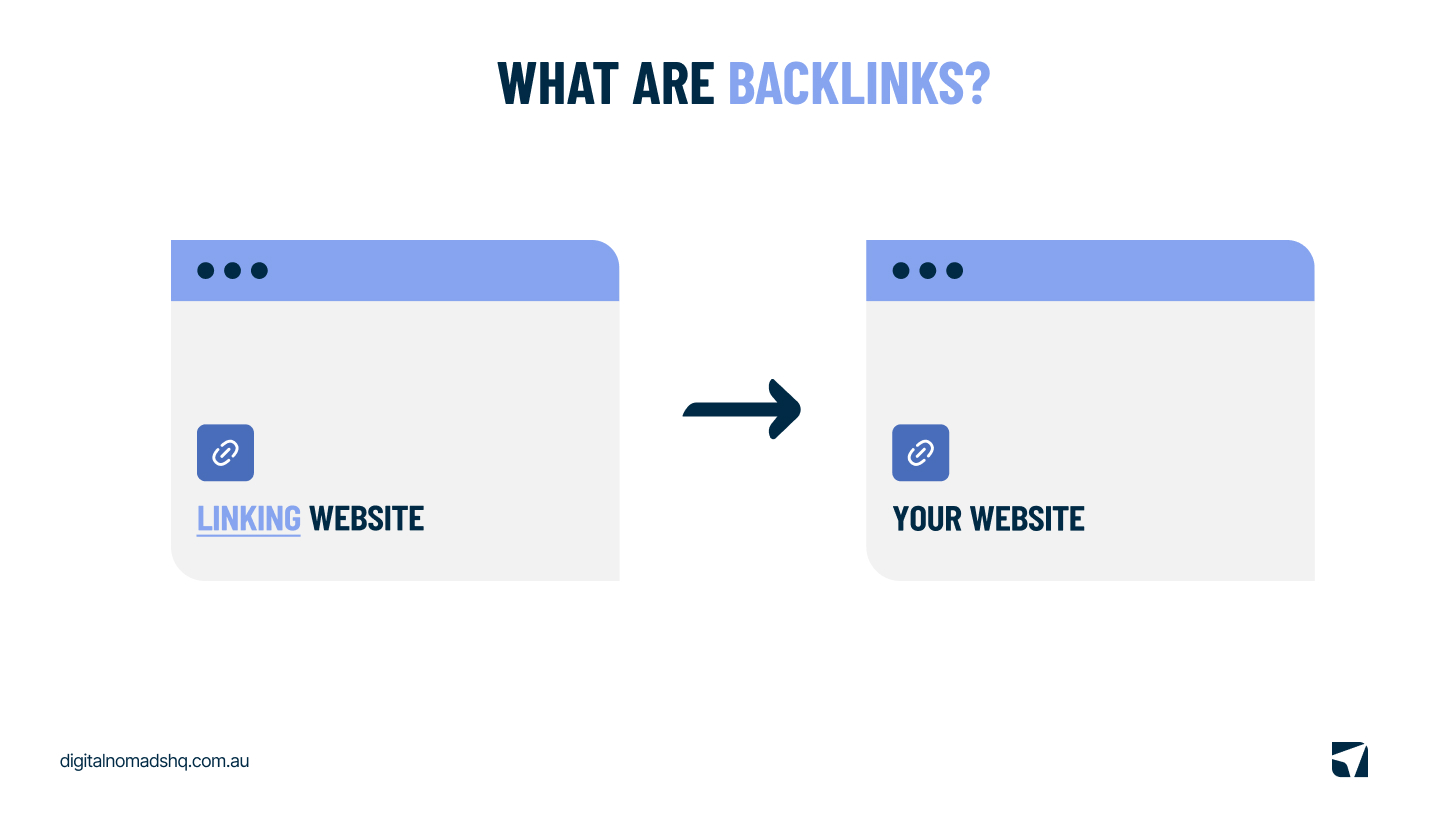
5. Off-page authority and links
Google still rewards being talked about.
Earned links from real publications, genuine digital PR, and authority built through expertise, not links bought from a marketplace.
The shortcut approaches that some agencies still quietly rely on are the ones most likely to get a site into trouble.
We build authority the slow, durable way, because it is the only way that survives an algorithm update.
6. Local SEO
For any business that serves a place, this is where a lot of the real money is.
Google Business Profile optimisation, local citations, reviews, and Map Pack visibility.
There is a 2026 bonus here too: our data shows that local, suburb-qualified searches are the surface AI is least likely to answer itself, so they remain one of the cleanest, most defensible places to compete. We lean into that deliberately.
7. AI search visibility, the new pillar
This is the job that did not exist three years ago.
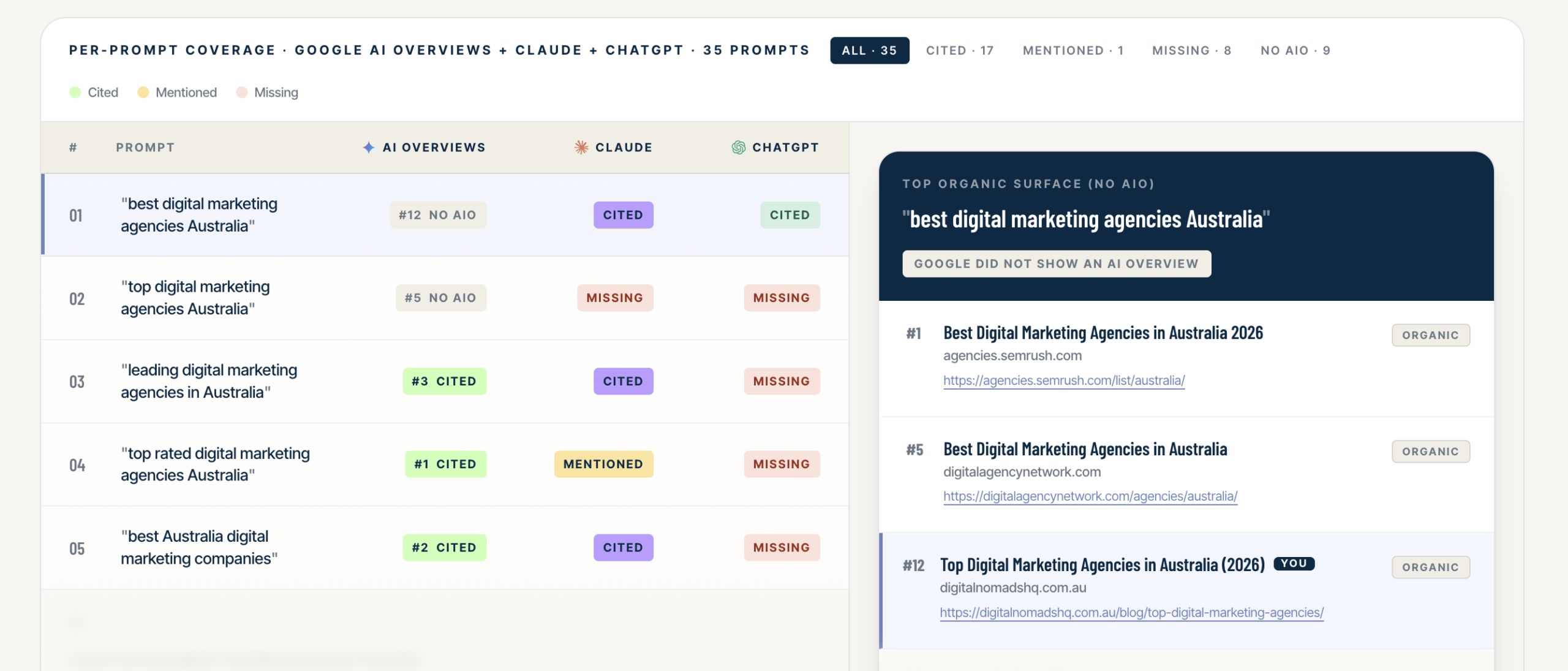
Tracking whether AI engines cite you, for which queries, and how you compare to competitors, then optimising to win those citations.
Classic rank tracking does not capture any of it. This is the gap most agencies have not closed, and it is the one we built a tool specifically to solve.
8. Measurement and reporting
The last job is proving it worked, in terms that matter.
We report on leads, conversions and revenue from organic search, not just rankings and sessions.
A ranking is an input.
A booked enquiry is the result.
If your current reports are full of traffic graphs and light on leads, you are being shown activity, not outcomes.
How we actually run it
The 2026 difference most agencies are still missing
Here is the uncomfortable truth about a lot of the industry right now.
The search results page has fundamentally changed, and most agencies are still selling against the old one.
We have the data on exactly how much it has changed.
Beyond the 37.8% of commercial searches now carrying an AI Overview, our Australian search demand study found that local-service search demand fell 38% in early 2026, as AI began absorbing the searches that used to be typed, repeated and clicked.
The ground has moved.
An agency that promises “we’ll get you to number one” without a word about AI visibility is promising a 2021 outcome. Ranking first underneath an AI answer that already satisfied the searcher is a hollow win.
The job in 2026 is to be inside the answer, to defend the transactional and local searches AI cannot resolve, and to measure visibility in a way that reflects how people actually search now.
If your agency cannot talk fluently about that, they are optimising for a web that is disappearing.
Our edge: Amalfi
This is where we do something almost no other Australian agency can.
The standard rank-tracking tools, the ones most agencies quietly rebrand and resell, were built to measure the old results page.
They cannot see AI Overviews, and they cannot tell you whether AI is citing you or your competitor.
So we built our own.
Amalfi is our proprietary AI-search intelligence platform.
It scans where AI cites you, where it cites your competitors instead, and exactly what to fix, live.
It turns the one thing every other agency is guessing at, your visibility inside AI search, into something measurable and actionable.
That matters for a simple reason.
You cannot improve what you cannot see.
Most agencies are flying blind on AI search because their tooling was built for a different era. Amalfi was built for this one, which means our clients get a true picture of how they show up in AI answers, not just a rankings report that ignores half of what is happening on the page.
How to tell a good SEO agency from a weak one
If you are choosing an agency, a few questions cut through the noise fast:
Do they measure your visibility in AI search, or only classic rankings?
Do they report on leads and revenue, or just traffic and positions?
Do they have their own data and tools, or are they reselling the same dashboards as everyone else?
Can they show real results for businesses like yours, with named outcomes?
If the answers are thin, you are looking at an agency working off the old playbook.
The search results page has changed too much for that to be enough.
The Bottom Line
A good SEO agency in 2026 still does the fundamentals: technical foundations, smart keyword and intent research, on-page work, real content, earned authority and local visibility. What separates the good from the dated is whether they have absorbed what AI has done to search, and whether they can measure and win the new visibility that comes with it.
That is the job we have built Digital Nomads HQ around: 300-plus SEO campaigns, 97% client retention, 25,000-plus page-one rankings, and the only proprietary AI-search platform of its kind in the Australian market. We do the old job properly, and the new one most agencies have not started.
Want to see where you actually stand? Run a free AI visibility audit powered by Amalfi, or talk to our SEO team about what is possible.