For twenty years, one number told you whether your SEO was working: your ranking.
In AI search, that number is close to useless.
When someone asks ChatGPT, Perplexity or Google’s AI for a recommendation, there is no page two. There is one answer, built from a handful of sources. You are either in it or you are invisible, and your blue-link ranking does not decide which.
So the question changes. Not “where do I rank”, but “how often does AI mention and cite me, and how do I compare to competitors when it does”. This guide covers the three metrics that answer that, and exactly how to track them. If you want the background first, start with what GEO is.
Why your rankings no longer measure visibility
AI answers cite a small set of sources, and most of the time the user never clicks through.
The numbers are stark.
93% zero-click Across Google, sessions that end without a click run at about 34% with no AI Overview, 43% when an AI Overview shows, and as high as 93% in AI Mode.
AI Overviews cut clicks to the top organic result by roughly 58%.
That sounds like a disaster until you look at what the remaining clicks are worth.
AI referral traffic converts at around 14%, against 2.8% for traditional Google search. That is roughly five times more valuable per visit.
So AI search is a small but fast-growing channel, full of high-intent buyers, that your ranking tools cannot see. You have to measure presence in the answer itself. We did exactly that at scale for our State of AI Search study, across 116,918 Australian search results, and the metrics below are how we track it for clients.
The three metrics that matter
1. Mention rate
The share of your target prompts where the AI names your brand at all.
Track 100 priority questions, get named in 32 of them, and your mention rate is 32%. It is the broadest signal that AI knows you exist.
2. Citation rate
How often the AI links or cites you as a source, not just names you.
Being mentioned is good.
Being cited is what earns the referral click and credits your content as the authority.
Do not confuse the two. A high mention rate with a low citation rate means AI knows your brand but is not sending you traffic or pointing to your pages.
3. Share of voice
Your mentions or citations as a proportion of the total for a prompt set, measured against named competitors. This is the one that matters most, because an AI answer is close to zero-sum.
One response, a few sources.
If a competitor owns 40% of the answers in your category and you own 5%, that gap is your whole strategy.
Track share of voice, not just your own count, or you will celebrate your growth while a rival quietly pulls further ahead.
Supporting metrics worth logging: prominence (are you first in the answer or buried), sentiment (how you are described), which of your pages gets cited (so you know what to double down on), and the platform split (ChatGPT versus AI Overviews, Perplexity, Gemini and Claude).
How to measure it, step by step
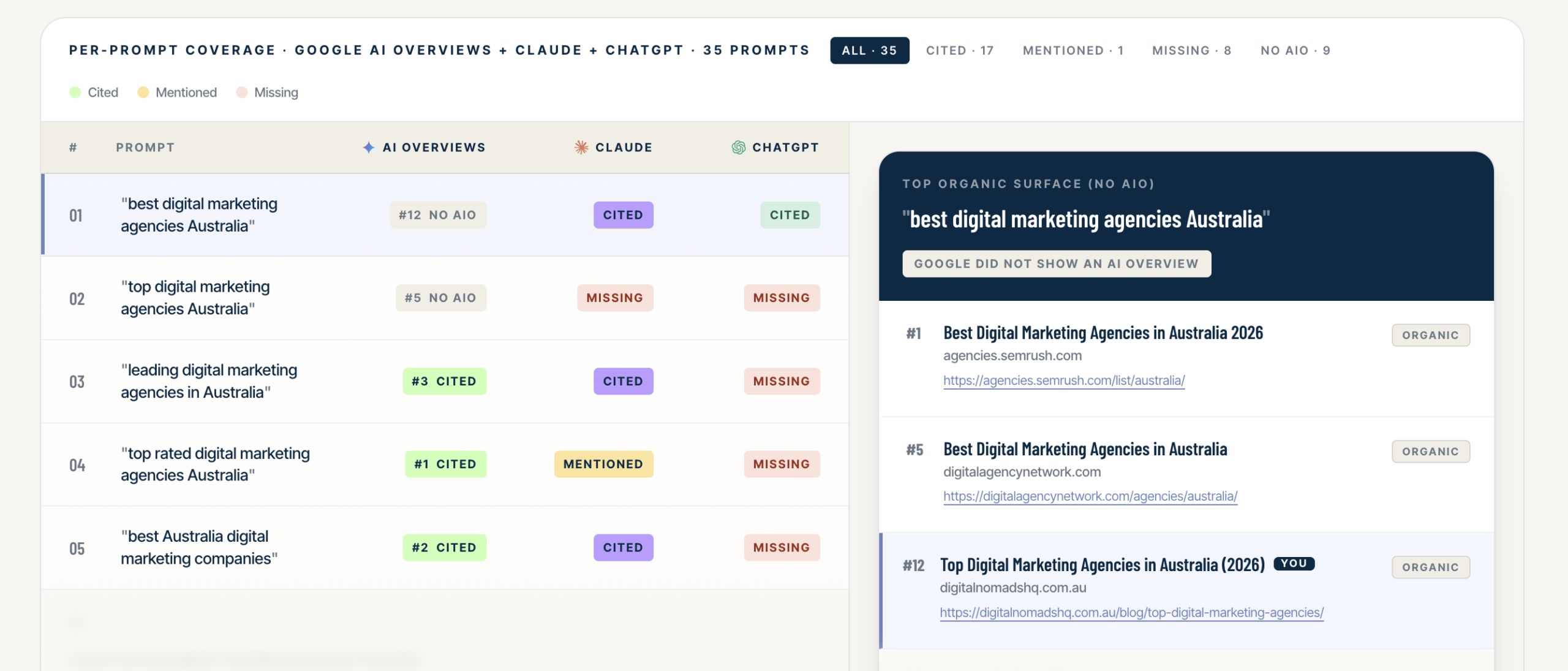
- Build a prompt set.
List the 50 to 100 questions your buyers actually ask –
You can use our AIO audit tool that will map this based on your domain for both commercial, informational and brand related terms.This is the foundation. Weak prompts give you weak data, so treat it like keyword research for the AI era.
- Run manual checks first.
Before any tool, put your prompts through ChatGPT, Google AI Overviews, Perplexity, Gemini and Claude, and log whether you are mentioned, whether you are cited, and where you sit in the answer. It is tedious, but it shows you the truth and teaches you what the tools are abstracting away. Keep doing it even after you buy a tool. - Add a tracking tool for scale.
Platforms such as Profound, Otterly, the Semrush AI toolkit and Ahrefs Brand Radar automate prompt tracking across models and report mention rate, citation rate and share of voice over time.
Results vary by tool, prompt and personalisation, so trust the trend rather than any single day’s number. - Track AI referral traffic in GA4.
Filter referrals from chatgpt.com, perplexity.ai and gemini.google.com to see which platforms actually send you visitors and what they do once they arrive.
This is your downstream proof that visibility is turning into business. - Run a baseline audit. Our free AIO audit shows where AI Overviews, local widgets and organic results fall for your top keywords, which is the fastest way to see your starting point before you commit to a tool.
One more rule: weight by platform. ChatGPT drives the majority of AI referrals, around 62%, but Claude has climbed to second at roughly 18%, with Gemini and Perplexity growing fast. Measure all of them, but weight your share-of-voice target toward where your buyers actually are.
Google Update:
Since June 2026, Search Console has a Search Generative AI performance report showing how often your pages appear in AI Overviews, AI Mode and Discover. Two caveats keep it in perspective: it covers Google’s AI surfaces only, not ChatGPT, Perplexity or Claude, and it reports impressions only, with no clicks, position or query data. Treat it as your free Google baseline, then use the metrics above for the full picture. We break it down in our guide to the Generative AI Performance Report.
What to do with the numbers
The metrics only matter if they change what you do next. Three common readings:
- Low mention rate. AI does not know you. Earn mentions on the third-party sources AI trusts, publish original data, and build your brand as a recognised entity.
- Mentioned but rarely cited. Your content is not citation-friendly. Answer the question directly in the first 200 words, use clear structured headings, and add original data. Structured, answer-first content is markedly more likely to be cited.
- Losing share of voice. A competitor is being cited more than you. Find the prompts they win and the sources behind those answers, then close the gap. This is the core of what our AI SEO and GEO service does for clients.
What most people get wrong about AI visibility
Having tracked this across a lot of accounts, the same mistakes come up:
- They measure mentions and ignore citations and share of voice, so they cannot tell the difference between being known and being chosen.
- They obsess over ChatGPT and ignore where their actual buyers are.
- They trust a tool’s single number and never run a manual check, so they never catch it when the tool is wrong.
- They build a dashboard and admire it, instead of acting on the gaps it shows.
And an honest caveat: these tools are early and imperfect. Numbers shift with model updates and personalisation. Measure the trend over weeks, not the reading on any single afternoon.
Frequently Asked Questions
How often should I measure AI visibility?
Monthly for the trend, with a manual spot-check on your most important prompts more often if AI is a priority channel for you.
Which AI platforms should I track?
At a minimum, ChatGPT, Google AI Overviews, Perplexity, Gemini and Claude. Weight your attention toward the ones your audience uses most.
Do I need a paid tool?
No. You can start with manual checks and GA4. A tool saves time once you are tracking dozens of prompts across several models. Our free AIO audit is a no-cost way to get a baseline.
Is AI visibility a ranking factor?
It is an outcome, not a lever. You improve it the way you improve GEO: answer-first content, original data, author authority and mentions on trusted third-party sources.
How is this different from keyword rankings?
Rankings measure your position in a list. AI visibility measures whether you are in the answer at all, and whether you are credited for it. It is the natural next layer beyond the SEO KPIs you already track.
The Bottom Line
You cannot improve what you cannot see, and ranking tools no longer show you the part of search that is growing fastest and converting best. Mention rate tells you whether AI knows you. Citation rate tells you whether it credits you. Share of voice tells you whether you are winning. Track all three, act on the gaps, and you will have sight of the channel most of your competitors are still flying blind on.
Want a fast read on where you stand? Run our free AIO audit, or talk to our AI search team about a GEO campaign.