TL;DR
Your product pages are where the money is made, and most stores under-optimise them. In 2026 they have to win two audiences: Google, and the AI engines now answering shopping questions before anyone clicks.
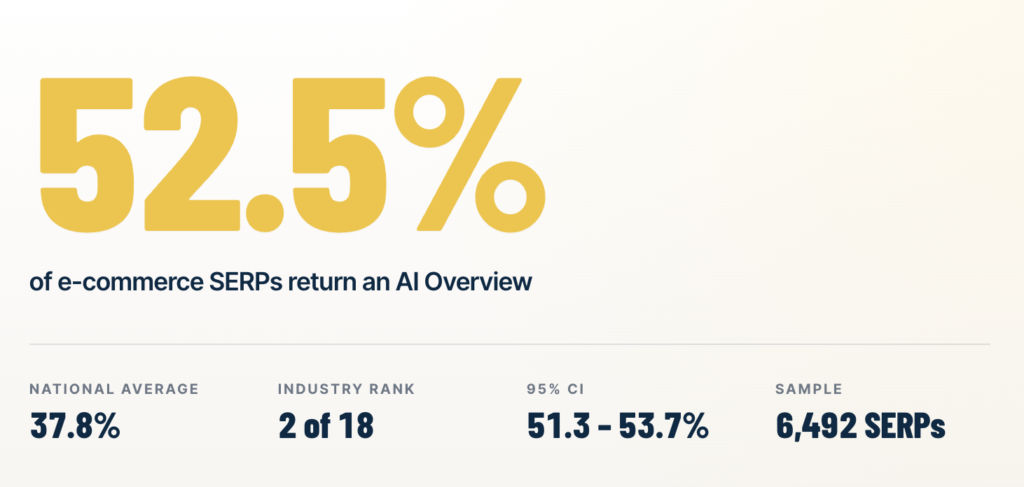
AI isn’t skipping ecommerce. Our own Australian research found 52.5% of ecommerce SERPs return an AI Overview, and even a product page ranking number one has one above it about half the time. Don’t assume you’re insulated.
The mindset shift: optimise to be chosen and cited, not just to rank. The same clean, specific, well-structured page wins in classic search and gets pulled into AI answers.
On-page still decides it. Write your own descriptions, name the specific attributes, and target transactional, long-tail terms.
Structured data is table stakes. Product, merchant and review markup still earn rich results; FAQ results were retired in May 2026. Run schema and a Merchant Center feed together.
Reviews do triple duty: trust, content and an AI qualifier. Aim for 150-plus genuine reviews on hero products, never write your own.
Fix the technical leaks: faceted navigation, canonicals, keep temporary out-of-stock pages live (200), and hit INP and mobile targets.
For AI search: your Google Shopping rank gates your ChatGPT visibility, get cited off-site (Reddit, category authority), build brand demand as your safe harbour, and don’t stuff “Australia” into product titles.
I’ve spent years staring at product pages as part of our ecommerce seo…
Auditing them, rebuilding them, watching what moves and what doesn’t. So I’ll start with the thing I believe most:
Your product pages are where the money is made, and they’re the pages you’re almost certainly under-optimising.
I see it on nearly every store we audit.
Manufacturer description pasted in. One photo. A title that reads like a warehouse label.
That was fine in 2019. It’s costing you now in 2026.
Two things changed, and they changed fast. AI started answering shopping questions before anyone clicks. And Google rewrote the rules on structured data, reviews and quality while a lot of stores weren’t looking.
Here’s the reframe I’ve landed on for 2026.
Stop optimising a product page to rank.
Optimise it to be chosen.
By Google, and by the AI engines now sitting between your product and your buyer.
This is the full playbook as I run it. What changed, what still works, and where I’d put my effort if it were my store.
What actually changed, and why I'm not panicking
Let me set the scene, because the ground moved.
AI is in the shopping journey now.
Google’s AI Mode and AI Overviews answer “find me a waterproof travel bag under $200” on the spot, pulling from a Shopping Graph of more than 50 billion product listings, over 2 billion of them refreshed every hour. ChatGPT, Perplexity and Gemini all bolted on shopping features in the last year.
Zero-click is rising, and I’m not going to guess at the scale from US data.
We ran our own.
Our State of AI Search for Australian SMEs captured 116,918 Australian SERPs across 18 industries and 6 cities in May 2026, and the headline is that 37.8% of commercial searches now return an AI Overview.
For ecommerce it’s worse, and I’d rather you hear it straight.
Ecommerce was the second-most AI-exposed industry we measured: 52.5% of ecommerce SERPs return an AI Overview.
The comparison searches that are the bread and butter of product marketing (“best running shoes”, “Sony vs Bose”) trigger one 68.1% of the time. And when a product page ranks number one, an AI Overview still sits above it on 48.8% of searches.
So I’m not going to tell you product pages are safe.
Our own data killed that comfort.
But I’m still optimistic, and here’s why: the one query type the AI rarely touches is navigational, your brand, at about 26%. Brand demand is now the most defensible asset you own.
And the game underneath hasn’t changed.
Get chosen, get cited, and the same clean page that earns that also wins in classic search.
Structured data got a shake-up too. FAQ rich results were fully retired on 7 May 2026. HowTo went in 2023. Product, merchant and review markup are alive and well.
And the technical bar moved: INP replaced FID in March 2024, mobile-first indexing finished in July 2024, and the helpful content and reviews systems are now baked into core ranking and run quietly in the background.
The throughline I keep coming back to: the same clean, structured, genuinely useful product page wins in classic search and gets pulled into AI answers. You build it once. It works in both places. That’s the whole game, and it’s why I’m optimistic, not anxious.
The on-page basics I still won't skip
None of the AI stuff matters if the page itself is thin!
So I always start here.
Titles and H1s. Lead with the words people actually type. Primary term near the front of the title, close to 60 characters so it doesn’t truncate, and an H1 written for the human who landed. I think of it simply: the title earns the click, the H1 earns the read.
Meta descriptions. They don’t rank you. They earn the click, and Google rewrites the weak ones. I keep them to a tight 120 to 160 characters that sells the product.
Write your own descriptions. This is the mistake I see most, and the advice around it is usually wrong too.
Reusing the manufacturer’s copy will not get you “penalised.” I know that gets repeated everywhere, but it’s not how Google works.
John Mueller has said it plainly: duplicate content isn’t a penalty. What actually happens is Google filters the duplicates and picks one page to show for that text, and in my experience it’s rarely yours. No penalty. Just quiet invisibility, which is arguably worse because nobody warns you.
So write original copy, and describe what makes the product specific.
My rule: if a shoe comes in blue and you never write “blue” on the page, don’t be surprised when you don’t rank for “blue shoes.” – especially in AI.
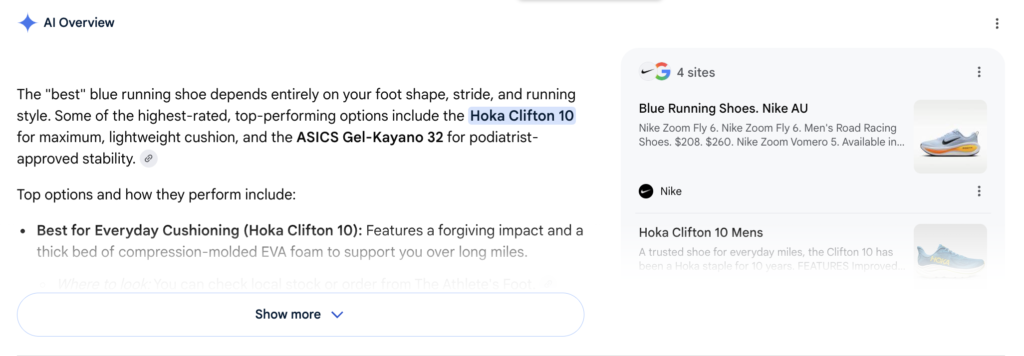
Spell out the attributes. Google isn’t guessing for you anymore.
Go deeper than a paragraph.
Word count isn’t a ranking factor, full stop. But the pages I see winning answer the whole decision: specs, materials, sizing, use cases, what it pairs with. Write like the best salesperson on your floor, not like a spec sheet.
Match intent. Product pages are for transactional queries. Buy, price, “best,” near me. Long-tail terms convert better and rank easier, every time. I send informational queries to guides and keep the product page commercial. If you want the method I use, it’s in our keyword research guide.
Reviews: the hardest-working block on the page
If I could only add one thing to a bare product page, it’d be reviews – They are incredibly powerful!
They give you fresh, keyword-rich content in your customers’ own words, they build trust, and with valid markup they earn star ratings.
One distinction I wish more people understood.
Google’s reviews system, the one tied to ranking, judges first-party editorial review content, like your own “best running shoes” article.
It does not judge the third-party customer reviews sitting on a product page.
So your review widget is a conversion and rich-snippet play, not a reviews-system ranking lever. I treat them as two different jobs, and you should too.
Two hard rules I never break and nor should you!
1: Never write your own reviews. Google bans it outright, and it’s not worth the risk.
2: Never ever scrape other sites’ reviews into your markup, which can earn you a manual action.
Here’s why I now push reviews harder than I used to: AI engines lean on them.
One analysis of 1,000 shopping prompts found the median product ChatGPT recommended had around 156 reviews.
Review count has quietly become a qualifier for being recommended at all. So on hero products, I treat 150-plus genuine reviews as a target, with the rating and count shown clearly.
Structured data: the part I'd fix first
If you do one technical thing to a product page, make it clean structured data.
It’s how Google understands the product, and it feeds the graphs that ground AI answers. I’d argue it’s gone from “nice to have” to “table stakes.”
Product markup has two flavours. Merchant listings, for pages people buy from (price, availability, shipping, returns, sizing), and product snippets, for editorial or review pages. Each gets its own Search Console report.
Get the Offer right. Price, currency, availability (InStock, OutOfStock, PreOrder, BackOrder) and price validity. Since 2024 you can declare shipping and returns at the business level, or set them straight in Search Console, without a feed.
You don’t need Merchant Center to be eligible anymore. Since 2022, on-page Product schema alone can earn merchant listing experiences. That said, I still recommend doing both the on-page schema and a Merchant Center feed, because Google says that combination maximises eligibility, and because (as you’ll see) the feed is now an AI lever. More on schema markup if you want the foundation.
Review markup still earns stars. The “self-serving” rule that kills review stars applies to LocalBusiness and Organization markup, not products. A merchant marking up genuine customer reviews of a product it sells is fine. Keep them visible and real.
Variants have their own markup. Google added ProductGroup support in 2024, so you can group size and colour variants under one parent instead of spawning a pile of near-duplicate pages.
FAQ and HowTo rich results are gone. FAQ went in May 2026, HowTo in 2023. I broke down the FAQ deprecation separately.
My take: the schema is still valid and harmless to leave in, and it might help AI parse the page, but Google hasn’t confirmed that, so I don’t build new FAQ blocks chasing a snippet that no longer exists. I build them because buyers ask the question.
The technical stuff that quietly drains rankings
Big catalogues create big problems, and this is where I find the most leaks on an audit.
Crawl budget and index bloat. It mainly bites large sites.
The lever you control most is what I’d call junk inventory: if Google keeps finding duplicate and filter URLs, it wastes its crawl on them and may never reach your good pages.
Faceted navigation is almost always the culprit.
Fifty categories times a few filters becomes tens of thousands of URLs.
Google’s lead advice is to block the filter URLs you never want crawled with robots.txt. The nuance I always add: robots.txt can’t remove URLs already in the index, so if they’re already in there, you clean up with canonical or noindex first, then block. Order matters.
Canonicalise variants and parameters. Point parameter URLs back to the clean product URL. If a variant has real, distinct demand and unique content, give it its own self-canonical page. If it differs only by a swatch, canonical it to the parent. I decide that per product, not by blanket rule.
Pagination changed, and a lot of sites missed it. Google stopped using rel=next and rel=prev years ago. Today: link pages with real crawlable anchor tags, give each a unique URL, and let each paginated page self-canonicalise. Don’t canonical them all to page one. And remember Google won’t click your “load more” button, so infinite scroll needs crawlable URLs behind it.
Stock handling is where I see the worst instincts.
For a temporarily out-of-stock product, keep the page live, return a 200, and mark it OutOfStock in structured data. Do not 404 it or noindex it, because you’ll just rebuild it next week.
For a permanently discontinued product, it’s a judgement call: 301 to the closest real equivalent if the page has links or traffic worth keeping, or 410 it if it doesn’t. Redirecting to a vaguely related category gets treated as a soft 404, so keep it relevant or don’t bother.
Core Web Vitals and mobile. INP replaced FID in 2024. Aim for 200 milliseconds or better, which is harder than it sounds on a product page loaded with variant scripts and add-to-cart logic. Mobile-first indexing is done, so if it’s not on the mobile page, it doesn’t exist. The rest is in our technical SEO checklist.
Internal linking. Keep key products within about three clicks of the homepage and link to them from category pages with descriptive anchors. Orphaned products don’t rank, and I find them on nearly every audit.
Images and visual search, which I think most stores ignore
Product SEO is visual SEO.
People search with their camera now, and I don’t think enough stores have caught up.
Google Lens handles around 20 billion visual searches a month, and roughly a fifth are shopping.
That’s a discovery channel, not a gimmick.
The basics still carry it.
Write descriptive alt text, which Google calls the most important signal for understanding an image.
Use real file names, not IMG_0023.
Serve sharp, high-quality images from multiple angles, use standard image tags (Google doesn’t index CSS background images), and submit an image sitemap. Our image SEO guide has the detail.
Add video where you can. It lifts conversion and gives you another surface to be found on.
Optimising product pages for AI search
This is the frontier, and honestly the part most stores haven’t touched. Here’s how I see products actually surfacing in AI answers, and how I’d be the one chosen.
How AI picks products. Google’s AI Mode runs a “query fan-out,” firing several searches at once to break “a cute waterproof travel bag for a rainy trip” into criteria, then matching products from the Shopping Graph. The others do their own version.
The Google Shopping connection is the lever I’d pull first.
A 2026 study of 43,000-plus ChatGPT carousel products found around 83% matched Google’s top-40 organic Shopping results, most from the top 10. Sit with that.
Your Google Shopping rank effectively gates your ChatGPT visibility. So a clean Merchant Center feed and strong free listings are now an AI tactic, not just a paid one.
What I’d put on an AI-ready page.
The pattern across AI-cited products is consistent, and it lines up with what good selling looks like anyway: clear specs in tables or lists, honest pricing, explicit use cases (“good for small apartments,” “great for travel”), buyer questions answered plainly (mine them from your reviews and from Reddit), genuine reviews with a visible count, and the structured data to tie it together. If the spec isn’t on the page, the AI can’t match your product to the need.
Simple as that.
One counterintuitive finding from our research, and it’s about your titles.
Across the dataset, adding “Australia” or “AU” to an ecommerce query pushed the AI Overview trigger rate up, from 39.9% to 57.5%. That’s the opposite of every other industry we measured, where a location token reduces AI Overviews. So if you’ve been stuffing “buy X in Australia” into product titles to chase local visibility, you may be optimising for more AI mediation, not less. Brand and product specifics earn the click. Geographic tokens can just summon the summary. Test it on your own terms before you commit.
Get cited beyond your own page, because this is the uncomfortable bit.
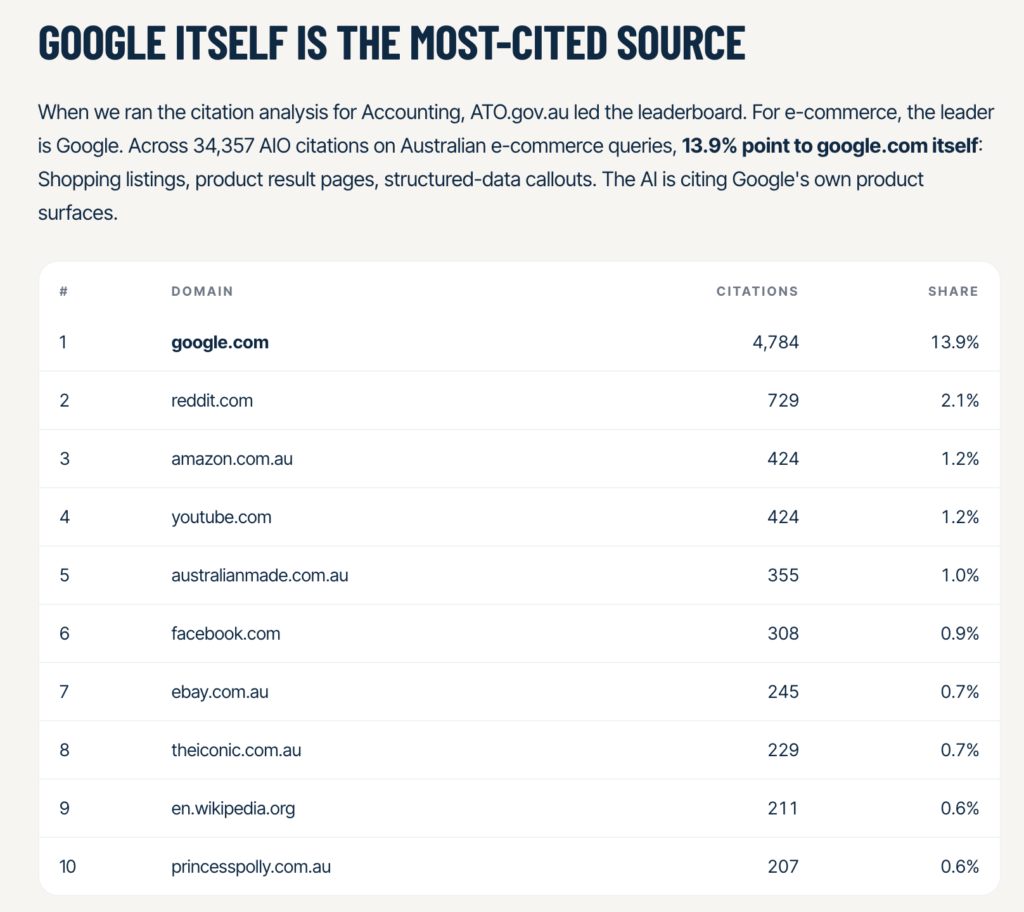
When we analysed 34,357 AI Overview citations on Australian ecommerce queries, the most-cited source was Google itself (about 14%), and the biggest non-Google source was Reddit.
Nearly 59% of citations went to Australian domains, and the independent retailers that did get cited (The Iconic, Princess Polly and the like) won on category authority, not broad SEO. You cannot on-page your way into that.
Third-party reviews, category-specific subreddits and creator coverage are product SEO now too. It’s where GEO meets ecommerce, and where our AI SEO work lives. The mechanics are in how to rank in AI Overviews.
Don’t chase the checkout buttons.
In barely six months we’ve seen OpenAI’s checkout protocol, Google’s Universal Commerce Protocol, Perplexity’s PayPal checkout, and OpenAI already walking its buy-button back.
I’m not integrating my clients into plumbing that’s still being fought over. Discovery is the stable layer. I invest there and let the checkout wars settle.
Why I bother when AI traffic is still tiny.
Because it converts.
AI-referred shoppers arrive high-intent and convert well above the ecommerce average, and the referrals are growing fast off a small base. I’m not chasing today’s volume. I’m building the page that wins as it arrives, and it’s the same page that ranks in classic search anyway. No wasted effort.
Where I'd actually spend the next quarter
If it were my store, this is the order I’d work in.
Fix the foundations first. Unique descriptions with real attributes, clean Product and Offer schema, fast mobile pages, tidy faceted navigation. Unglamorous, highest ROI, every time.
Win the buyer-guide queries, but win them properly. “Best [product]” and comparison searches are the most AI-mediated of all.
Our data put commercial intent at 68.1%, and content pages ranking #1 carry an AI Overview about 90% of the time. You don’t win that with thin listicles. You win it with genuine primary research: head-to-head testing, real comparison tables, named expert reviewers. That’s the content AI actually cites.
Build brand demand, deliberately. Navigational brand searches are the one query type our data showed the AI rarely intercepts (around 26%, versus 68% for commercial). Email lists, repeat customers, above-the-line brand: they generate the one kind of search the AI doesn’t get in front of. It’s the most under-rated SEO investment in ecommerce right now.
Build review depth on your heroes. It’s a trust signal, a conversion lever and an AI qualifier all at once. Rare to get three wins from one job.
Feed the machine.
A complete, fresh Merchant Center feed that matches your on-page schema.
It powers free listings, Shopping, and your visibility across AI Mode and ChatGPT.
Then go off-page, and get your products into the third-party conversations AI engines actually cite.
When I'd tell you to get help
Most of this you can work through yourself if you’re methodical. Some of it isn’t a tweak, it’s a rebuild, and I’ll be honest about which is which.
The signs I look for: a catalogue spitting out tens of thousands of junk filter URLs, manufacturer copy across hundreds of pages, no structured data, product pages that choke on mobile, and zero presence in AI shopping answers.
That’s the work my team does. If your store has outgrown its SEO, our ecommerce SEO crew can audit the catalogue and prioritise the fixes by revenue, whether you’re on Shopify or WooCommerce. It usually pairs with conversion rate optimisation, because here SEO and conversion pull the same way.
Here’s where I land. A product page that’s specific, well-structured, fast and genuinely useful wins in Google and gets pulled into AI answers. The page you build for the shopper is the page the algorithms reward. Build that one, and most of this takes care of itself.
Frequently asked questions
Is FAQ schema still worth adding to product pages in 2026?
Not for a rich result. Google fully retired FAQ rich results on 7 May 2026. The schema is still valid and won’t hurt if you leave it, and it may help AI parse your page, though Google hasn’t confirmed that. My advice: add FAQ content because buyers ask, not for a snippet that no longer shows.
Do duplicate manufacturer descriptions hurt my SEO?
Not as a penalty, despite what you’ll read. Google doesn’t demote you for it. It just filters the duplicates and usually shows someone else’s page instead of yours. Write original copy, and always include the specific attributes (colour, size, material) that let the page rank.
Should product variants be separate pages or one page?
I default to consolidating size and colour variants onto one canonical page with selectors, using ProductGroup structured data. I only split a variant out when it has genuine, distinct search demand and unique content to justify it.
How do I get my products into AI Overviews and ChatGPT?
Start with Google Shopping, because most ChatGPT product results trace back to top Google Shopping listings. So: a clean Merchant Center feed plus matching on-page Product schema, clear specs and pricing, genuine reviews, and use-case language. Then build off-page presence on review sites, Reddit and with creators, because AI leans on those heavily.
Are AI Overviews killing ecommerce traffic?
Ecommerce is one of the most exposed industries, not a protected one. Our own Australian study found 52.5% of ecommerce SERPs carry an AI Overview, and even product pages ranking number one have one above them about half the time. The one safe harbour is brand and navigational search. So the move isn’t to hope you’re insulated. It’s to build brand demand, own comparison content with genuine primary research, and optimise to be the source the AI cites.
How many product reviews do I actually need?
More than you’d think. AI assistants skew towards products with real review depth (one analysis found a median around 156 for ChatGPT picks). I aim for 150-plus genuine reviews on priority products, with the rating and count shown. A spread of mostly-positive reviews converts better than a wall of suspicious five stars.
What should I do with out-of-stock products?
If it’s temporary, keep the page live, return a 200, and mark it out of stock in structured data. If it’s permanently discontinued, 301 to the closest equivalent when the page has traffic or links worth keeping, or 410 it when it doesn’t. Don’t redirect to a loosely related category, because Google may treat it as a soft 404.