The Map Pack is the most valuable real estate in local search.
Three results. A map. A decision.
If you are not in those three spots, a huge share of local searchers will never see your business. They will see your competitor instead.
We manage local SEO campaigns across Australia. This is how we approach Map Pack ranking for our clients, and what we have seen actually work — backed this year by our own study of nearly 117,000 Australian search results.
Is the Map Pack Still Worth Chasing in 2026?
Short answer: more than ever. And for once, we can prove it with our own data.
For our State of AI Search study, we analysed 116,918 Australian search results across 18 industries. One finding matters more than any other for local businesses:
24.7% vs 40.1% Local searches trigger an AI Overview just 24.7% of the time. General searches trigger one 40.1% of the time – a 38% relative drop.
The moment someone adds a suburb, a city, or “near me” to a search, Google’s AI tends to step aside and hand the result back to the map, the reviews, and the local listings. That pattern held across 16 of the 18 industries we measured.
So while AI Overviews are busy eating the informational web – the “how do I”, “what is”, “best way to” searches – the local-service web is the most insulated surface left in search. The phone-call-and-booking queries are exactly the ones AI backs away from. The Map Pack isn’t dying. It’s becoming one of the last places organic visibility still converts.
How Protected Is Your Industry?
That protection varies by category. Here’s the local-intent “discount”… how much less often AI Overviews appear once a location is added, for a sample of service categories from our study. A bigger negative gap means local search is safer.
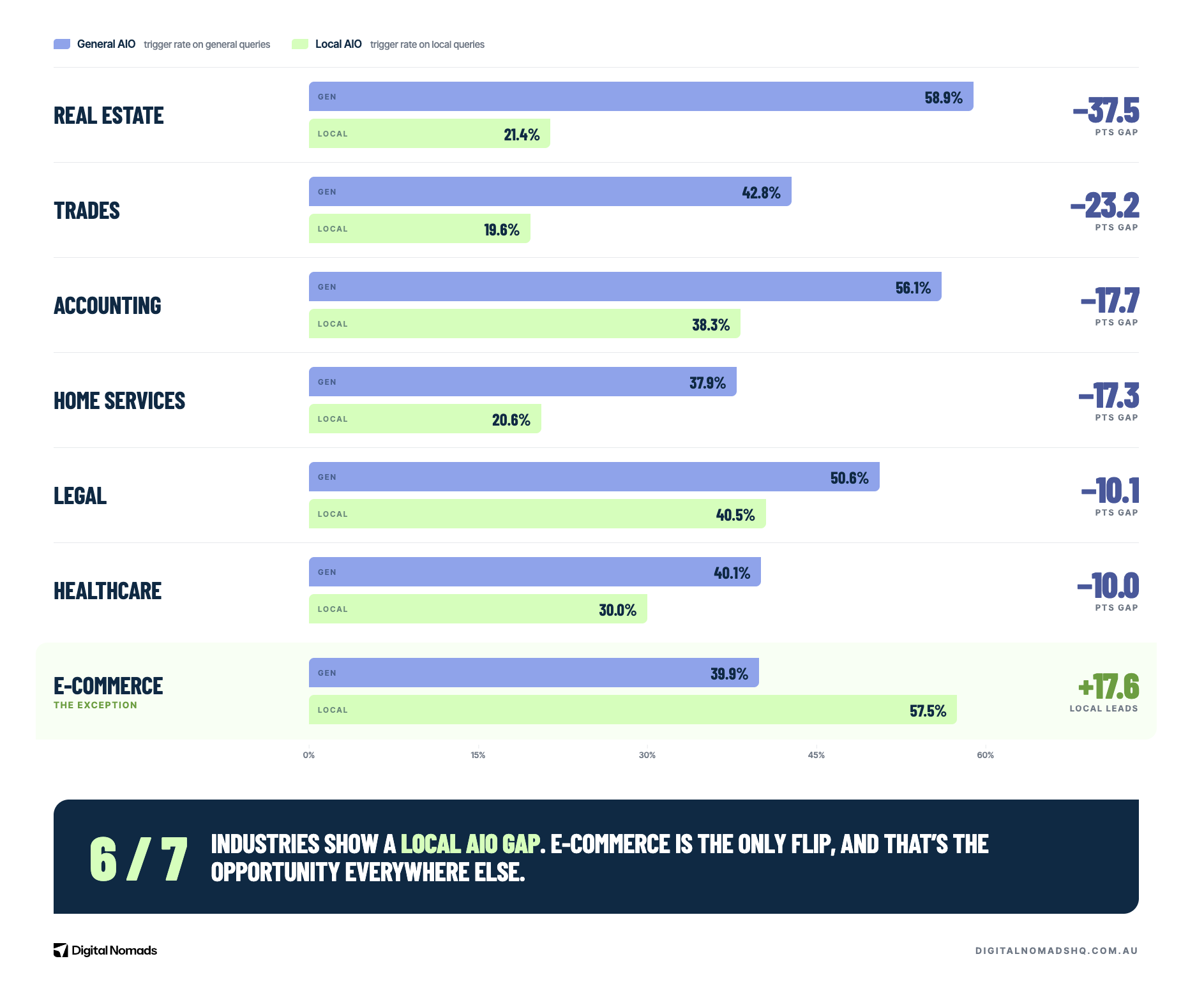
Every service vertical we measured moved the right way. Only product- and shopping-led categories like e-commerce saw AI exposure rise on local queries. If you sell a local service, location intent is your strongest card. (Full 18-industry breakdown in the study.)
What Is the Google Map Pack?
The Map Pack (also called the Local Pack or 3-Pack) is the block of three business listings that appears with a map at the top of local search results.
Search “plumber near me” or “dentist Brisbane.” The Map Pack is usually the first thing you see.
It shows your business name, star rating, review count, address, hours, and a click-to-call button. All above the organic results.
For local businesses, this is the highest-converting position in search. Not position 1 in organic. The Map Pack.
A customer sees three options, scans the reviews, taps the phone number, and calls. That entire journey can happen without them ever visiting your website.
The Three Factors That Control Map Pack Rankings
Google uses three factors to decide which businesses appear in the Map Pack:
1. Relevance
How well your business matches what the searcher is looking for.
This is driven by your Google Business Profile categories, your business description, the services you list, and the content on your website.
Someone searches “emergency plumber.” If your profile says “plumbing contractor” with emergency services listed, you are relevant. If it just says “plumber” with no service details, Google has less confidence.
2. Distance
How close you are to the person searching.
This is the factor you have the least control over. Google uses the searcher’s location at the moment they search and calculates proximity to your listed address.
Our map pack study quantified how local this game really is: the same query surfaces around 19 different businesses across one metro, the pack changes between suburbs 99% of the time, and the average pack member is visible from just 17% of their own city. The “3-pack” is really a 19-pack – which is why we track rankings from multiple points across a metro, never just the CBD.
You cannot game distance. You can only make sure your address is accurate and your service areas are properly defined.
3. Prominence
How well-known and trusted your business is.
This is where most of the work happens. Prominence is influenced by your review count and quality, citation consistency, backlinks, overall web presence, and GBP engagement.
You cannot move your building closer to the searcher. But you can build a stronger reputation than every competitor in your area.
Your Google Business Profile Is the Foundation
According to the 2026 Whitespark Local Search Ranking Factors survey, eight of the top 10 Map Pack ranking signals come from your Google Business Profile.
Your primary category is the single most influential factor. That one field determines which searches you are even eligible for.
Here is what we optimise for every local SEO client:
Primary category
Be as specific as possible. “Plumber” is better than “Contractor.” “Emergency Plumber” is better again if that is your core service.
Secondary categories
Add every category that genuinely applies. A dental practice might use “Dentist” as primary, then add “Cosmetic Dentist,” “Emergency Dental Service,” and “Teeth Whitening Service.”
Services and products
List every service with descriptions. This gives Google granular data about what you do and helps you match more specific queries.
Business description
750 characters. Describe what you do, who you serve, and what sets you apart. Write it for humans.
Photos and Google Posts
Profiles with recent photos get more engagement. We upload fresh images monthly and publish Posts for offers, events, and updates. An active profile signals to Google that the business is current.
Hours and attributes
Accurate hours including holidays. Attributes like “wheelchair accessible” or “free Wi-Fi.” Small details that influence both ranking and click-through.
Full setup walkthrough in our complete guide to local SEO.
Reviews: The Factor You Cannot Shortcut
Reviews influence both your ranking and your conversion rate.
A business with 150 reviews at 4.6 stars will almost always outperform a business with 12 reviews at 5.0 stars. Volume, recency, and quality all matter.
What most guides skip: the content of reviews carries ranking weight too.
A review that says “best plumber on the Sunshine Coast, fixed our burst pipe in 30 minutes” contains keywords that help Google associate your business with those services and that location. A review that says “great service” does almost nothing.
What works
- Ask at the point of satisfaction. Right after delivering the service, when the customer is happiest. QR code on an invoice, follow-up SMS, or a simple in-person ask.
- Make it easy. Send a direct link to your Google review form. Every extra click loses reviews.
- Respond to every review. Positive and negative. Google has confirmed that responding is a ranking signal. It also shows potential customers you care.
AI Overviews and the Local Pack Compete for the Same Slot
Here’s something our data made clear: when Google shows an AI Overview, it’s much less likely to also show a local widget – and vice versa. A local widget appeared on 17.4% of pages with no AI Overview, but only 10.3% where one fired.
They’re fighting over the same prime real estate, and Google usually picks one.
Split the whole dataset by what shows above the organic results:
- 51.4% – neither an AI Overview nor a local widget
- 33.9% – AI Overview only
- 10.8% – local widget only
- 3.9% – both together
Two takeaways. First, more than half of searches still show a clean organic SERP – the old rules apply, the best page wins the click outright, so don’t let AI panic pull your whole budget. Second, for local queries your real competition usually isn’t the AI Overview at all – it’s the entity widget. Win local search in 2026 by owning the reviews block and the knowledge panel, not by out-writing the AI.
Citations and NAP Consistency
Citations are mentions of your business name, address, and phone number (NAP) across the web. Australian directories like Yellow Pages, True Local, and industry-specific platforms all count.
The key is consistency. Your business name, address, and phone number must be identical everywhere.
This sounds simple. We find inconsistencies in almost every new client account we audit.
An old phone number on Yellow Pages. A slightly different business name on True Local. A previous address on an industry directory. Each inconsistency creates uncertainty for Google about which information is correct.
What we do:
We audit citation consistency as part of every local SEO campaign. Clean up incorrect listings, standardise NAP data, and build new citations on the directories that carry the most weight for your industry. Focus on the top 20 to 30 Australian directories, not 200 random ones.
Your Website Needs to Back Up Your Profile
Your GBP tells Google what you do and where you are. Your website confirms it.
If there is a mismatch, or if your website says nothing about your location and services, you are leaving ranking signals on the table.
Here is what matters:
- Location in your title tags. “Emergency Plumber Sunshine Coast” not just “Emergency Plumber.”
- NAP on every page. Footer or header, matching your GBP exactly.
- LocalBusiness schema markup. Structured data that tells search engines your business type, address, phone, hours, and service area. Not optional in 2026.
- Location-specific landing pages. If you serve multiple suburbs, each needs its own page with genuine local content. Not a template with the suburb name swapped.
- Embedded Google Map. On your contact or location page. Reinforces geographic relevance.
Our on-page SEO service covers all of these as part of a local SEO campaign.
The Proximity Reality
Distance is the one factor you cannot directly optimise.
If a searcher is 2km from your competitor and 8km from you, they have an advantage.
But proximity is not everything.
We regularly see clients outrank closer competitors because their prominence signals are stronger.
More reviews. Better GBP optimisation. Stronger website. More consistent citations.
Google will show a business further away if it is clearly more relevant and more trusted.
What we tell clients:
You cannot move your building. But you can out-review, out-content, and out-optimise every competitor in your area. We have seen businesses consistently appear in the Map Pack for areas 10 to 15km away because their profile, reviews, and website were significantly stronger than the local alternatives.
Stop Wasting Time on These
There is a lot of outdated advice that business owners still follow. Here is what does not move the needle:
Keyword stuffing your business name
Adding “Best Plumber Sunshine Coast” as your business name when your real name is “Smith Plumbing” violates Google’s guidelines. It can get your profile suspended. Use your real registered business name.
Obsessing over star rating decimals
The difference between 4.5 and 4.7 stars is negligible for ranking. Below 3.9 is where visibility drops. Above 4.2 is the sweet spot. Focus on volume and recency, not chasing a perfect 5.0.
Submitting to hundreds of directories
200 random directories does nothing. Focus on the top 20 to 30 Australian directories that carry actual authority and the industry-specific ones for your trade.
Ignoring your website entirely
Some business owners treat GBP as a standalone thing. Your website is the confirmation layer. Without it, your prominence signals are half of what they should be.
How We Approach Map Pack Ranking for Clients
Here is the order we work in for every new local SEO client:
Month 1: Fix the foundation
GBP audit and optimisation. Citation audit and cleanup. Website NAP and schema. Local keyword mapping.
Months 2 to 3: Build the review engine
Review strategy setup. Direct review link. Response templates. Integration with the client’s post-service workflow.
Months 3 to 6: Content and authority
Location-specific landing pages. Locally focused blog content. Local link building. Ongoing GBP posting and photos.
Ongoing: Monitor and adjust
Monthly Map Pack tracking. Competitor monitoring. Review velocity. Citation maintenance. Continuous refinement.
After the May 2026 core update, directory sites that dominated “near me” queries are losing ground fast. The Map Pack positions they held are opening up for real local businesses.
The window to capture those positions is open now.
Final words
Map Pack ranking is not about one trick or one setting.
It is the combined weight of a complete Google Business Profile, a steady stream of genuine reviews, consistent citations, and a website that confirms everything your profile says.
The businesses in the top 3 are the ones that get all of this right and maintain it over time. No shortcut. But for a local business, no higher-value investment in search.
Want to know where your business stands?
Get in touch and we will run a free Map Pack audit.