TL;DR
The August 2026 spam update ran from 18 to 21 August.
No new spam policies were announced, but the early movement we are seeing is heavily weighted toward scaled AI content: high-volume, thin, multi-topic sites losing top rankings, AI Overviews citations and traffic together. In our data the slide began roughly a week before the official start, a pattern we see often. Early signs, not final verdicts, but the direction is hard to miss.
Google’s third spam update of the year rolled out between 18 and 21 August.
Quick, quiet, and no new policies announced. If you read only the release notes, you would think nothing much happened.
The rankings data tells a different story, and this update has been reported on being one of the more volatile updates of 2026.
We have been tracking Australian sites through the rollout (and post), and one pattern keeps repeating: sites built on high-volume, low-effort AI content did not just slip… they fell over.
And in our tracking, the fall started before Google said a word.
What Google actually announced
The update began on 18 August at about 12:30pm ET, logged on Google’s Search Status Dashboard, and completed on 21 August, a rollout of roughly two days and sixteen hours.

It is global, covers all languages, and follows the March and June spam updates as the third of 2026.
Notably, Google published no blog post alongside it and announced no new spam policy types.
That means the update is better enforcement of the existing rules, and the rule that matters most here is the one Google formalised against scaled content abuse: publishing many pages with little effort or originality, at volume, to capture search traffic.
However the content is produced, although in practice, in 2026, that overwhelmingly means AI.
Our observation: the movement started early
Here is the part you will not find in Google’s release notes.
Across the Australian sites we track, the sharpest movers did not start moving on 18 August, the slide and volatility started earlier, roughly a week before the official start.
We see this pattern often: rankings and SERP-feature data begin shifting before the official Google dashboard entry appears.
Whether that is early testing, staged rollout, or simply the gap between systems changing and Google saying so, the practical lesson is the same.
If your traffic turned somewhere in the first or second week of August, this update is a live suspect, even though the official window had not opened yet.
Why this matters: If you are matching your traffic drop to the official 18 to 21 August window and finding it does not quite line up, widen the window.
In our tracking the movement associated with this update spans roughly 11 to 21 August – however sites declining traffic continues to take effect.
The case that shows the pattern
One example from our tracking makes the shape of this update very clear.
It is a high-volume Australian content site, and we will not be naming it, the point is the pattern, not the pile-on.
The model will sound familiar.
Hundreds of pages, produced at a pace no human editorial process could sustain and not to any quality thats for sure – almost entirely AI-generated, light on effort and depth, and spread across multiple unrelated subjects with one clear goal: capture high-traffic keywords wherever they happened to be.
And for the previous 12 months, it was working.
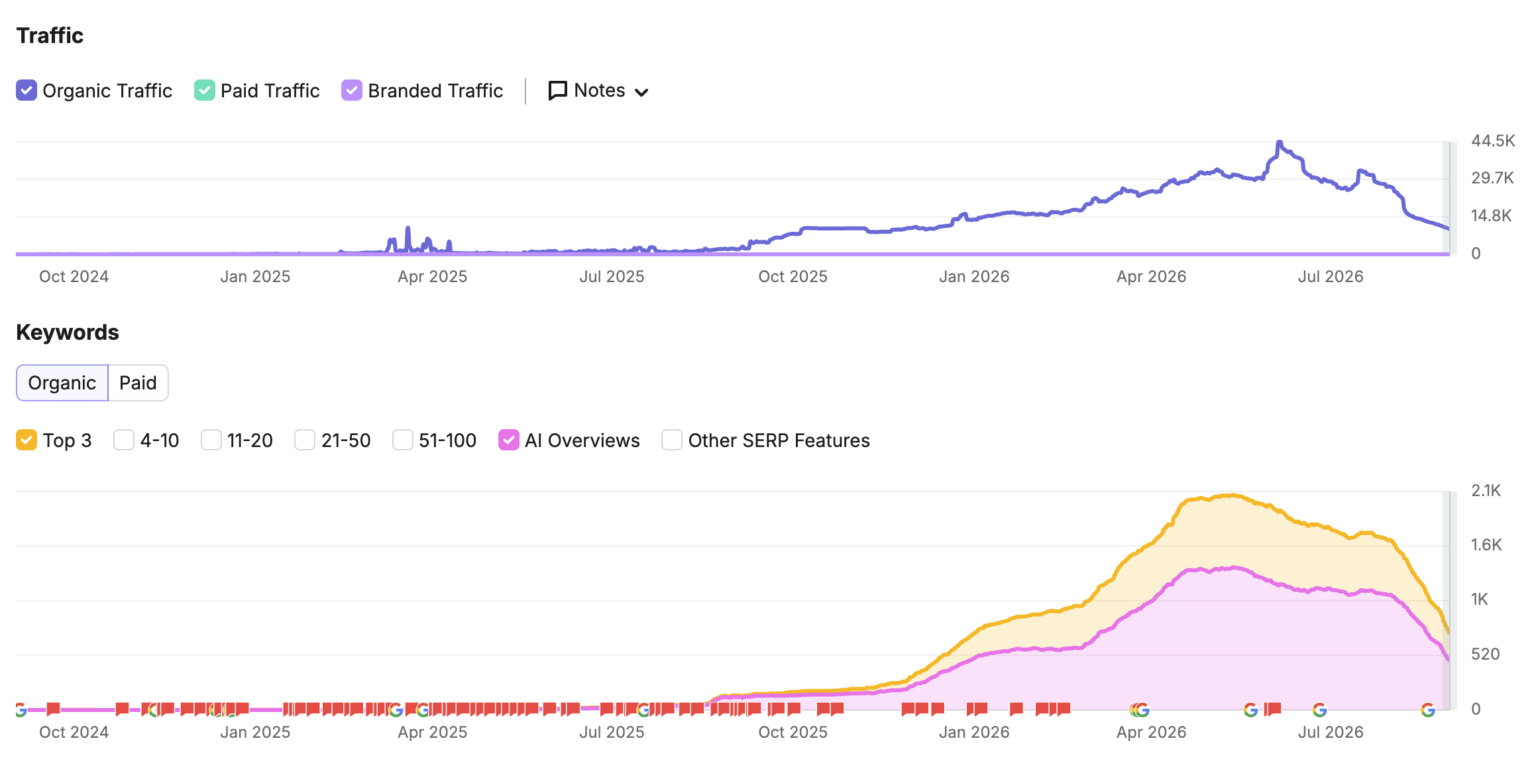
The site grew rapidly through late 2025 and peaked in mid 2026 at roughly 44,000 monthly organic visits, with around 2,000 keywords in the top 3 and a substantial footprint in AI Overviews.
Then the updates, in two movements.
Softening after the June spam update. Collapse in August. Top 3 rankings fell by more than half. Its AI Overviews citations, at the peak around 1,400 keywords with an AIO presence, fell off a cliff in the same window.
Traffic followed, down by roughly two thirds from the peak and still falling as the rollout closed.
Every part of its visibility, classic rankings, AI citations, traffic, turned together.
That synchronisation is the tell.
Pages do not all fail at once.
Site-level decisions fail at once.
This is exactly the pattern we described in our piece on site-level classifiers: when Google decides the corpus is the problem, everything built on it goes down together.
The AI Overviews wipeout is the new part
If your taking notes…
The site did not just lose blue-link rankings.
It lost its AI Overviews presence at the same time, and just as steeply.
That confirms something we have argued all year: AI visibility is downstream of organic trust.
AI Overviews cite from the pool of sources Google’s systems already consider credible.
When a spam classification hits the domain, you are not just pushed down the results page, you are pulled out of the answers.
For sites that quietly celebrated AI content earning AI citations, this update is the correction: the same shortcut that built the visibility removes it, everywhere at once.
What this update seems to be weighting
1. Volume without effort
Publishing at a pace that only automation can sustain, with minimal editing, no original data and no first-hand experience.
2. Topic sprawl
Sites covering dozens of unrelated subjects purely because the keywords were there. No expertise footprint, no reason to be the source.
3. Thin, interchangeable pages
Content that restates what the top ten already says, the exact opposite of information gain.
4. AI as the workforce, not the tool
To be clear, using AI is not the offence, Google has said as much.
Using AI as an unsupervised content factory is what this update punishes.
The caveat: not all AI content fell
Here is the nuance that makes this update more interesting than “AI content got hit” which is what many publishers will report on.
In assessing domains currently scaling content with AI, we found a clear dividing line, and it was not whether AI wrote the content.
AI-assisted content enriched with real supporting elements, genuine imagery (not AI-generated images), charts and graphs, comparison tables, icons, structured layouts, did not show the same decline.
The content that fell hardest was what we would call lift and shift:
AI output pasted into a page builder as a single block of text, published, and repeated at scale.
Same writing tool, very different outcomes.
Here is that dividing line in our tracking data, four Australian domains all scaling AI content, compared across the same mid-August window:
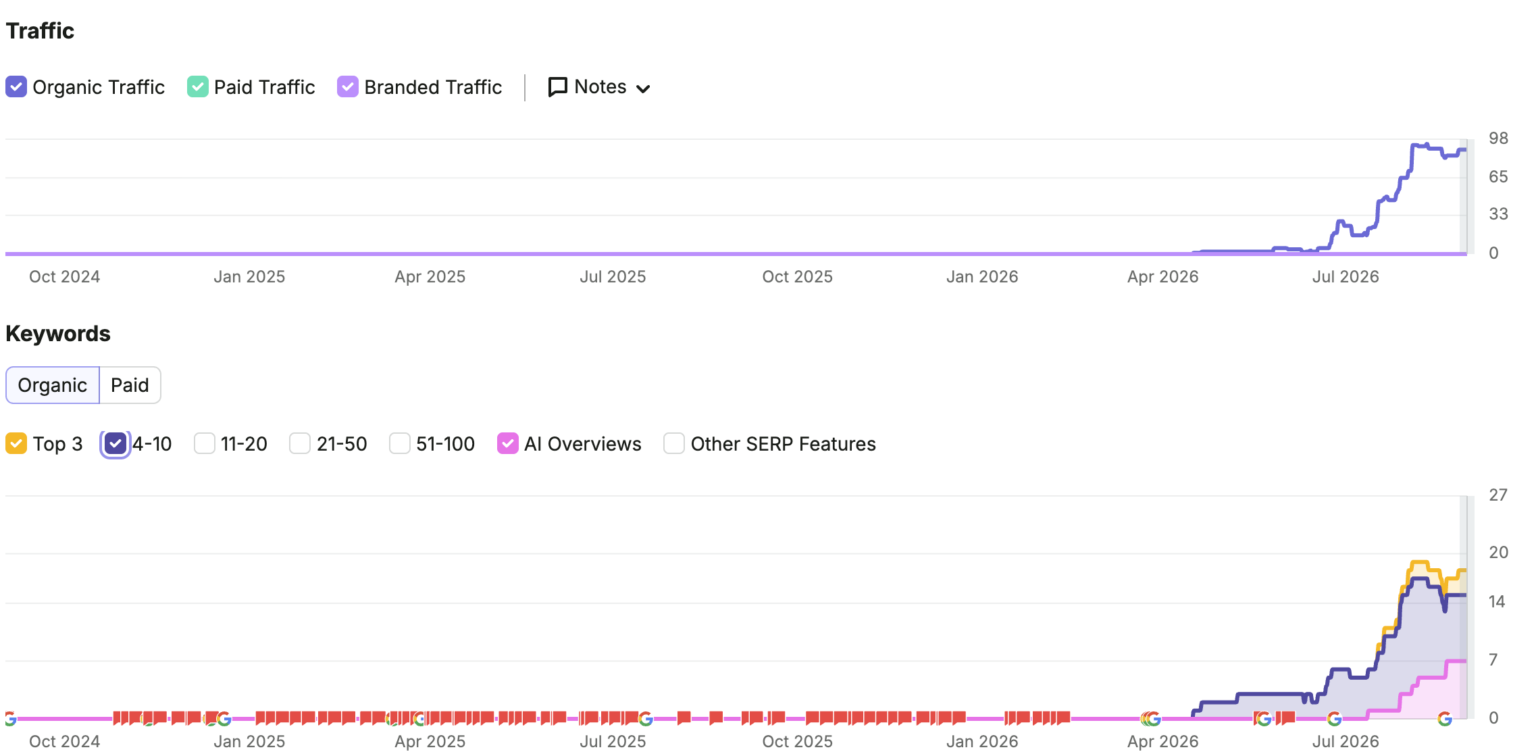
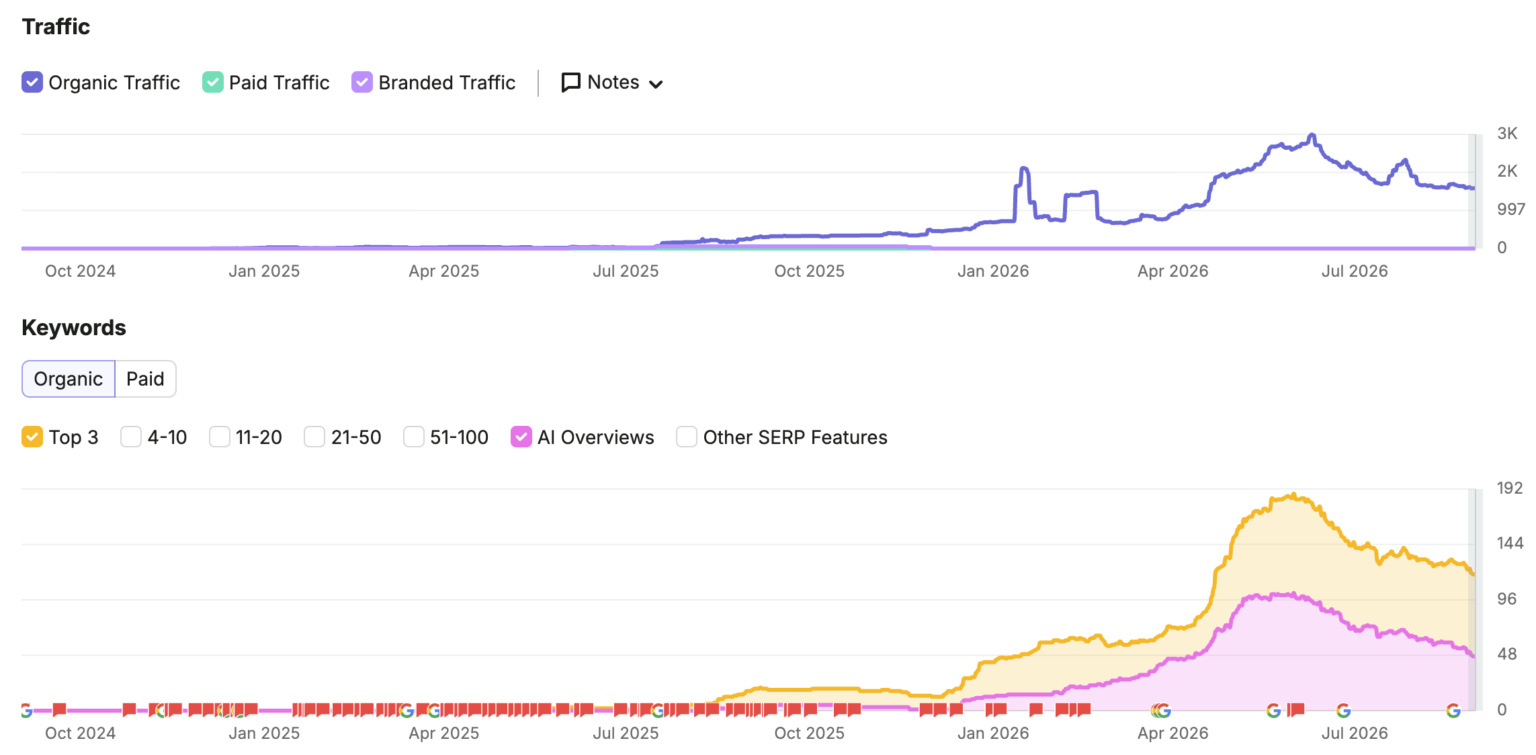
Read that table twice, because the usual explanation does not survive it.
Domain authority did not decide the outcome: the strongest domain of the four (DR 72) took the biggest hit, while a DR 17 site grew through the same window.
Every one of these sites is publishing full AI content.
The only variable that tracks the outcome is enrichment, the imagery, tables, charts and structure wrapped around the text.
Our read is that the enrichment is doing two jobs.
It adds real information the text alone does not carry, tables and charts are information gain in visual form, and it is evidence of effort, a human deciding what deserves a comparison table and building it. Both are exactly the signals a scaled-content classifier would weigh.
A wall of unbroken generated text at volume is trivially recognisable. A page where someone structured the argument, built the table and sourced the imagery reads like publishing, not extrusion.
The practical line: The risk is not using AI to write.
The risk is publishing AI output untouched.
If a page shows no evidence a human added anything, structure, data, visuals, judgement, it now carries update risk. The enrichment is not decoration, it is the difference.
What to do now
Check your sites performance and be sure to have a few weeks buffer – effects start early and can often take time to see the patterns.
Pull 16 months of Search Console data and look for the turn
If it sits anywhere from 11 to 21 August, treat this update as the likely cause. Check Manual actions too, it will be clean if this is algorithmic, and that is the point.
Audit the corpus, not the pages
What share of your site would you rebuild today with real expertise or data?
If thin, scaled content is the majority, that is your problem, and polishing individual pages will not fix it.
Prune before you publish
Remove what you would not rebuild, merge the near-duplicates, and keep only what earns its place. Recovery follows corpus change, and it is typically re-evaluated at future updates, so it is measured in months.
Keep AI in the process, take it off the byline
Use AI for research, drafts and scale where it helps, then add the things it cannot: your data, your experience, your point of view, a named author who stands behind it.
Enrich what you keep
Break up generated text with the elements our data says survived: real imagery, charts, comparison tables, structured layouts. If a page is a single unbroken block of AI text, it is the profile this update punished.
Watch your AI visibility as closely as your rankings
This update showed AIO citations get pulled with the classification. Track your citation share so you see movement early, our free AIO Audit shows where you stand in sixty seconds.
FAQ
When did the August 2026 spam update happen?
Officially, 18 to 21 August 2026, a rollout of about two days and sixteen hours. In our tracking, movement associated with the update began around a week earlier, from roughly 11 August.
Does the August 2026 spam update target AI content?
Google has not said so, and no new policies were announced. But the early pattern, in our data and industry reports, is heavily weighted toward scaled, low-effort AI content published at volume. AI use itself is not penalised; unsupervised AI publishing at scale clearly carries risk.
My traffic dropped in August. Is it this update?
Check whether the turn sits between roughly 11 and 21 August, confirm Manual actions is clean, and look at whether your pages fell together rather than individually. A synchronised, sitewide fall in that window makes this update the likely cause.
Is all AI content at risk from this update?
No, and this is the important nuance in our data. AI-assisted pages enriched with real imagery, charts, comparison tables and structured layouts did not show the same decline. The heavy losses concentrated in lift-and-shift publishing: raw AI text pasted in as a single block, at volume. The dividing line is evidence of human effort, not the writing tool.
How do I recover from the August 2026 spam update?
Change the corpus. Remove or consolidate the scaled, thin content, rebuild around original data and demonstrated expertise, and expect re-evaluation at future updates rather than an overnight bounce. Recovery is typically measured in months, and there is no one to appeal to, the site has to become better.