TL;DR
Query fan-out is the technique AI search uses to take one query and quietly expand it into many sub-queries, run them all at once, then synthesise one answer.
Google named it at I/O 2025, and it powers AI Overviews, AI Mode and the shopping experience.
It breaks the keyword model. Ranking number one for a single term isn’t enough when the AI is scoring you across a dozen related searches you never targeted.
The proof, from our own Australian study: only 53% of the pages Google’s AI cited also ranked in that query’s top 10, so almost half were surfaced by a sub-query, not the head term. Global studies agree (Ahrefs: 38% from the top 10; Surfer: +161% citation odds for pages covering multiple fan-out queries).
You can’t see the exact fan-out queries (they’re AI-generated, often zero-volume, and different every time), so stop trying to optimise for the literal strings. Optimise for the pattern.
The play is comprehensive topical coverage: answer the full set of questions around a topic on well-structured pages, build entity and trust signals on and off your site, and for ecommerce, get your product data and feed complete.
Ignore the snake oil. Google says there’s no special schema or llms.txt that gets you into fan-out. It’s helpful, people-first content. I agree with them.
Ask Google’s AI Mode to help you buy a waterproof jacket and it doesn’t search “waterproof jacket.”
It fires off a dozen searches you never typed. Best waterproof jackets, breathable versus fully waterproof, jackets for a Melbourne winter, which brands people actually rate.
Then it reads all of them and writes you one answer.
That’s query fan-out.
And it quietly breaks the way we’ve done SEO for 10 years.
I keep getting asked about it, usually in a slightly panicked tone, so here’s the plain-English version: what it is, why it matters, and what I actually do about it.
What is query fan-out?
Query fan-out is a technique AI search platforms use to take a single query and automatically expand it into multiple related sub-queries, run them simultaneously, and synthesise the results into one answer.
Google named it publicly when it launched AI Mode at I/O in May 2025, describing it as “breaking down your question into subtopics and issuing a multitude of queries simultaneously on your behalf.”
Google’s own developer documentation now confirms that both AI Overviews and AI Mode “may use a query fan-out technique, issuing multiple related searches across subtopics and data sources” to build a response, and that this surfaces “a wider and more diverse set of links” than a classic web search.
Here’s the shift in one line.
Search used to be one-to-one: one query, one set of results.
Then it went many-to-one, where “Sydney plumber” and “plumber in Sydney” returned the same thing.
Query fan-out flips it to one-to-many. One search becomes many, on your behalf, before you see a single result.
It’s the same engine underneath AI Mode, AI Overviews, the deep-research modes, and shopping. And it isn’t just a Google thing. ChatGPT, Perplexity and Claude all do their own version.
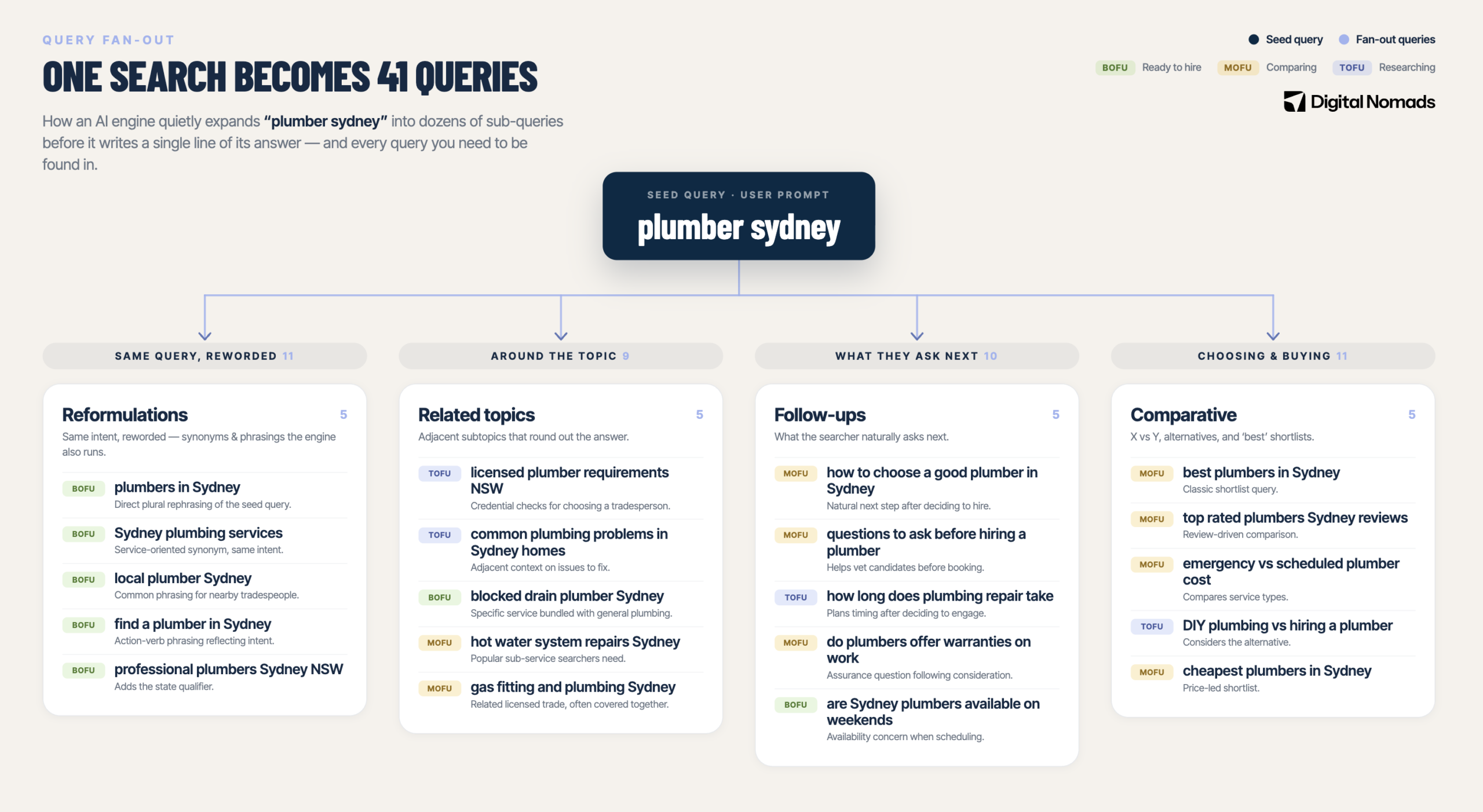
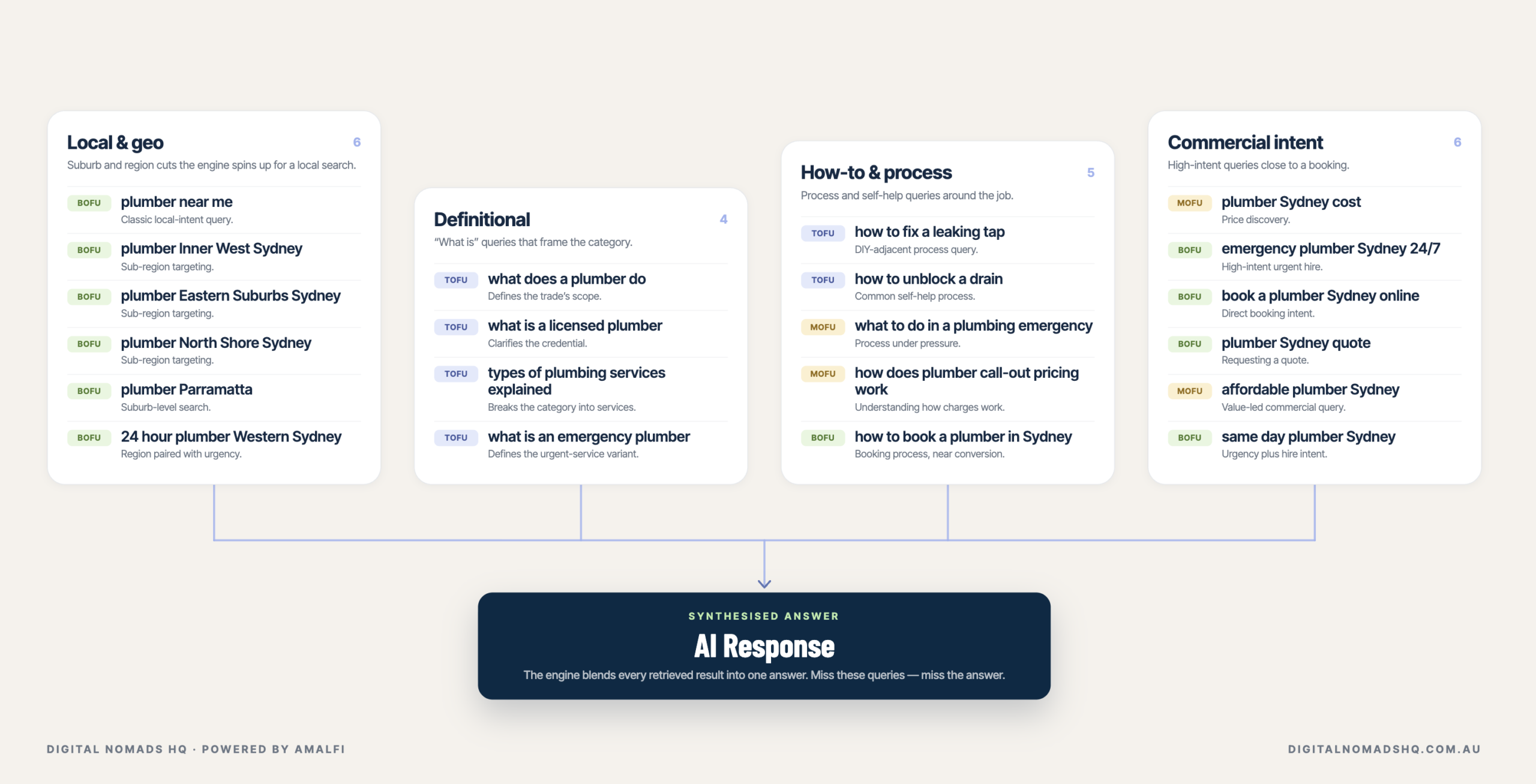
try our query fan-out tool
Why it matters (and why I'm not hand-waving)
Because it kills the comfort of “we rank number one, we’re fine.”
When the AI fans out across a dozen related queries and scores results across all of them, your single ranking for the head term is just one input. You’re now competing for relevance across an entire topic, not one keyword.
Here’s the proof, and the strongest version of it is our own.
Our State of AI Search study analysed 116,918 Australian SERPs in May 2026, and the fan-out fingerprint is sitting right there in the citations: only 53% of the pages Google’s AI cited also ranked in that query’s top 10.
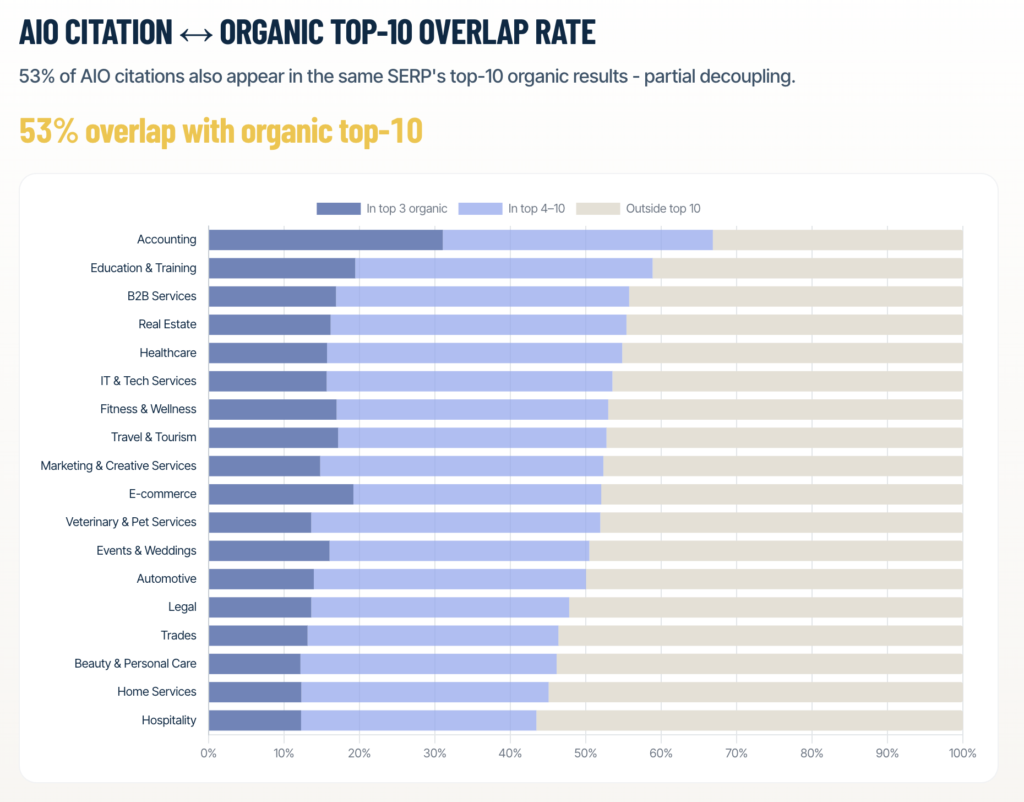
Flip that around.
Almost half the cited pages weren’t in the top 10 for the query they appeared on.
They earned the citation through a sub-query, not the head term. In service categories like hospitality and home services, more than half the citations came from outside the top 10.
That matches the global picture, which makes me more confident in it, not less.
Surfer found pages ranking for multiple fan-out queries are 161% more likely to be cited than pages ranking only for the main term, and Ahrefs found just 38% of AI Overview citations now come from the query’s top 10.
Read it together and the message is blunt: breadth across a topic now beats a single trophy ranking.
And it’s already the default here, not a future problem.
37.8% of those commercial searches returned an AI Overview, ranging from about 9% on the quietest topics to 53% on the most AI-heavy.
Query fan-out is the machinery sitting under all of it.
How it actually works
Strip away the jargon and it’s four steps.
Decompose. The AI reads your prompt and breaks it into sub-queries covering the angles it thinks you need. “How to start a business” becomes searches about business plans, legal structure, funding, registration and marketing.
Retrieve in parallel. All those sub-queries run at once across the web index, the Knowledge Graph, the Shopping Graph and other sources. Running 15 searches takes about as long as running one, which is the whole trick.
Synthesise. The AI merges the result sets, rewarding pages that show up consistently across multiple sub-queries, and scores them.
Answer and cite. It writes one response and cites the sources it leaned on most.
How many sub-queries?
Most analyses land around 9 to 11 per prompt, though it scales with how vague or complex your query is. Google’s “Deep Search” mode takes the same technique and fires dozens or hundreds of searches to write a fully cited report. The vaguer your question, the deeper it digs.
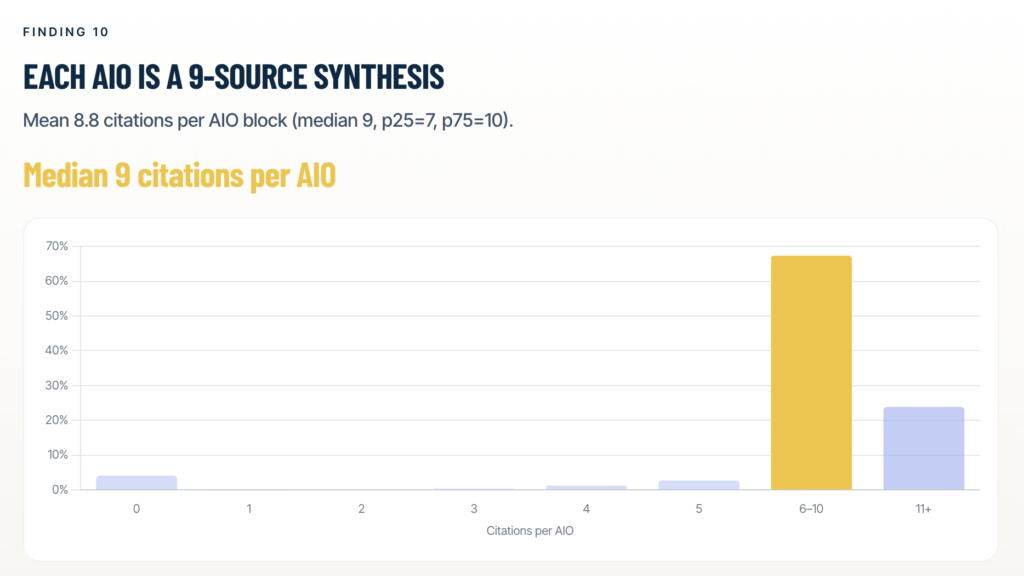
You can see the residue of this in the output. In our own Australian study we logged about 387,000 AI Overview citations, which works out to roughly nine sources cited per AI Overview.
That is fan-out made visible: one question, many searches, many sources stitched into a single answer.
It’s powered by a custom version of Gemini, and Google has been clear the AI is using Search itself as the backend tool. It’s Googling for you, many times, faster than you could.
The types of fan-out queries
This is where I’d add a caution that a lot of articles skip. Google has confirmed the technique and given a one-line definition. It has not published a list of sub-query “types.”
The neat taxonomies you see going around (including mine below) come from practitioners like Mike King at iPullRank reverse-engineering Google’s patents. Useful, but interpretation, not gospel.
With that flagged, these are the patterns that show up consistently. I’ve used Australian examples.
| Fan-out type | What it does | Example sub-queries (seed: “best running shoes”) |
|---|---|---|
| Related | Adjacent subjects for context | “running shoe brands”, “cushioned vs minimal shoes” |
| Implicit | Questions you didn’t ask but probably have | “how often to replace running shoes”, “shoes for flat feet” |
| Comparative | Side-by-side evaluations | “Asics vs Brooks”, “best shoes under $200” |
| Recency | Time-sensitive versions | “best running shoes 2026”, “new releases” |
| Reformulation | Same intent, different words | “top rated running shoes”, “what shoes do runners recommend” |
| Contextual | Personalised by location or history | “running shoes Australia”, “stores near me” |
| Next-step | What you do after | “how to break in new shoes”, “running shoe return policy” |
The uncomfortable truth:
you can't see them, and you shouldn't chase them
Here’s what trips people up.
They get a list of fan-out queries from a tool and treat it like a keyword list to stuff into a page. Don’t.
Fan-out queries are synthetic, generated by the AI on the fly. They’re probabilistic, so the same prompt produces different sub-queries on different runs.
They’re context-rich, padded with modifiers a human would never type. And around 95% of them have no recurring search volume at all, according to Seer Interactive’s analysis. You will never “rank” for most of them in the old sense.
And here’s the part the GEO-tool salespeople won’t tell you.
Google’s own documentation says there are no special requirements and no special optimisations to appear in these AI features.
You do not need llms.txt.
You do not need magic schema.
You need indexable, genuinely helpful content. I agree with them, and I’d be sceptical of anyone selling you a shortcut.
So you don’t optimise for the strings. You optimise for the pattern.
How I'd optimise for query fan-out
The mindset shift is from “rank for the keyword” to “comprehensively cover the topic and the context behind it.” Here’s how I’d actually do it.
Cover the whole question, not just the headline.
On any important page, answer the related, implicit and next-step questions a buyer has, not just the one in the title.
Use clear question-style subheadings, comparison tables, and short self-contained passages that make sense even when the AI lifts one out of context. This is topical authority done properly, and it’s the single biggest lever.
Mine the real questions.
People Also Ask, related searches, the “ask a follow-up” in AI Mode itself, AlsoAsked, and your own reviews and category subreddits will surface the implicit questions faster than guessing.
Pull them, then make sure your content answers them. Our keyword research process still applies, you’re just casting wider.
Build entities, not just pages.
The AI is matching things and concepts, so be consistent about who you are, what you sell and what you’re known for, on your site and off it. Structured data helps the machine understand you (more in our schema guide), even though it isn’t a magic fan-out switch.
Go off-site, because fan-out reaches there too.
A big share of sub-queries chase validation: reviews, comparisons, “best of” lists, forums and YouTube. Ahrefs found YouTube is the single most-cited source in AI Overviews.
You can’t on-page your way into those, so third-party presence, reviews and creator coverage are part of the job now. This is where GEO meets old-fashioned PR, and where our AI SEO work lives.
For ecommerce, feed the machine. Shopping fan-out runs against Google’s Shopping Graph, so complete, accurate product data is your version of topical coverage: full attributes, specs, GTINs, and a clean Merchant Center feed (Google has even added natural-language “conversational attributes” for AI matching).
I went deep on this in our product page SEO guide, and it ties straight to ecommerce SEO.
If you want the broader AI-search playbook, our guide on how to rank in AI Overviews covers the rest.
How to find and predict fan-out queries
You can’t pull the real fan-out queries from Google. But you can predict the shape of them.
Start with People Also Ask, related searches and the follow-up suggestions inside AI Mode.
That’s the closest free signal.
Use a simulator or query fan out tool
– This generates likely fan-out queries for a topic and classifies them by type.
Brand Radar, Semrush and others now surface fan-out style queries too.
Sanity-check with a normal keyword tool. Most fan-out queries have no volume, so this quickly tells you which handful are worth a dedicated page versus which are just sections to add.
Treat the output as patterns to cover, not a checklist to match word for word.
The measurement problem (this is the annoying bit)
Rank tracking alone won’t show you any of this. Google folds AI Overview and AI Mode impressions into the single “Web” type in Search Console with no separate breakout, so you literally cannot isolate fan-out performance there.
So the metrics shift.
Alongside rankings and traffic, you start tracking AI share of voice and citations: how often your brand and pages get referenced across AI Overviews, AI Mode, ChatGPT and Perplexity, at a topic level rather than a single-keyword level.
Tools like Ahrefs Brand Radar, Profound and Otterly exist for exactly this. It’s a new layer on top of traditional measurement, not a replacement.
The mental model I use: stop asking “where do I rank for this keyword” and start asking “am I showing up everywhere this topic gets discussed.”
Where I'd start
Don’t boil the ocean. Pick one high-value topic.
Map its fan-out patterns from People Also Ask and a simulator, audit what you already cover, and fill the obvious gaps, on-page and off. Then watch your citations, not just your rankings.
Here’s where I land. Query fan-out sounds like a threat, and for thin, single-keyword pages it is.
But it rewards exactly what good SEO has always rewarded: genuinely covering a topic better than anyone else, for real people, with the trust signals to back it up. The keyword era is ending. The topic era is here. Build for that.
Frequently asked questions
Is query fan-out just keyword research or topic clusters with a new name?
No, and treating it that way will burn your time.
Fan-out queries are AI-generated, change between runs, are padded with context a human would never type, and around 95% have no search volume. Don’t write pages targeting the exact strings. Use them to spot the patterns of questions to cover, then build genuinely comprehensive content.
How many searches does one query fan out into?
Most analyses put it around 9 to 11 sub-queries per prompt, scaling up with how vague or complex the question is. Google’s Deep Search mode can fire dozens or hundreds for a single research-style query.
Can I see the actual fan-out queries for my topic?
Not from Google. You can predict the shape of them using People Also Ask, related searches, AI Mode’s follow-ups, and simulators like Qforia, then validate the few with real volume in a keyword tool.
Do I need special schema or an llms.txt file to optimise for fan-out?
No. Google’s documentation explicitly says there are no special requirements or optimisations for its AI features beyond standard, helpful, indexable content and accurate structured data. Be wary of anyone selling a “GEO-specific” technical fix as the secret.
Does query fan-out apply to ChatGPT and Perplexity, or just Google?
All of them. Query fan-out (or a close equivalent) is how every major AI search platform builds answers, which is exactly why broad topical coverage now pays off across multiple engines at once.
How do I measure whether my fan-out optimisation is working?
Not with rank tracking alone. Google folds AI traffic into the “Web” type in Search Console, so track AI citations and share of voice at a topic level using a tool like Ahrefs Brand Radar, Profound or Otterly, alongside your usual rankings and conversions.