Here’s a scenario that’s happening right now, probably to your business.
A potential customer opens ChatGPT (or Perplexity, or Google’s AI Mode) and types something like “What’s the best digital marketing agency on the Sunshine Coast?” The AI spits out an answer… and your brand is nowhere in it.
No link. No mention. Nothing.
That’s the problem Generative Engine Optimisation (GEO) – also called Generative Engine Optimisation and Engine Optimisation GEO – is designed to solve.
GEO is the practice of optimising your content and optimizing content structure so AI driven platforms like ChatGPT, Google AI Overviews, Perplexity, and Gemini can find it, understand it, and cite your brand when they generate answers to user queries.
If traditional SEO is about getting your site to rank on page one of Google… GEO is about getting your brand into the AI’s answer itself.
And yeah, that’s a very different game.
Why Does GEO Matter Right Now? (And why this Optimization shift affects your marketing)
Let’s talk numbers, because this isn’t a theoretical shift… it’s already happening.
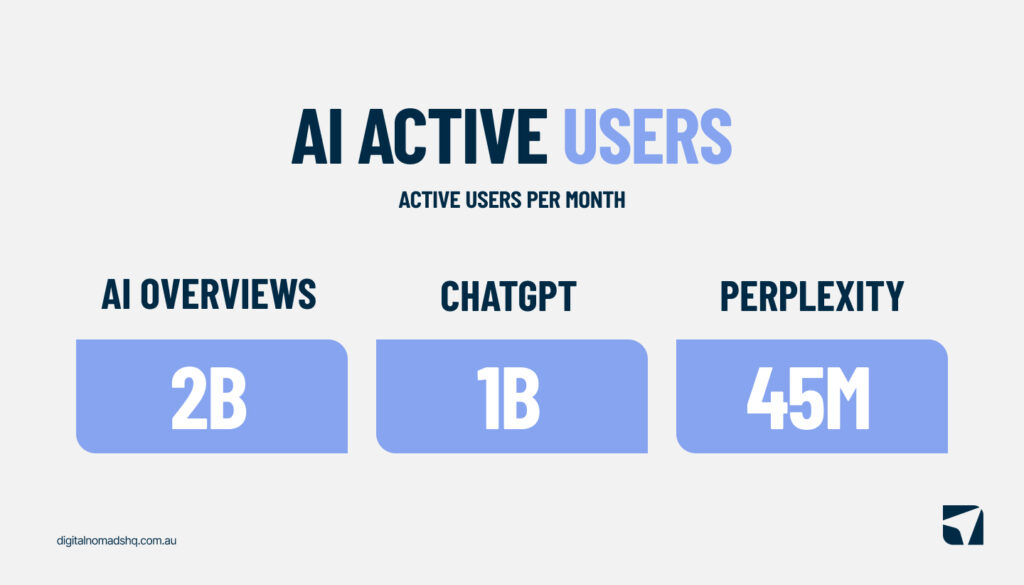
Google AI Overviews has over 2 billion monthly active users (as of July 2025).
ChatGPT has an estimated 1 billion monthly active users (as of early 2026).
Perplexity has approximately 45 million monthly active users (as of early 2026).
These platforms aren’t “up and coming.” They’re here, and they’re reshaping how people find information.
Here’s the kicker.
Research shows that roughly 93% of AI search sessions end without a single website click, even when search engines surface relevant sources.
When an AI Overview appears in Google, the top-ranking page sees its click-through rate drop by about 58%.
So what does that mean for your business?
Put simply: if you’re not part of the AI’s answer, you’re not part of the conversation. Rankings alone aren’t enough anymore.
PRO TIP: Don’t panic about this. GEO doesn’t replace your SEO strategy or your existing optimisation work… it extends it. Think of it as adding a new channel to your visibility mix, not burning the old one down—and a way to improve performance in AI driven search.
GEO vs SEO... What’s Actually Different?
This is where a lot of businesses (and frankly, a lot of marketers) get confused, because the optimisation targets look similar but the outcomes are different.
So let’s break it down clearly.
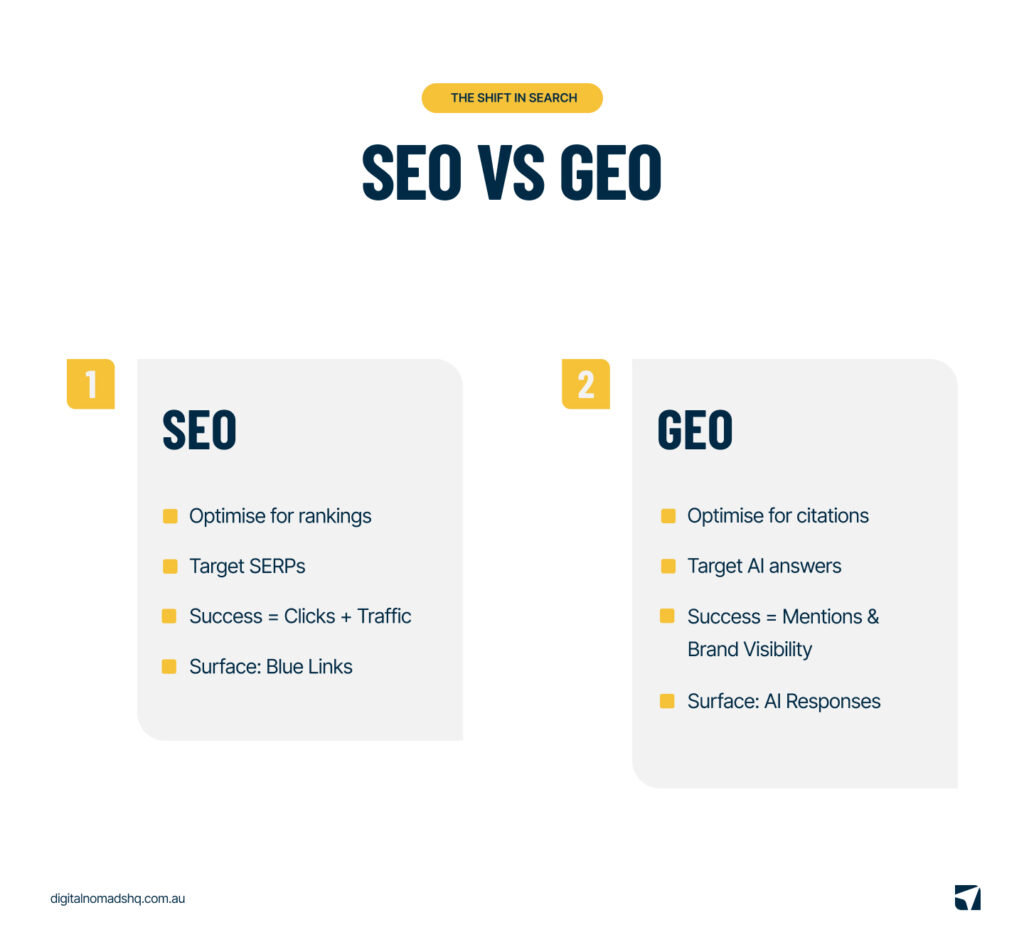
SEO (Search Engine Optimisation) focuses on getting your website to rank highly in traditional search results across search engines.
You’re optimising for clicks, position, and measurable performance.
Your content appears as a blue link, the user clicks through, and they land on your site.
GEO (Generative Engine Optimisation) – also referred to as Generative Engine Optimisation and Engine Optimisation GEO – focuses on getting your brand cited, mentioned, or recommended inside AI generated answers.
You’re optimising for mentions, citations, and reference signals that improve visibility and performance.
The user might never click a link… but they see your brand name in the answer.
The Goal is Different
With SEO, the goal is: “Get my page to the top position of the search results.”
With GEO, the goal is: “Get my brand into the AI’s response.”
Same intent. Completely different surface.
But They’re Not Competing
Here’s the thing most people miss. GEO and SEO are complementary, not competing strategies.
The fundamentals of good SEO… quality content, strong site structure, topical authority, E-E-A-T signals, and technical optimisation… are exactly what AI models and search engines look for when deciding which sources to cite.
You don’t need to choose one or the other. You need both.
The brands winning in AI driven search right now? They were already doing solid SEO. GEO just gives them an extra edge.
In other words,
Generative Engine Optimisation is about earning a strong position in AI generated answers, while traditional SEO is about earning a strong position in classic search results.
How Do AI Search Engines Actually Work?
Understanding GEO starts with understanding how these AI platforms generate their answers. It’s not magic… it’s a process.
Step 1: Retrieval
When a user asks a question, the AI searches its knowledge base (which includes indexed web pages, training data, and sometimes live web results) for content that’s semantically relevant to the query, then it scores candidates for usefulness. This isn’t just keyword matching. It’s concept matching. Content about “generative engine optimisation” might surface even if the user typed “how to get mentioned by AI.”
Step 2: Ranking and Scoring
Retrieved content gets scored based on relevance, authority, recency, and structural quality—an Optimization layer that rewards clarity. The highest-scoring content becomes the source material for the AI’s response.
This is where GEO, Generative Engine Optimization, and Engine Optimization GEO make their impact. Content that’s well-structured, clearly written, factually accurate, and backed by credible signals scores higher in this process and improves downstream performance.
Step 3: Generation and Citation
The AI reads the selected sources and synthesises a response. It doesn’t copy your text word-for-word… it understands the concepts and rewrites them. Then it attributes information back to specific sources via inline citations or footnotes.
The takeaway? If your content is easy for AI systems to discover, understand, and extract… you get cited, which improves visibility and performance. If it’s buried in jargon, thin on substance, or structurally messy… you don’t – and your position in AI generated answers suffers.
EXPERT TIP: AI systems are effectively doing what a diligent researcher would do… scanning multiple sources, evaluating credibility, and synthesising the best answer based on real evidence. Write your content as if you’re the source that researcher keeps coming back to. If you want a simple reference point: strong Generative Engine Optimization usually comes from optimizing content that is easy to retrieve, easy to verify, and easy to cite.
Practical GEO Strategies That Actually Work
Right, enough theory. How do you actually do GEO? Here are the strategies we’re implementing for clients at DNHQ right now to improve Generative Engine Optimization performance.
1. Write Content That Answers Questions Directly
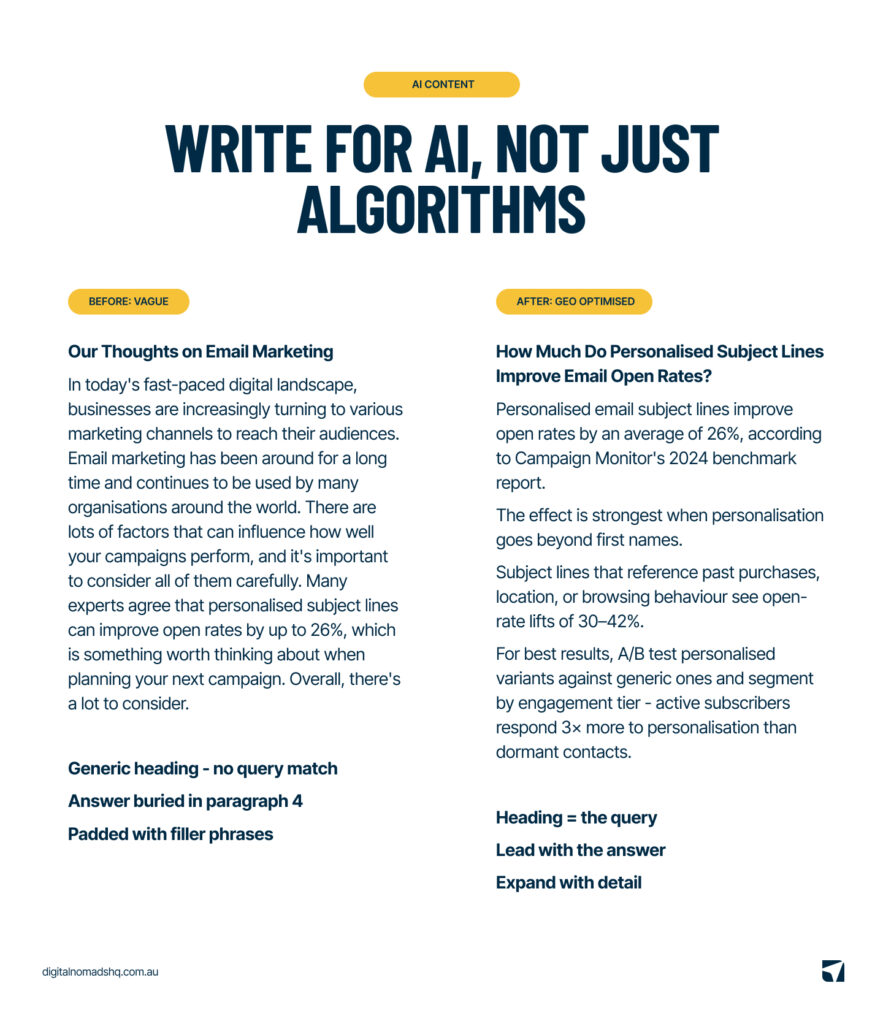
AI platforms love content that provides clear, direct answers to specific questions, because it improves clarity for both users and models. Think about how people ask AI tools for help… they ask questions in natural language.
Structure your content around the questions your audience is actually asking. Use headings as questions. Lead each section with a concise answer, then expand with detail so the AI can extract the relevant text quickly.
Sound familiar? That’s good SEO practice too. GEO just rewards it even more heavily. This is also where Engine Optimization GEO overlaps with on-page Optimization: you improve clarity, you improve structure, and you improve the chance your answer is pulled into AI generated answers.
2. Include Statistics, Data, and Cited Sources (Reference-Ready Content)
Research shows that content with statistics, citations, and quotations achieves 30–40% higher visibility in AI-generated responses.
Makes sense, right?
AI models are trained to value evidence-backed content, and this Optimisation step helps them choose what’s real.
If you’re making a claim, back it up with a number, a source, or a worked example. Don’t just say “PPC can be expensive in Sydney.” Say “Average CPCs for legal keywords in Sydney sit around $15–25… compared to $6–12 on the Sunshine Coast.”
Specificity builds credibility with both AI models and human readers. Where possible, provide a plain-language reference to the original dataset or report, so AI systems and readers can verify what’s real.
3. Build Topical Authority Across Your Site (Site-Wide Optimisation)
AI models don’t just evaluate a single page.
They assess your entire site and website footprint to determine whether you’re a credible source on a topic.
That means having a cluster of interlinked content around your core topics matters more than ever.
A standalone blog post about GEO is useful. But a blog post about GEO that links to your glossary, your SEO service page, your AI content guide, and your case studies?
That tells the AI you’re a genuine authority.
PRO TIP: Domain authority is still the number one predictor of AI citations, and it supports both SEO and Generative Engine Optimization. Sites with higher traffic and stronger backlink profiles earn roughly 3x more AI citations than smaller sites.
Don’t neglect your traditional link building while chasing GEO. If you want consistent success, combine authority-building with technical Optimization (crawlability, internal linking, and schema) so search engines and AI systems can interpret your site without friction.
4. Optimise for Entity Clarity (Brand, Business, and Service Signals)
AI systems need to understand who you are as a business.
That means your brand name, location, services, and expertise should be clearly and consistently represented across your website, Google Business Profile, social profiles, and third-party mentions to improve entity understanding.
Structured data (like Organisation schema, Person schema, and FAQPage schema) helps AI models and search engines connect the dots, which is a technical Optimisation win. If Google’s Knowledge Graph understands your brand as an entity, AI systems built on that data will too.
Brand Signals Map
5. Keep Content Fresh and Updated (Ongoing Optimisation)

Pages updated within the last 60 days are nearly twice as likely to appear in AI-generated answers compared to older content. AI models prioritise recency because they’re trying to give users the most current information.
Audit your key pages quarterly.
Update statistics.
Refresh examples.
Add new sections where the topic has evolved.
This isn’t just good content hygiene… This isn’t just good content hygiene… it’s a direct GEO ranking signal and a lever you can pull to improve performance.
6. Structure Content for Easy Extraction (Technical Optimisation and Page Features)
AI models are essentially scanning your page and pulling out the most useful chunks. Make that easy for them.
Use clear heading hierarchies (H1, H2, H3).
Write in short, definitive paragraphs. Lead sections with the key point, then elaborate.
Use schema markup – these technical features help search engines interpret your site.
Include FAQ sections with concise answers.
If a human skimmer can quickly find what they need on your page, chances are an AI model can too. These structural features support Generative Engine Optimisation because they reduce ambiguity and improve extraction quality for search engines and AI tools.
How Do You Measure GEO Performance (And Prove Success)?
This is where things get interesting… and honestly, a bit tricky.
Traditional SEO gives you nice, clean metrics. Rankings. Traffic. Click-through rates. Conversions. Easy to track in Google Search Console.
GEO metrics are different, but you can still measure performance and define success. Here’s what to look for (and what to record for insights):
Brand mentions in AI responses – How often does your brand appear when relevant queries are run through ChatGPT, Perplexity, or Google AI Mode?
AI referral traffic – Tools like Google Analytics 4 can now track traffic coming from AI platforms. This traffic is growing fast and, interestingly, converts at around 14.2% compared to Google’s 2.8%.
Citation frequency – When AI platforms cite sources, is your content among them, and is it used as a reference? Tools like Semrush’s Enterprise AIO, Otterly, and Peec AI are building tracking capabilities for exactly this.
Brand search volume – AI exposure often drives people to search for your brand directly. A lift in branded search queries can be an indirect but powerful signal that GEO is working and improving marketing performance.
EXPERT TIP: AI visibility isn’t “set and forget.” Research shows a brand can lose a third of its AI visibility in just five weeks. Weekly monitoring is the new baseline if you’re serious about this channel. To turn tracking into insights, log which prompts you tested, which platform you used, your resulting position (mentioned, cited, or absent), and what page was used as the reference.
Where is GEO Heading (and what’s next for Optimisation)?
The GEO market was valued at approximately $848 million in 2025 and is projected to hit $33.7 billion by 2034. That’s a compound annual growth rate of over 50%. This isn’t a fad… it’s a structural shift in how search works.
A few trends we’re watching closely:
AI Overviews are expanding into commercial queries. They started with informational queries, but commercial-intent triggers grew from 8% to 18% by late 2025.
That means product and service searches are increasingly getting AI-generated answers too.
Multi-platform optimisation is essential, and it’s a core Generative Engine Optimisation requirement.
ChatGPT, Perplexity, Google AI Mode, Gemini, and Claude all surface content differently.
A strategy that works on one platform may fall flat on another.
You need to think across the entire AI search ecosystem.
This multi-platform reality is why Generative Engine Optimisation and Engine Optimisation GEO are becoming core parts of modern marketing, not side projects.
AI referral traffic is exploding, and it’s increasingly AI powered.
AI platforms generated over 1.13 billion referral visits in June 2025 alone… a 357% increase from the year before… and that traffic converts at roughly 5x the rate of traditional search.
The businesses that start building their GEO strategy now will have a significant head start and a clearer path to success. The ones that wait? They’ll be playing catch-up in an increasingly competitive space. The future belongs to brands that treat Generative Engine Optimisation as ongoing Optimisation work: test, learn, and refine based on real performance.
Your GEO Quick-Start Checklist (Practical Optimisation Steps)
Want to get moving on GEO for your business? Start here.
✓ Audit your key pages for clear, direct answers to common questions in your industry, and improve clarity where it’s missing
✓ Add statistics, data points, and cited sources to your most important content
✓ Implement structured data (Organisation schema, FAQ schema, Article schema) across your site
✓ Build topical authority with interlinked content clusters around your core services
✓ Update your highest-value pages at least quarterly with fresh data and examples
✓ Monitor AI referral traffic in GA4, measure performance, and track brand mentions across ChatGPT, Perplexity, and Google AI Mode for ongoing insights
✓ Ensure your Google Business Profile and brand mentions are consistent across the web so search engines can trust the signals
✓ Don’t abandon your SEO fundamentals… they’re the foundation GEO is built on
Final Thoughts
If you’re still asking “what is geo,” the simplest answer is: Generative Engine Optimisation is optimising content so search engines and AI systems can reliably surface, summarise, and cite your brand in AI generated answers. GEO isn’t some distant, theoretical concept… it’s Generative Engine Optimisation in practice. It’s the evolution of search that’s happening right now.
The good news? If you’ve been investing in quality SEO… strong content, solid site structure, genuine expertise… you’re already halfway there. GEO builds on those foundations with additional Optimization for AI driven search engines.
The question isn’t whether you need a GEO strategy. It’s how quickly you can get one in place before your competitors do.
Need help getting your brand visible in AI search with AI powered support? That’s exactly what we do at Digital Nomads HQ. We’re already implementing GEO strategies alongside our SEO campaigns for clients across Australia to improve performance.
Let’s chat about where your business sits. Get in touch.
Frequently Asked Questions About GEO
What is Generative Engine Optimisation (and Generative Engine Optimisation) and why is it important?
Generative Engine Optimisation (GEO) — also called Generative Engine Optimization and Engine Optimization GEO — is the practice of optimising your content so AI platforms like ChatGPT, Google AI Overviews, Perplexity, and Gemini can discover, understand, and cite it when generating answers. It’s important because AI search is rapidly becoming a primary way people find information. If your brand isn’t appearing in AI-generated answers, you’re missing a growing share of potential customers.
How does GEO differ from traditional SEO and other optimisation approaches?
Traditional SEO focuses on ranking your website in search engine results pages (SERPs) to earn clicks. GEO focuses on getting your brand mentioned and cited within AI-generated responses. SEO optimises for rankings and traffic. GEO optimises for mentions, citations, and brand visibility inside the AI’s answer, improving both position and performance. Both strategies share common foundations like quality content and site authority, but the end goal and surface are different.
What are the best strategies for implementing GEO (Generative Engine Optimisation)?
Start by writing content that directly answers common questions in your industry. Include data, statistics, and cited sources. Build topical authority with interlinked content clusters. Use structured data markup. Keep content fresh and updated. And ensure your brand identity is clear and consistent across the web. These strategies improve your chances of being cited when AI tools generate responses, and they support long-term success.
How can businesses measure the effectiveness and performance of their GEO strategies?
Track AI referral traffic in Google Analytics 4, monitor brand mentions in AI platforms using tools like Semrush Enterprise AIO or Otterly, measure branded search volume trends, and check citation frequency across ChatGPT, Perplexity, and Google AI Mode. AI visibility requires ongoing monitoring… a brand can lose significant AI presence in just a few weeks if content goes stale.
Does GEO replace SEO?
No. GEO complements SEO. The core principles of good SEO (quality content, technical excellence, topical authority, E-E-A-T signals) are exactly what AI models and search engines look for when deciding which sources to cite, and this is where Optimization carries over. You need both strategies working together for maximum visibility across traditional search and AI-driven search. Done well, Generative Engine Optimization improves visibility AI outcomes by increasing the likelihood you’re selected as a reference in AI driven search experiences.
What future trends should marketers anticipate with AI in search and Generative Engine Optimisation?
Expect AI Overviews to increasingly appear for commercial and transactional queries, not just informational ones. Multi-platform AI optimisation will become essential as ChatGPT, Perplexity, Google AI Mode, and Gemini all surface content differently… so your Optimisation needs to account for different features and ranking behaviors. AI referral traffic will continue to grow rapidly and convert at significantly higher rates than traditional search traffic. Businesses that invest in GEO now will have a substantial competitive advantage.