Google is pushing AI Max for Search harder than anything since Performance Max.
If you run Google Ads, you have seen the prompts: switch on AI Max, get more conversions, one click. From September 2026, some of it stops being optional.
Here is the honest version, from actually running it.
AI Max is not a new strategy.
It is reach extension for broad match, dressed up as an upgrade, and the early results, ours included, are underwhelming.
But there is a twist…
Google is folding Dynamic Search Ads into AI Max, so for a lot of accounts the question is no longer whether you use it, only when and how it is configured.
This is what it actually is, why Google wants you on it, who it genuinely helps, and how to run it for our Google Ads clients without losing control.
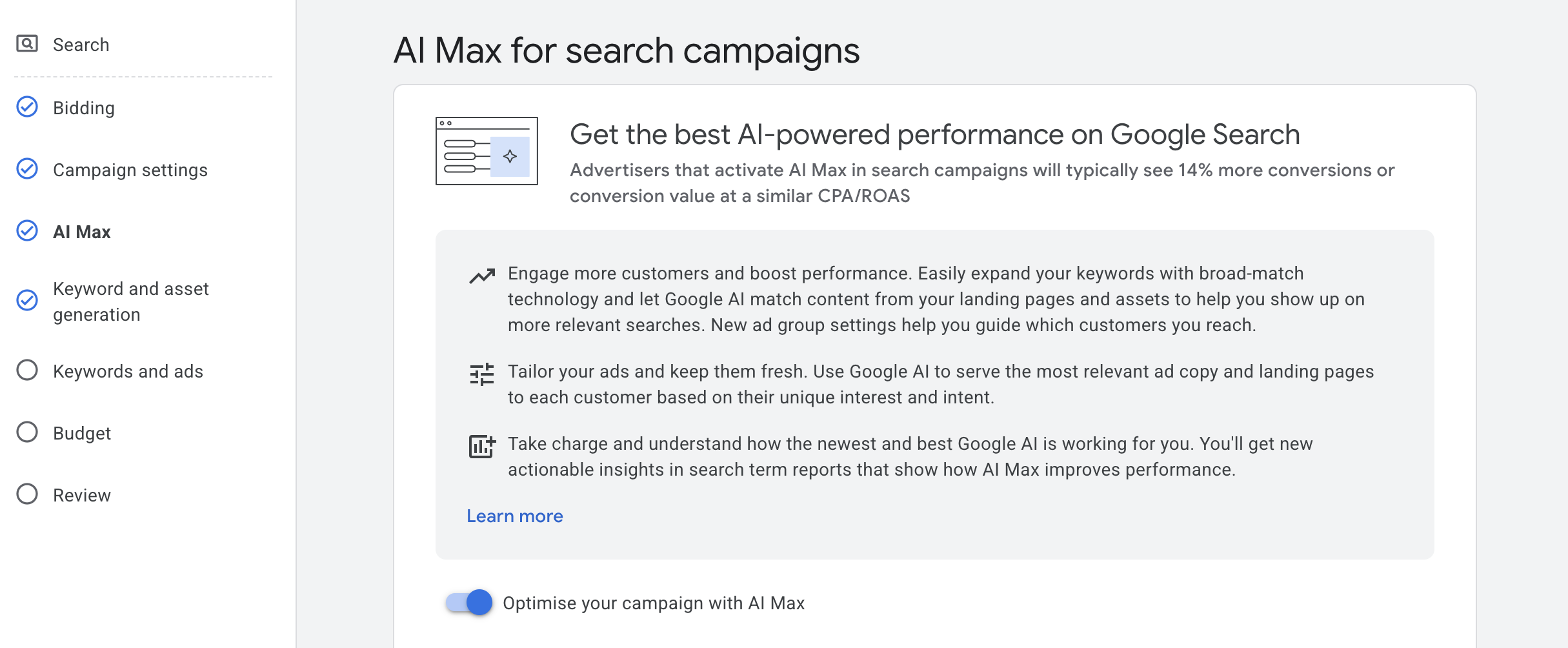
What AI Max for Search actually is
AI Max for Search is a bundle of three automation features you switch on inside a normal Search campaign:
- Search-term matching. Finds queries beyond your keywords, using broad match expansion and keywordless matching. This is the engine of the whole thing.
- Text customisation. Google generates and rewrites your headlines and descriptions to suit each query.
- Final URL expansion. Sends the click to whichever page on your site Google decides fits best, not just the landing page you chose
Turn the suite on and Google also folds in what used to be separate:
Dynamic Search Ads, automatically created assets, and campaign-level broad match.
From September 2026 DSA campaigns still running those legacy features are being auto-upgraded to AI Max, with your existing URL controls preserved.
14%  27%
27%
Google’s claim is up to 14% more conversions at a similar cost per acquisition, rising to 27% for accounts still leaning on exact and phrase match.
Worth knowing, with two caveats: the 14% figure excludes retail, and these are Google’s numbers, not independent ones.
Strip away the branding and it is broad match, extended
Here is the part the launch material skates over.
The core of AI Max, search-term matching, is an expansion mechanism. It is broad match plus keywordless matching, reaching searches your keywords would never have caught.
That 27% figure is the giveaway… the upside is biggest for exact and phrase-match accounts precisely because AI Max opens up query volume they were not previously bidding on.
So the right mental model is not “AI Max, the smarter campaign.” It is “broad match, pushed further.”
That is genuinely additive for a disciplined account with untapped query volume, and a fast way to waste money on everything else.
Why we believe Google is pushing it so hard
Be honest about the incentive.
Automated systems like AI Max improve with usage.
The more advertisers switch it on, the more data Google has to refine the matching, the bidding and the copy.
Adoption is the roadmap.
You can see it in how the controls are being released.
Brand inclusions and exclusions, the settings that stop your ads showing on the wrong branded queries, are now locked behind AI Max. If you want that brand safety, you have to opt in.
That is not a coincidence, it is a nudge.
None of it is sinister, it is how platforms grow features, but it means the default “turn it on” prompt is built for Google’s benefit first and your account second.
Why it matters regardless
This is the part that overrides the “is it any good” debate.
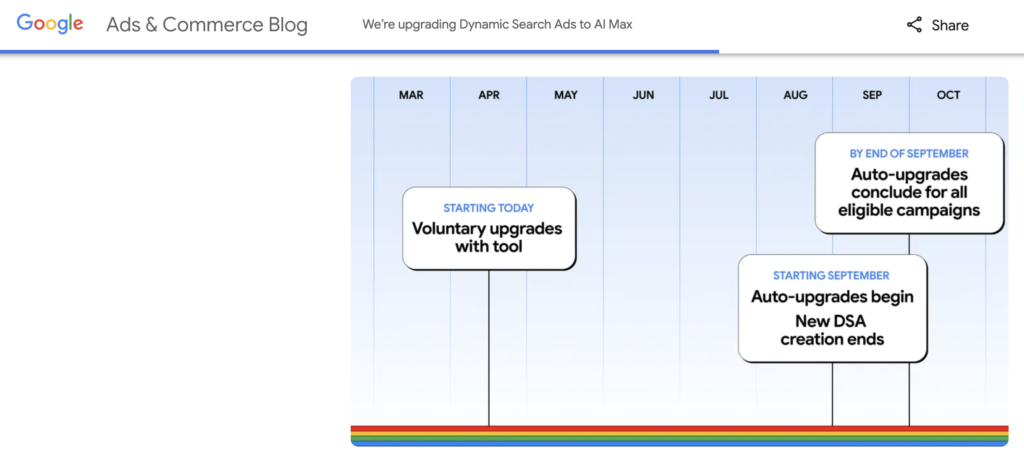
Google has confirmed Dynamic Search Ads is being deprecated and folded into AI Max, and from September 2026 campaigns using DSA, automatically created assets and campaign-level broad match are being auto-upgraded automatically.
For a large share of accounts, AI Max is not a decision you get to avoid. It is arriving on a schedule, and the only real choices are timing and configuration.
The worst outcome is letting it switch on by default, unconfigured, and finding out later.
What we are seeing in real accounts
We manage Google Ads for more than 250 businesses, with 98% client retention, across $10m+ in managed ad spend.
We have started moving and testing accounts onto AI Max ourselves.
So far, the results are underwhelming…
Outside a specific account profile, the expansion pulls in looser, lower-intent traffic that needs heavy negative-keyword work, and the conversion lift does not reliably show up.
It will probably improve as the system gathers data, which is the whole reason for the push.
But “it will likely get better later” is not a reason to hand over your budget now.
Who it actually helps, and who it burns
The profile that benefits is consistent, and in our experience it is worth testing when:
- Your campaigns are exact and phrase-match heavy with untapped query volume. This is the profile behind the 27% claim, because there is genuinely new high-intent search to find.
- You have 100+ conversions a month, so the system has enough signal to learn from.
- You have a real budget, around 15x your target CPA per day, roughly $750/day, not Google’s $50 floor, which produces a technically enabled but practically hobbled campaign.
- You have a team that will actually audit the search-term report, because that is where this is won or lost.
It is likely to inflate cost when:
- You run retail or ecommerce at scale (Google’s 14% benchmark explicitly excludes retail).
- You do lead generation without offline or CRM conversion tracking. Without that data feeding back, AI Max optimises for form volume, not lead quality, so cost per lead can improve on paper while cost per qualified lead gets worse.
- You are on a low budget, below that 15x-CPA threshold.
- Your account is already saturated with broad match, DSA and Performance Max, so there is little new ground for AI Max to find.
How to run it without losing control
If you do test it, or you get auto-upgraded, these are the guardrails:
- Run it as a 50/50 Experiment, not a wholesale switch. Google’s own Experiments feature lets you measure AI Max against your existing setup instead of trusting a blended number.
- Start with search-term matching only. Turn the three features on one at a time so you can isolate what is actually driving any change.
- Exclude Search Partners from day one. In our accounts, Search Partner traffic converts far worse than Google Search, so cut it before it drains the test.
- Build your negative keywords before launch, not after. With expansion turned on, the negatives are the brakes, and you want them on first.
- Set brand inclusions and exclusions, and lock your copy. Use the brand controls so you are not expanding onto off-brand queries, and protect your headlines from text customisation rewriting them badly.
Judge it on a business metric, not blended CPA. Cost per qualified lead, or revenue per customer. The conversions AI Max finds tend to carry lower order values, so a flat CPA can hide a real drop in quality. This sits alongside Performance Max as another automation layer that rewards tight control and punishes set-and-forget.
The Bottom Line
AI Max for Search is a reach lever, not a revolution, and with DSA being folded into it, it is coming to most accounts whether you like it or not.
So configure it deliberately rather than let it default on.
In the right profile, an exact and phrase-match account with untapped volume, real budget and a team watching the search terms, it is worth a controlled test.
In the wrong profile it quietly inflates cost.
For most of our service-business and lead-generation clients, the caveat that bites is offline conversion tracking.
If Google cannot see which leads actually became customers, AI Max will happily buy you more of the cheap, low-quality ones. Fix the tracking first, then test.
Want to know whether AI Max is right for your account, or whether your September auto-upgrade is about to cost you? Get a free Google Ads audit, or talk to our team.
Frequently Asked Questions
Is AI Max replacing Dynamic Search Ads?
Yes. Google is deprecating Dynamic Search Ads and folding the technology into AI Max. From September 2026, campaigns using DSA, automatically created assets and campaign-level broad match are being auto-upgraded to AI Max, with your legacy URL controls preserved.
Does AI Max actually work?
Google claims up to 14% more conversions at a similar CPA, rising to 27% for exact and phrase-match-heavy accounts, with retail excluded from the 14%. In practice it is more mixed: it performs for that specific profile and tends to inflate cost outside it, and in our own accounts so far the results have been underwhelming.
When is AI Max worth testing?
When your campaigns are exact and phrase-match heavy with untapped query volume, you have 100+ conversions a month, a budget around 15x your target CPA (roughly $750/day, not Google’s $50 minimum), and a team that will audit the search-term report.
Can I opt out of AI Max?
Yes. You can toggle off the whole suite, or opt out of individual features (search-term matching, text customisation, final URL expansion) one at a time. With the September auto-upgrade coming, decide deliberately rather than letting it default on.
What is the biggest risk for lead-gen businesses?
Conversion tracking. Without offline or CRM data feeding back to Google, AI Max optimises for form submissions regardless of quality, so your cost per lead can fall while your cost per qualified lead rises. Get offline conversion import in place before you test.
About the figures: the 14% and 27% claims and the September 2026 auto-upgrade are Google’s own announcements, worth confirming at publish time since this area is moving fast.
The thresholds, recommendations and performance observations here come from Digital Nomads HQ’s own account management.