TL;DR
Google is collapsing the matching, copy, and landing page selection layers into Gemini. AI Max does it on paid. AI Mode and AI Overviews do it on organic.
From September 2026, DSAs and broad match get force-migrated to AI Max. Whether the algorithm performs in your account comes down to three inputs you control: landing page quality, exclusion architecture, and measurement that holds up when last-click reporting doesn’t. Get these right before September and AI Max produces the lift Google describes. Get them wrong and it spends your budget on competitor terms, irrelevant queries, and the wrong pages. The window to fix this isn’t quarters. It’s months.
On 15 April, Google confirmed that from September 2026, Dynamic Search Ads, automatically created assets, and campaign-level broad match will all be force-migrated to AI Max for Search.
From the same date, advertisers will lose the ability to create new DSA campaigns altogether. Google Ads, Ads Editor, and the API will all stop offering it as a campaign option.
Plenty of trade press coverage of the migration and plenty of how-to guides on what carries over.
Almost no one asking the question that actually matters.
If Google can absorb the keyword-targeting, copy-generation, and landing-page-selection layers into a single AI system, what exactly is the agency selling?
The signal layer
The real shift sits underneath the AI Max announcement, and it’s bigger than one product change.
For the last two decades, paid and organic search worked because there was a translation layer between user intent and what Google chose to deliver.
Agencies made their money inside that translation layer. Keyword research. Match type strategy. Ad copy testing. On-page optimisation. Bid management.
All of it was the work of converting raw business goals into the specific instructions Google needed to decide what to show.
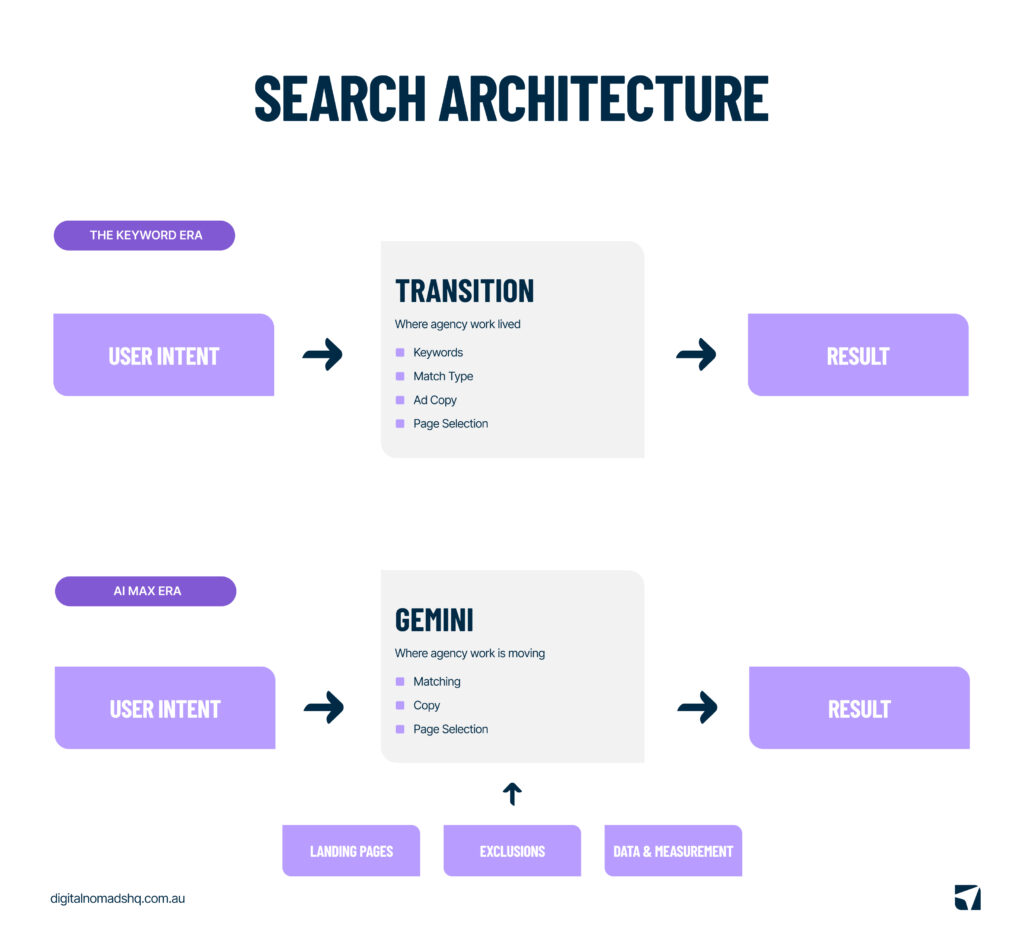
Google has now collapsed that translation layer into Gemini.
AI Max is the paid-side version.
AI Mode and AI Overviews are the organic-side version.
The mechanism is the same in both cases: Google’s models read your content, infer the intent of the query, and decide what to surface. The advertiser or publisher supplies inputs and guardrails. Gemini does the matching.
That is not an incremental change. It is an inversion.
Paid and organic are now the same problem
We’ve been writing for a while about the two-hop citation model, where AI Overviews and ChatGPT pull from a narrow set of cited sources, and those sources in turn pull from a deeper set.
The whole thing works because the inference layer sits between the user and the original content.
The user no longer sees the SERP. The model summarises it for them.
AI Max is the same architecture applied to paid.
Your keyword list becomes a starting signal, not a boundary.
The system expands beyond it using broad match and keywordless matching.
Headlines and descriptions are generated from your landing page content (remember this!)
Final URL expansion picks the destination page. The “campaign” is no longer a set of instructions you give Google.
It’s a set of inputs the system uses to make its own decisions.
So with this being said… If Gemini generates the headlines, why is the agency billing hours for headline testing.
If keywordless matching reads the landing page, why is the agency billing for keyword research the system is going to override anyway.
What we're actually seeing
Google’s launch around the AI Max numbers got some press.
A 14% conversion lift on average.
27% for accounts heavy on exact and phrase match.
L’Oréal doubling conversion rate.
MyConnect cutting cost per lead by 13%.
Aritzia reporting an 80% sales gain.
All real, all from Google’s own reporting, and all from accounts where the conditions were already right for AI Max to work.
The lived reality across client accounts is that the foundations are often a lot messier…
The pattern we’ve seen since AI Max moved out of beta is a wide variance in outcomes that correlates almost entirely with the inputs going in.
Accounts with high conversion volume, strong landing page content, mature negative keyword lists, and clean conversion tracking produce something close to the lift Google describes.
Accounts missing any one of those produce the noise.
Search terms that don’t make sense for the business.
Ad copy that mismatches user intent.
Traffic sent to landing pages that aren’t equipped to convert it.
ROAS that goes backwards before it goes anywhere… and so on!
The specific failure modes are predictable enough to list.
AI Max bids aggressively on competitor brand terms by default, which inflates spend on traffic that was never going to convert at scale.
It leans on Search Partner inventory in a way the previous keyword-match logic didn’t, which dilutes traffic quality. Auto-generated ad copy drifts away from brand voice in ways that take a human eye to catch. Made in USA headlines paired with queries about overseas products.
Generic shop-now phrasing where the brand has a deliberate tone.
Claim language that doesn’t match what the page actually offers.
Final URL expansion sends traffic to whatever page Google decides is most relevant, including outdated pages an account team would never have run paid spend to.
And the reporting itself is unreliable.
AI Max attributes impressions misleadingly, so a chunk of what looks like AI Max lift in the dashboard is actually attribution shifting from existing match types. The lift Google describes and the lift you can actually book to the campaign are often different numbers.
AI Max isn’t broken.
It’s a delivery layer whose output quality is bounded by input quality. Strong landing pages, mature conversion tracking, clean exclusion architecture, and enough conversion volume to give the algorithm something to learn from produce the lift Google describes.
Weak inputs produce the competitor-bidding, irrelevant-query, wrong-landing-page failure modes.
In a keyword-driven world, an agency could compensate for weak inputs through better targeting.
In an AI Max world, the targeting layer is now AI. The only place to compensate is by improving the inputs themselves. The work didn’t get easier. It moved.
Where the work moved
The work didn’t disappear. It moved. Three places, specifically.
Landing pages.
Both paid and organic now read the page as the primary signal. The copy, the structure, the entity coverage, the topical depth, the schema.
All of it has more weight than it did six months ago, and this I believe will continue!
A poorly written landing page used to cost you conversion rate. Now it costs you matching quality too, because Gemini reads it to decide who you appear for. The landing page is simultaneously a paid input and an organic input. Treating them as separate disciplines is now a structural mistake.
Exclusion architecture.
AI Max is, by design, a reduced-control product.
The AI decides which queries trigger your ads. Your control sits in negative keyword lists, brand exclusions, URL exclusions, and ad group structure. Building and maintaining these well is a higher-skill task than building keyword lists ever was, because the system is more aggressive than broad match ever was.
Agencies without a real method for this will burn client budget on queries that look related and aren’t.
Measurement.
With AI Max and Performance Max blending channels and queries, last-click attribution is less honest than ever. Incrementality testing, marketing mix modelling, and qualified conversion modelling become the only credible way to know what’s working. Google announced Meridian integration into Analytics 360 at GML 2026 precisely because the measurement problem has worsened, not improved.
None of these three are jobs an account manager moving sliders inside Google Ads can do.
What expert looks like now
Setting up an AI Max campaign is trivial.
Any junior media buyer can launch one in an afternoon. The barrier to entry has collapsed.
Running an AI Max campaign that performs to an expert standard requires three skill sets that used to live in different teams.
A conversion specialist who understands the landing page as a paid input. Not “is the form working” CRO.
Page structure that maps user intent cleanly enough for the algorithm to read it.
Copy that gives Gemini something useful to extract.
Information architecture that holds up when the system picks the destination URL itself. Closer to content strategy than to traditional CRO.
A data specialist who understands the feedback loop.
Conversion tracking that captures actual outcomes, not just clicks.
Offline conversion imports for lead-gen accounts. Audience signals that strengthen Gemini’s matching. The discipline to read the search term report with enough nuance to know what to exclude and what to leave alone. Most agencies don’t have this person. They have a media buyer who occasionally checks search terms.
A marketing strategist who lays the foundation before the algorithm starts spending.
What the brand is for.
Who it’s for.
What the value proposition actually is in five words.
AI Max is brutally honest about positioning. If the strategy is woolly, the algorithm reflects it back as mismatched queries, generic copy, and budget spent on traffic that was never going to convert.
The paid ads specialist becomes a commodity. The three people behind them become the value.
For agencies, the implication is direct. If your team is structured around channel specialists, you’re staffed for the world that ended in 2025. The teams that perform under AI Max are integrated, with CRO, data, strategy, and paid sitting in the same room on the same brief, because the inputs cross domains and the feedback loops do too.
For clients running their own AI Max campaigns, the implication is harsher.
They’ll get campaigns live easily.
They’ll see the spend going out and some conversions coming in and assume the system is working. The question they won’t think to ask is what it would have looked like if the inputs had been right from the start. That gap is invisible from inside the account.
The positioning question
It runs paid and organic together, not as separate departments.
The landing page is now a paid input and an organic input at the same time. If the SEO team and the SEM team don’t talk to each other, the landing page work happens twice, badly, with different assumptions baked in.
It has proprietary intelligence, not just access to the same Google tools every other agency has. If Gemini is doing the matching, the only edge left is knowing things about the search environment that Google doesn’t surface in its own reporting.
Citation patterns in AI Overviews. Query-level performance inside AI Mode.
Real-time search demand at the suburb level. Brand sentiment inside Gemini conversations. The agencies that built this kind of intelligence in-house are about to have an unfair advantage. The agencies that didn’t are about to look interchangeable, because the underlying Gemini layer they’re all operating on is the same.
It charges on outcomes, not on hours.
Once Gemini absorbs the execution layer, the hours line item is hard to justify. What’s left is strategy, guardrail design, measurement, and landing page quality. High-impact, low-hours work. Agencies still selling time will get squeezed. Agencies selling results will be fine.
It is selective about which clients it takes on.
The new model rewards landing page quality and brand strength. Agencies dragging weak brands with thin websites through paid spend are about to get caught out, because the system now reads those weaknesses and prices them in. You can’t fix a poor brand with bid adjustments anymore. The system has read the page and made up its mind.
What this looks like in practice
We’ve been planning a launch campaign for a new venue opening later this year.
The brief, if it had landed twelve months ago, would have looked familiar. Build keyword lists. Structure ad groups by service line. Write three or four ad variants per ad group. Set up conversion tracking. Optimise bids. Standard agency work.
The brief now looks different.
Build a landing page architecture that signals intent clearly enough for AI Max to match correctly.
Write base copy that Gemini can pull from to generate variants without losing the brand voice. Construct an exclusion list that catches the obvious mismatches before they burn budget.
Set up incrementality testing so we can measure what Meta and Google are actually contributing, versus what would have converted anyway. Once those inputs are right, the campaign largely builds itself.
The hours are lower. The thinking is heavier. The cost of getting the thinking wrong is higher.
The migration playbook
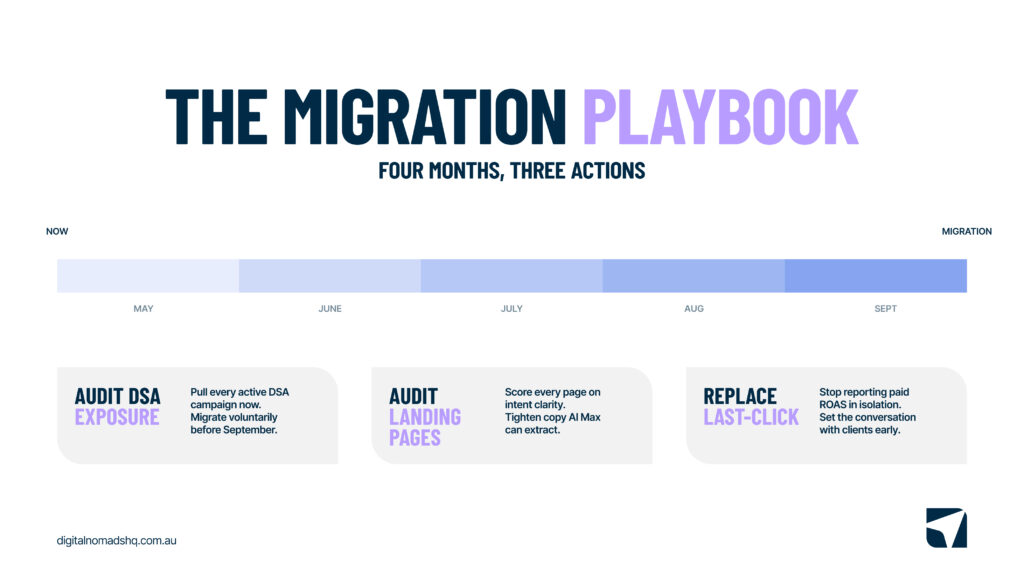
Audit DSA exposure across every account
Treat the landing page audit as the highest-impact work of the next ninety days
Stop running last-click as the primary measure
With AI Max and Performance Max overlapping queries and channels, last-click overstates paid one month and understates it the next. The Meridian integration into Analytics 360 is Google admitting last-click is broken inside their own product. Move clients to incrementality testing and marketing mix modelling now, even a rough first version. The alternative is answering uncomfortable questions about why reported ROAS doesn’t match the revenue line.
The September deadline isn’t a deadline for a Google migration. It’s a deadline for restructuring how you work.
The closing point
There’s a line from a senior Google executive at GML 2026 worth taking seriously. The pitch to agency partners was that they’d be able to service 50 clients with the team that used to be stretched thin across 10.
It’s a true statement, in the sense that the execution layer no longer needs human hours. It’s also a trap, because 50-client agencies running on the same Gemini outputs will all produce the same results.
The interesting agencies, two years from now, will be the ones that built proprietary intelligence underneath the Gemini layer, so their inputs are better than everyone else’s. That’s the only place an edge can come from when the matching, the copy, and the destination are all being decided upstream by the same model.
The September DSA deadline is the small story. The signal layer collapse is the big one. Most agencies haven’t noticed yet, which means there’s still time for the ones that have.