TL;DR
Google is retiring the standalone Local Services Ads platform. Every LSA campaign becomes a Performance Max campaign with pay-per-lead goals, managed inside Google Ads.
Migration starts August 2026 with US home and storefront services. Accounts outside the US follow in 2027.
Pay per lead stays. Search and Maps placement stays. Manual bidding goes, and historical performance reports do not carry over.
Local Services Ads never launched in Australia.
This migration shows the form pay-per-lead advertising will take if it arrives here: created inside Google Ads, bid by automation, and built entirely from your Google Business Profile.
The preparation is unglamorous. An accurate, complete, well-reviewed Business Profile already decides your map pack position today, and it becomes the ad itself under this model.
On 20 July, Google confirmed through its support documentation, and a follow-up post from Ads product liaison Ginny Marvin, that Local Services Ads are moving into Google Ads.
The standalone LSA dashboard is being retired.
Every existing campaign converts into a new campaign type: Performance Max with pay-per-lead goals.
Most coverage has framed this as an interface change. Same ads, new login.
That framing misses the story.
This is the final step in a multi-year project to rebuild local advertising around one asset, the Google Business Profile.
Australian businesses have never been able to run Local Services Ads, and that is exactly why the announcement is worth reading closely here… and why we are writing about it!
What is actually changing
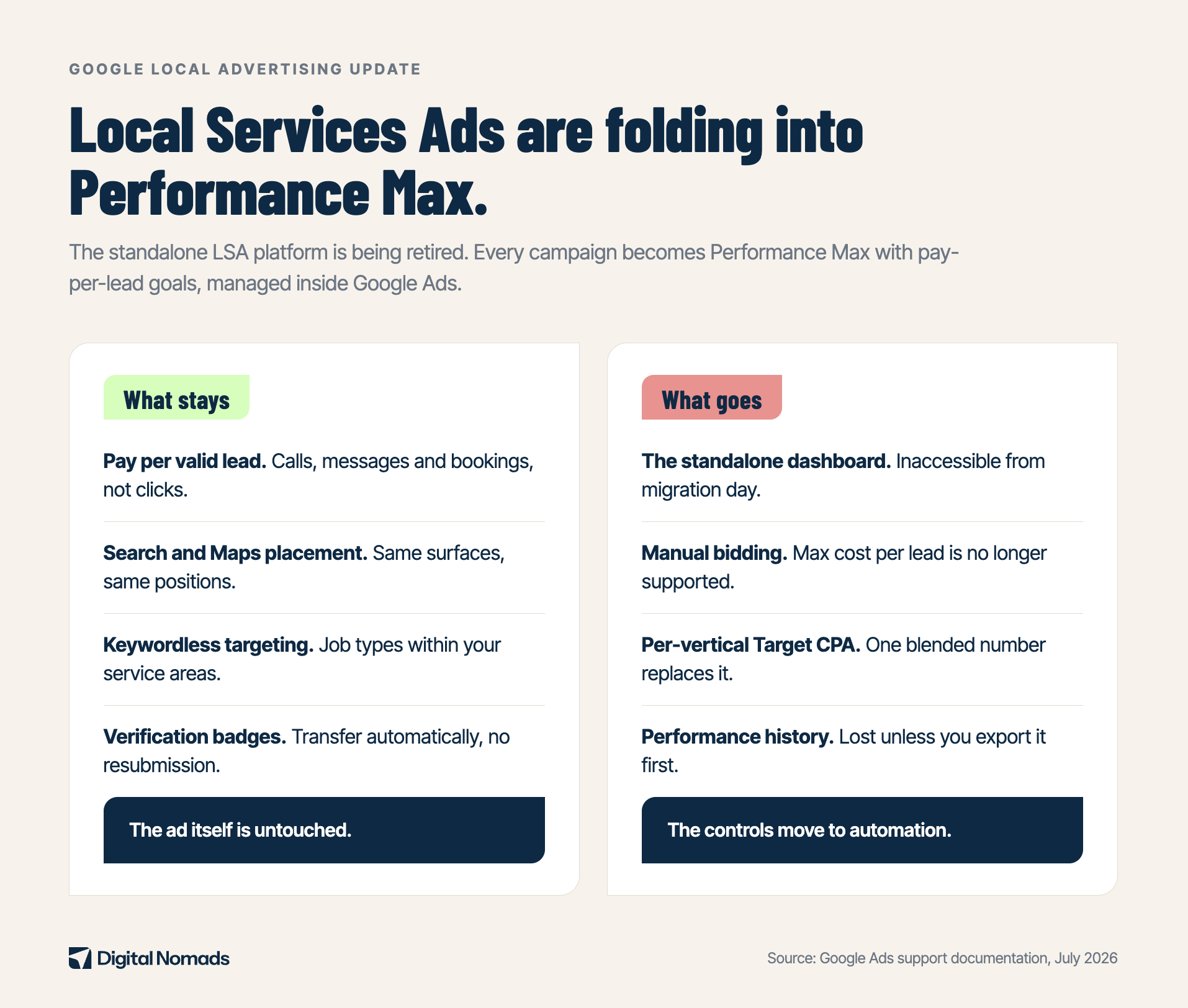
The mechanics of the ad stay put.
Advertisers still pay for valid leads, meaning calls, messages and bookings, not clicks.
The ads still serve only on Google Search and Google Maps, in the same positions.
Targeting stays keywordless: you bid on job types within your service areas, not on search terms.
Verification badges transfer automatically, with no need to resubmit insurance or licence documents.
The controls do not.
Manual bidding is gone.
Setting a maximum cost per lead is no longer supported, and per-vertical Target CPA disappears with it.
A business running plumbing and air conditioning under one campaign with separate bid ceilings will wake up to a single blended campaign-level Target CPA.
Keeping distinct economics per trade means splitting into separate campaigns.
Weekly budgets convert to daily averages, with monthly spend capped at roughly 30.4 times the daily figure.
Reporting history does not survive.
Lead records transfer: contact details, message threads, call recordings.
Performance reports do not. Impressions, spend history and cost-per-lead trends stay behind, and the old dashboard becomes inaccessible on migration day.
Google’s own advice is to download historical data before your transition date, and to start straight away.
Account admins get an email 14 days out and a reminder at seven. If a business benchmarks seasonality year on year, that benchmark disappears unless someone exports it. Google keeps its copy of the data. The advertiser loses theirs unless they act.
The Business Profile becomes the source of truth.
Core campaign details now sync one way, from the Google Business Profile into Google Ads. Business name, address and hours cannot be edited inside the campaign at all.
Change them on the profile and they flow through automatically.
A significant change to a business name or address triggers a verification review of 24 to 48 hours, and the campaign can pause while it runs.
Why Performance Max
The branding has caused confusion, because these campaigns behave nothing like standard Performance Max.
They do not expand to YouTube, Gmail or Display.
There are no headlines, videos or sitelinks, just up to 100 business photos and six callouts.
The reason for the label is inventory: Performance Max is the one campaign type in Google Ads able to serve across both Search and Maps, so it becomes the container.
The container matters, though.
Once these campaigns live inside the Performance Max framework, they sit on the same automation, measurement and account plumbing as everything else Google sells. Products that share a chassis converge.
The constrained version you migrate into is unlikely to stay constrained forever.
This was never about the dashboard
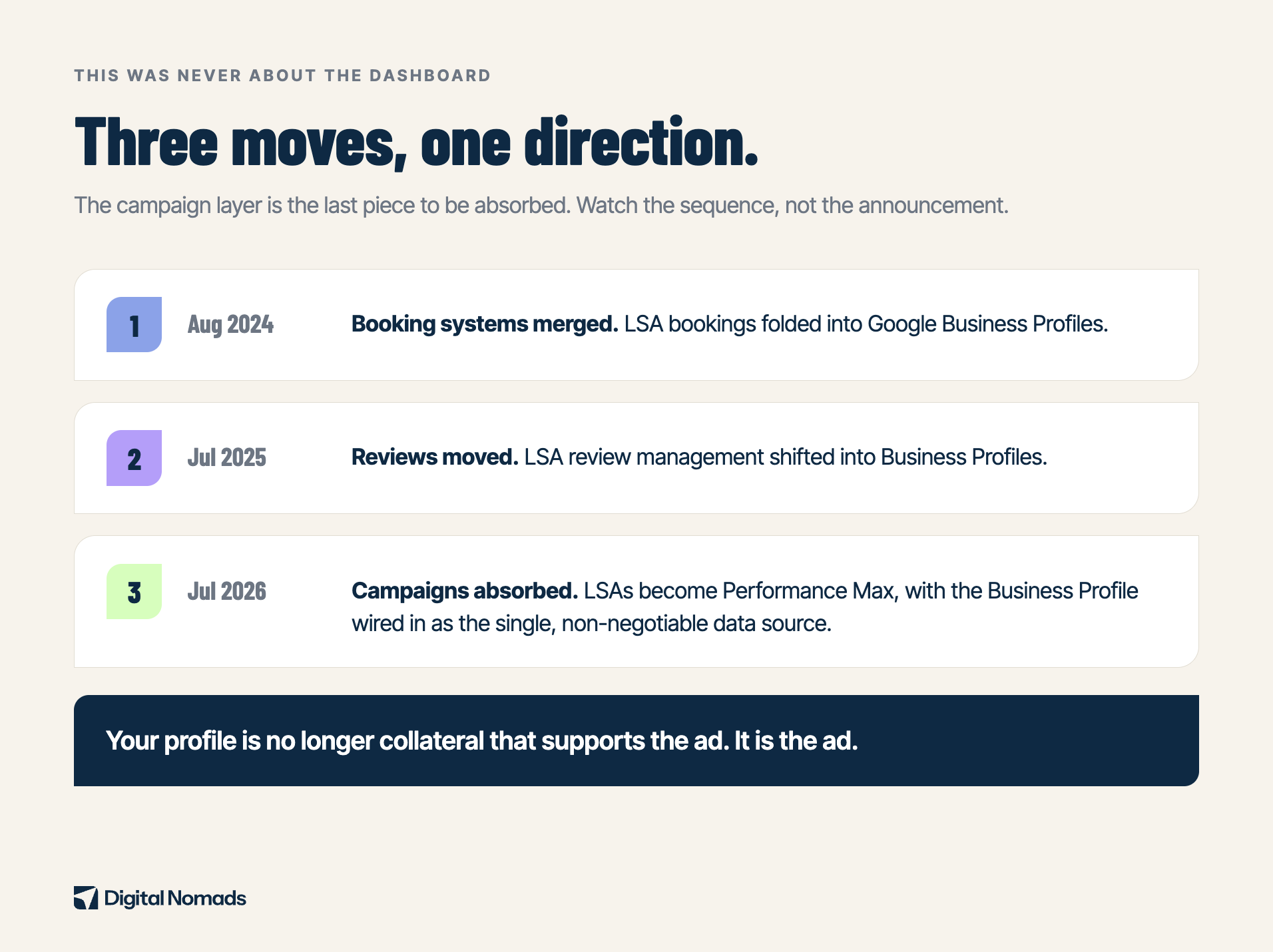
Watch the sequence, not the announcement.
In August 2024, Google merged the booking systems for Business Profiles and Local Services Ads.
In July 2025, it moved LSA review management into Business Profiles.
Now the campaign layer itself is being absorbed, with the Business Profile wired in as the single, non-negotiable data source.
Three moves, one direction.
The Google Business Profile has quietly gone from free listing to the operating system for local advertising.
Your profile is no longer collateral that supports the ad. It is the ad.
The Australian read
Local Services Ads never launched in Australia.
Google’s sign-up covers the United States, Canada, the UK and a group of European markets. Anyone who has sold “Google Guaranteed setup” to an Australian business was selling a product that does not exist here.
So why care about the internals of a product you cannot buy?
Because the migration timeline tells you what the distribution model looks like from now on.
US accounts move through 2026.
Accounts outside the US move in 2027.
Once the standalone platform is switched off, there is nothing left for new markets to launch on. Google has given no signal that Australia is next.
But if pay-per-lead advertising does arrive here, it now arrives in exactly one form: a Performance Max campaign created inside Google Ads, priced by automated bidding, and assembled from whatever your Google Business Profile says on the day.
That makes the entry requirements visible years in advance, and they look very familiar. The organic map pack is the unpaid version of the same real estate these ads occupy.
Our Price of the Pack study measured 12,635 pack appearances across 18 industries and six Australian cities.
The median business holding a pack position has 109 Google reviews at a 4.9 rating, and only 1.4% of positions went to businesses rated under 4.0.
Those are the economics of the surface Google is consolidating.
Whether you are earning that position organically or one day paying for it, the inputs are the same: a complete, accurate profile and a systematic review engine.
There is a second, quieter implication.
Every Google surface follows the same curve: organic first, hybrid second, then paid placements expanding their share.
Businesses with no organic pack position are the ones that hurt when the paid share grows, because they end up renting visibility they never built. The window before a surface is fully monetised is the cheap period. Australia is in it.
What we're telling clients
- If you or your clients run Local Services Ads in the US, Canada, the UK or Europe, export historical performance reports now. Fourteen days’ notice is all you get, and the dashboard is unrecoverable after migration.
- Multi-trade operators should decide before migration whether one blended Target CPA is acceptable, or whether service lines need separate campaigns, while clean per-vertical data still exists to base that call on.
- Australian businesses should treat the Google Business Profile as infrastructure, not a directory listing. Categories, services, service areas, hours, photos, response times. It already decides your map pack position, and under this model it becomes the ad itself.
- Build the review engine now. Systematic asks after every completed job. The Australian pack median is 109 reviews at 4.9, and that is the standard this environment expects. Find your market’s numbers in The Price of the Pack.
- Hold an organic pack position before you ever need to rent one. Paid share of local results only trends one way.