Most content marketing guides are still teaching the old playbook.
Publish, rank, collect the clicks.
The trouble is the clicks are drying up.
We tracked more than 80 service keywords across six Australian markets and 21 industries, month by month.
Demand climbed through 2024, peaked in late 2025, then fell 38% in 2026. None of the six markets escaped it.
That fall tracks almost exactly with Google rolling out AI Overviews across Australian search.
The answer now sits at the top of the results, so the questions people used to type, read and click on get handled on the spot.
Which means a content marketing strategy in 2026 has to do two things at once. Earn attention when the click never comes, and become the source the AI quotes.
This guide gives you a nine-step framework to do both, plus a free template and a tool that drafts your strategy in minutes.
What is a content marketing strategy?
Three terms get used as if they mean the same thing.
They do not.
Content marketing strategy is the why. Who you help, how, and why you are the one to do it.
Content strategy is the what and how. Creating, organising and governing the content itself.
Content plan is the when and who. The calendar, and the people who own each piece.
You do not need a 40-page document.
A strategy people actually use covers five things: a clear goal, a defined audience, a position (what you can say that nobody else can), the content and channels to deliver it, and a way to measure it.
Why you need a content marketing strategy in 2026
The old reasons still apply.
A documented strategy ties content to revenue instead of guesswork.
It wins buy-in from the people who hold the budget.
It stops you publishing for the sake of publishing.
Study after study finds the same thing: teams with a documented strategy outperform the ones working on instinct, and feel less stretched doing it.
Then there is the reason nobody was talking about two years ago.
Visibility no longer equals traffic.
When an AI Overview answers a question, you can be cited inside that answer.
You get seen, credited and trusted, with no click attached.
And if you are not the source the model pulls from, you are invisible even when you technically rank on page one.
A 2026 strategy is built to win the citation, not just the position.
The 2026 shift: AI search, GEO and the content that gets eaten
Before the how-to, look at the ground you are building on, because it has shifted under everyone. Two pieces of our own Australian research show how far.
In our State of AI Search study we captured 116,918 live search results across 18 industries and six cities. 37.8% of commercial Australian searches now trigger a Google AI Overview.
More than a third of the time, the answer shows up before anyone clicks a result, and across the study that came to roughly 387,000 AI citations.
Our Australian Search Demand study tells the second half.
Local-service search volume fell 38% in 2026, and the categories that fell hardest were the research-heavy ones: lawyers down 56%, mortgage brokers 47%, web design 40%. Those are exactly the questions an AI Overview can settle in a single box.
This is where it gets uncomfortable for content marketers.
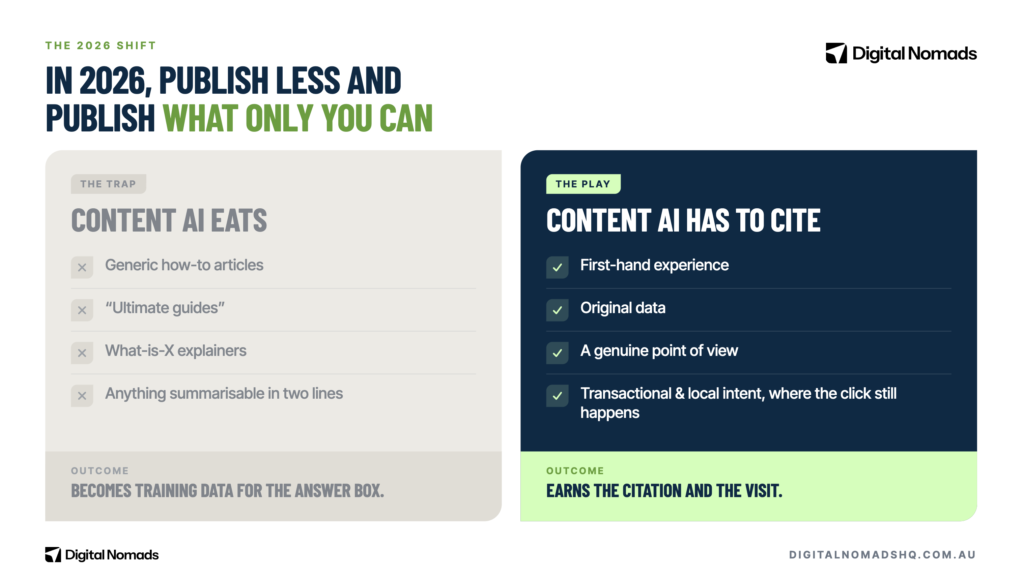
The classic how-to article, the ultimate guide, the what-is-X explainer: that is exactly the content AI now absorbs and summarises. Publish it in 2026 and you have mostly written training data for the answer box. You have not given anyone a reason to visit you.
So the bar has moved, and it moved fast.
Content that an AI can summarise in two lines is now a waste of budget.
What earns its place is the content AI cannot fully replace or has to cite: first-hand experience, original data, a genuine point of view, and the transactional or local searches where someone still has to click.
That is the thinking behind generative engine optimisation (GEO), and it runs through every step below. The rule is simple enough: publish less, and publish what only you can.
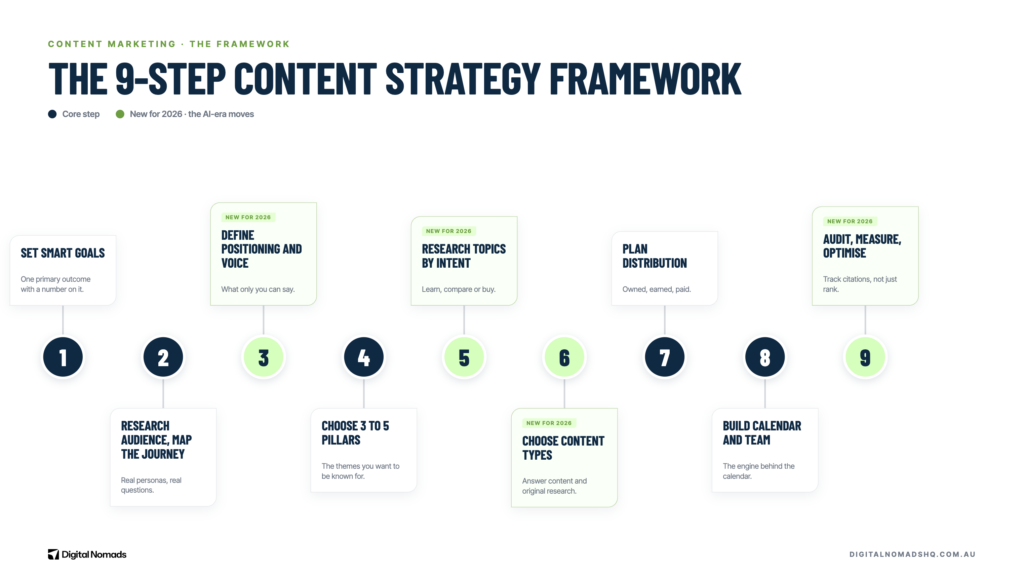
How to build a content marketing strategy (9 steps)
1. Set SMART goals
Start with the one outcome that matters most, and make it Specific, Measurable, Achievable, Relevant and Time-bound. “Grow organic leads 30% by Q4” beats “get more traffic”, because every later decision then has to earn its place.
Common goals, with a number attached: brand awareness (branded-search volume up 50% in six months), lead generation (40 qualified enquiries a month), authority (cited in AI answers for your 10 priority queries), sales (25% year-on-year revenue from organic), retention (cut churn 15%).
Pick one primary goal and at most two to support it. Everything cannot be the priority.
2. Research your audience and map the buyer journey
Then map content to the buyer journey, because a strategy that serves one stage only leaks revenue:
- Top of funnel (awareness): the problem-aware searcher. Guides, explainers, original research, short video.
- Middle of funnel (consideration): comparing options. Comparisons, case studies, webinars, how-tos.
- Bottom of funnel (decision): ready to act. Service pages, pricing guidance, testimonials, demos.
Most businesses over-invest at the top and starve the middle and bottom.
Fix that on purpose.
3. Define your positioning, brand story and voice
This is the step most tactical guides skip, and it is the one that decides whether your content is forgettable.
Before a single topic, decide what you can say that competitors cannot: your point of view, your proof (data, results, credentials) and the through-line that makes your content recognisably yours.
It matters more under AI search, not less.
Generative engines cite sources they understand and trust as entities, so a clear and consistent voice, a real named author, and demonstrable first-hand experience, the signals behind E-E-A-T, are now ranking and citation factors.
Anonymous, me-too content is the first thing a model skips.
4. Choose your 3 to 5 content pillars
Pillars are the core themes you want to be known for.
Pick three to five, no more, where your expertise, your audience’s interests and your commercial goals overlap.
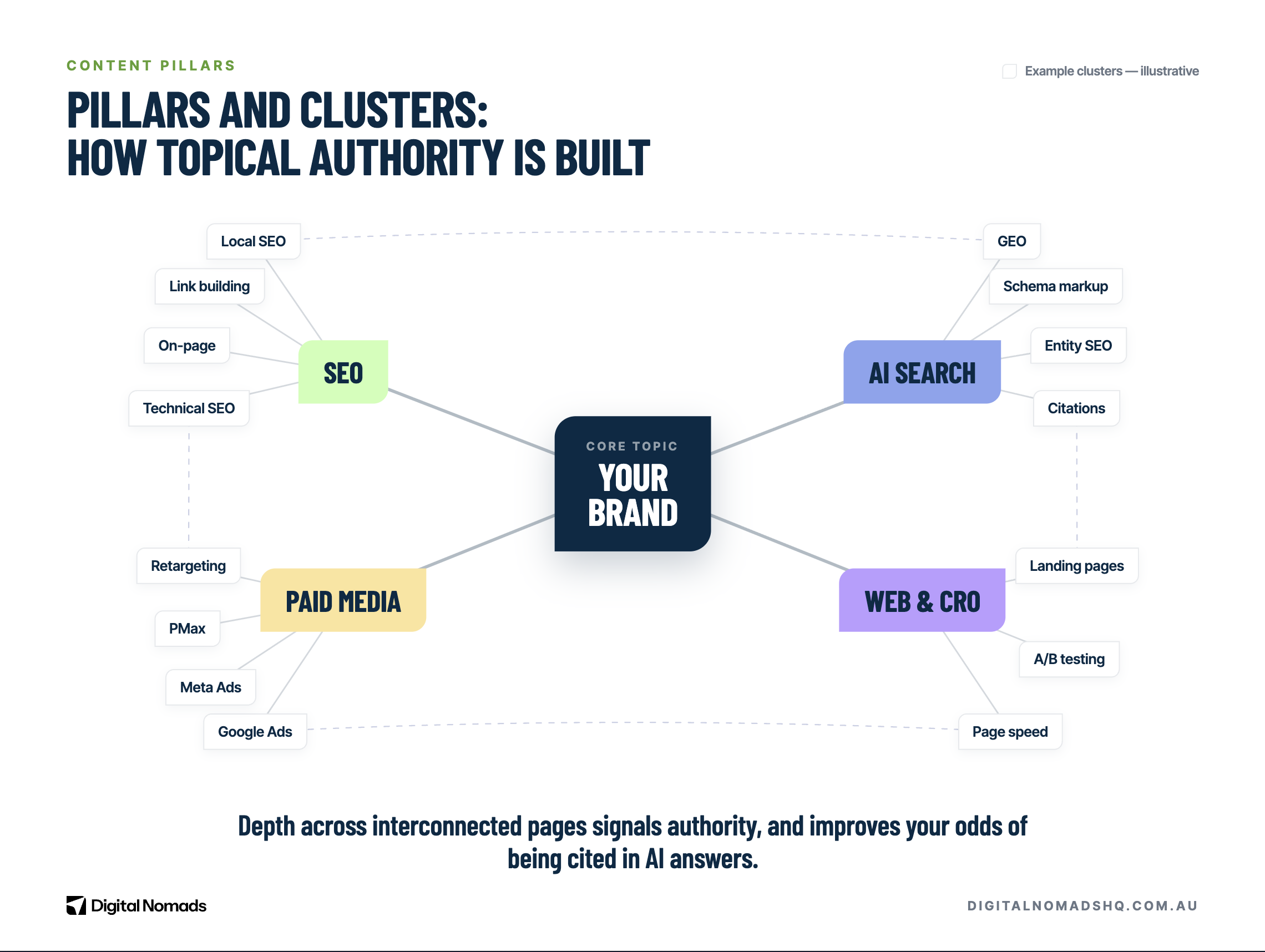
For a digital agency, pillars might be SEO, AI search, paid media, and web or CRO. Each pillar becomes a hub, with cluster content answering the specific questions beneath it, all interlinked.
There is a reason for this beyond tidiness.
Google now reads content as topic clusters, not isolated pages.
Depth across an interconnected set of pages signals real authority, and that same interlinking improves your odds of being cited in AI answers. Pillars are how you build authority on purpose instead of by accident.
5. Do topic and keyword research by intent
Find the specific topics under each pillar.
Use a keyword tool (Semrush, Ahrefs or Google Keyword Planner) to gauge search volume, difficulty and intent, meaning what the searcher actually wants: to learn, to compare, or to buy.
Then add the 2026 filter most guides miss. Ask which queries an AI Overview already answers in full, and which still need a click.
With AI Overviews on 37.8% of commercial searches, this is now the single most important call you make.
Weight your calendar toward the click-worthy topics (transactional, local, opinion-led and experience-driven) and toward topics where you have first-hand data to add.
6. Choose your content types and formats
Match formats to your audience and your goal. The core menu: blog posts and guides, video (still the highest-engagement format in 2026 across YouTube, Reels and LinkedIn), email, podcasts, webinars, case studies, infographics and social.
Then add the two modern types that actually survive AI search:
- Answer content. Pages built as direct, citable answers: the question as a heading, the answer in the first sentence or two, real numbers to back it. This is how you get pulled into AI Overviews instead of summarised out of them.
- Original research. Your own data. It is the single best asset for earning links and AI citations, and almost none of your competitors have it.
Do not spread across ten formats.
Pick the two or three your audience actually consumes, and do them properly.
7. Plan distribution and promotion
- Owned: your site, email list and SEO. The foundation, because it compounds.
- Earned: digital PR, guest articles, podcast appearances, and the backlinks original research attracts. For most Australian businesses this is the biggest under-used lever, and the one that earns the authority AI engines reward.
- Paid: Google Ads, Meta and LinkedIn to put your best pieces in front of the right audience faster.
Match channels to where your audience already is. Pick two and go deep. Six shallow ones will not move anything.
8. Build your calendar, workflow and team
Put your prioritised topics into a calendar with an owner, content type, status and due date.
Consistency beats sporadic bursts.
But a calendar on its own is not a system.
Define the engine behind it: who briefs, writes, edits, optimises and publishes, and to what standard.
Set your cadence honestly.
Promise two strong pieces a month and deliver them.
That will do more than eight thin ones you abandon by March. Document the strategy and share it, so freelancers, in-house staff and any agency are working to the same brief.
9. Audit, measure and optimise
A strategy does not end at “publish”.
Track your goal metric, organic traffic and conversions.
Then add the measurement the old playbooks omit: are you being cited in AI Overviews and AI answers for the queries that matter?
Classic rank tracking no longer sees what happens above the organic results, so treat AI citation as the new page one.
Tie content to pipeline and revenue with attribution in GA4 and Search Console so you can defend the budget.
Set KPIs by goal.
Awareness maps to branded search and impressions, leads to conversions and cost per lead, authority to citations and backlinks.
Run a content audit twice a year: find your winners and refresh them (recency is now a real AI-citation signal), prune or consolidate the dead weight, and repurpose the best pieces into video, social and email so one strong idea earns its keep five times over.
Then re-baseline your demand assumptions, because the curve is still moving.
Common mistakes to avoid
- Publishing the content AI eats. How-to explainers and “ultimate guides” are exactly what AI Overviews absorb. Lead with citable answers, real numbers and first-hand experience instead.
- Optimising for demand that no longer converts. Forecasts built on 2025 volumes are too high. Plan against the current curve.
- Skipping distribution. If you spend 80% on creation and 20% on promotion, flip it.
- No pillars, no owner, no measurement. A strategy that is not structured and run is just a document.
- Treating AI search as a future problem. It is already on 37.8% of commercial Australian results. It is a now problem.
Build your strategy with DNHQ
We build content marketing strategies for Australian businesses designed for how search actually works in 2026: content that gets cited, not just ranked. If you would rather not start from a blank page, see our Content Marketing Services and AI SEO work, or book a free strategy session.
Frequently asked questions
What is a content marketing strategy?
A documented plan for using content to reach a specific audience and achieve a business goal, and in 2026, to stay visible in AI search. At minimum it covers your goal, audience, positioning, content pillars, channels and measurement.
How do I create a content marketing strategy?
Set SMART goals, research your audience and map the buyer journey, define your positioning, choose three to five content pillars, research topics by intent, choose your content types, plan distribution, build a calendar and team, then audit and measure, including your AI visibility.
What are content pillars?
Three to five core themes you want to be known for. Each becomes a hub with cluster content beneath it, all interlinked, which builds topical authority and improves your odds of being cited in AI answers.
Is content marketing still worth it if search demand is falling?
Yes, but the goal shifts from clicks to citations. Australian search demand fell 38% in 2026 as AI answers scaled, and 37.8% of commercial searches now show an AI Overview, so the businesses that capture the attention that remains are the ones cited in those answers.
How long does a content marketing strategy take to work?
Most businesses see traction in three to six months. Original research and answer-led content can be picked up and cited faster.
Is there a free content marketing strategy template?
Yes. Use our free one-page template and 90-day calendar, or generate a tailored strategy with the interactive tool on the page.