What are ad impressions?
An ad impression is counted each time an ad is served and displayed on a user’s screen. It doesn’t matter whether the person interacts with the ad, clicks on it, or even consciously notices it… if the ad renders on their device, that’s one impression.
It’s one of the most basic units of measurement across every major paid media channel, from Google Ads and Meta Ads through to programmatic display, YouTube, and LinkedIn campaigns.
How are ad impressions measured?
Not every ad that loads technically counts as an impression.
The industry standard, set by the Media Rating Council (MRC) and adopted by platforms like Google and Meta, requires that at least 50% of the ad’s pixels are in the viewable area of the browser for a minimum of one continuous second for display ads, or two continuous seconds for video ads. Impressions that meet this threshold are referred to as “viewable impressions.”
This distinction matters because an ad that loads at the bottom of a page a user never scrolls to shouldn’t carry the same weight as one that actually appeared on screen.
When reviewing campaign performance, it’s worth checking whether a platform is reporting served impressions (the ad was loaded) or viewable impressions (the ad was actually seen).
Impressions vs. clicks vs. reach
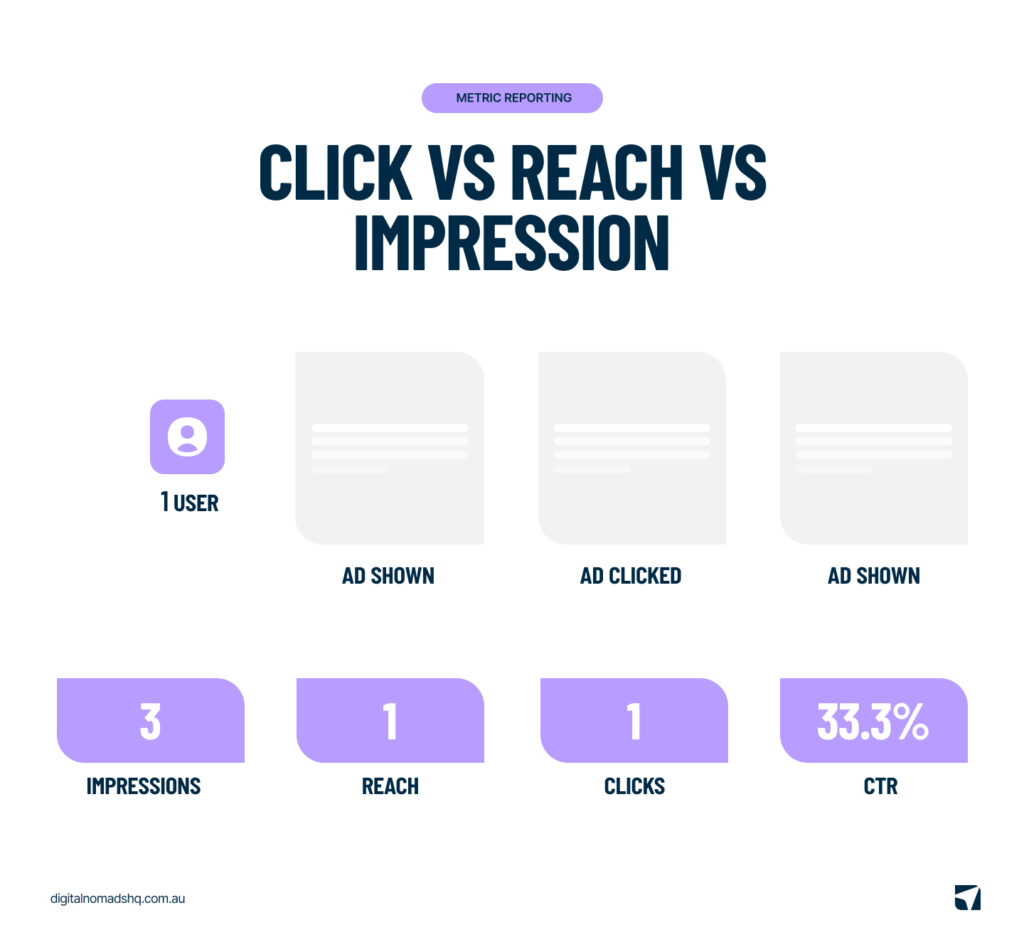
These three metrics are closely related but measure different things. Impressions count the total number of times an ad is displayed, including repeat views by the same person. Reach counts the number of unique users who saw the ad. Clicks count how many times someone actively engaged with the ad by clicking through.
To put it simply: if one person sees your ad three times and clicks once, that’s three impressions, a reach of one, and one click.
Understanding the relationship between these metrics is how you start to evaluate campaign efficiency. Dividing clicks by impressions gives you your click-through rate (CTR), which is a key indicator of whether your ad creative and targeting are working together effectively.
Use our CTR calculator.
Why do ad impressions matter?
Impressions are the starting point for almost every performance calculation in paid media. They feed directly into CTR, cost per thousand impressions (CPM), and frequency… all of which shape how you optimise a campaign.
Beyond the numbers, impressions also serve as a proxy for brand visibility. Campaigns focused on awareness and top-of-funnel reach are often optimised specifically for impression volume, because the goal isn’t necessarily a click… it’s ensuring your brand is seen by the right audience, repeatedly, at the right time.
That said, impressions on their own don’t tell you much. A million impressions with zero engagement suggests a targeting or creative problem. The real value of impressions comes when you pair them with engagement metrics to understand what’s actually driving results.
How impressions are used across ad platforms
Most major ad platforms use impressions as a core billing and reporting metric.
Google Ads reports impressions across Search, Display, YouTube, and Performance Max campaigns.
Meta Ads (Facebook and Instagram) uses impressions alongside reach and frequency to help advertisers understand delivery. Programmatic platforms typically trade on a CPM basis, meaning advertisers pay a set rate per thousand impressions served.
Each platform has its own nuances around how impressions are counted and reported, so it’s worth understanding the specific definitions within the platform you’re running campaigns on.