TL;DR
Google I/O 2026 just confirmed what we have been warning clients about for two years. Google is no longer just a search engine – It is an AI assistant that answers questions, builds tools, and processes transactions without users ever leaving Google. AI Mode has 1 billion monthly users. AI Overviews appear on 48% of queries. Google just launched AI agents that search for you in the background, a Universal Cart coming to Australia allowing purchases to happen without clients even visiting your website, and AI-generated interactive tools that replace the kind of content most businesses rely on for traffic (how-to’s, what Qs etc.). This is not a future problem… this is happening. Here is what we are doing about it for our clients and what you should be doing too.
Biggest update to search in 25 years
I do my best to watch every Google I/O keynote, despite the horrible alignment with the AEST timezone. Every time the announcements are incremental, whether everyone agrees or not, the innovation, better models, faster loading, shinier features… they are great.
Often, we take note, adjust a few things, and move on.
This year hits a little different.
The 2026 Search announcements are not incremental.
They represent a fundamental shift in what Google is and how people will interact with it. And if you run a business that depends on search traffic, paid ads, or e-commerce in Australia, you need to understand what just changed.
I am not going to recap every announcement.
I am going to focus on the ones that directly affect our clients and what we are doing about each one.
1 Billion People Now Use AI Mode. We Saw This Coming.
AI Mode has passed 1 billion monthly users with queries more than doubling every quarter. Gemini 3.5 Flash is now the default model powering it globally.
One in eight people on the planet used AI Mode last month. That is not a beta. That is not an experiment. That is a primary interface – Crazy numbers.
This month we analysed 116,918 Australian Google search results and found that AI Overviews were triggering on 37.8% of domestic queries, well above the global average at the time.
We said then that this was going to accelerate and the global data shows AI Overviews are now on 48% of all queries. AI Mode usage is growing faster than any Google product since Gmail.
We have been rebuilding our SEO campaigns around this reality for the last 12 months and if your agency is still optimising purely for traditional organic rankings and measuring success by “keywords on page one,” they are solving last year’s problem.
Search Agents Are the Biggest Shift Since Mobile
This is the announcement I am most focused on.
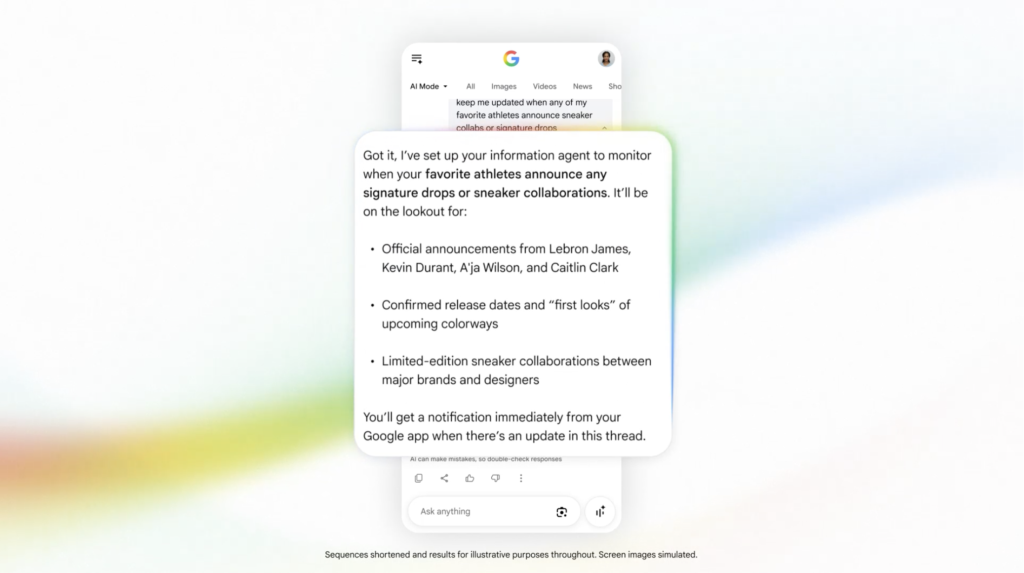
Google is launching Search agents – AI agents you create inside Google Search that run in the background 24/7.
So, simply… give them a task – They scan blogs, news, social media, shopping data, and more in real time. When something matches, they notify you.
The examples Google gave were consumer-focused.
An rental hunting agent.
A sneaker drop agent.
But think about what this means for B2B.
A procurement manager sets up an agent to monitor pricing changes across suppliers.
A marketing director creates an agent to track competitor announcements.
A business owner has an agent watching for regulatory changes in their industry.
This is crazy!
Search stops being something you do… it becomes something that runs for you.
Why This Should Change How You Think About Your Website
Every business I talk to thinks about their website from a human perspective. How does it look? Is the copy compelling?
Does the navigation make sense? Those things still matter. But AI agents do not care about your hero image or your brand story.
An AI agent scanning on behalf of a user is going to check structured data. Product specs. Pricing. Availability. Location. Opening hours.
Service descriptions in machine-readable formats. If that information is not in your schema markup, your product feeds, and your structured data, the agent will skip you and surface a competitor who made it easy.
We have been pushing structured data implementation across all of our SEO clients for years. Most businesses treat it as a “nice to have” technical SEO task. After this announcement, it is the foundation of being discoverable in the next generation of search.
Honest take: Most Australian business websites we audit have incomplete or missing structured data. Basic stuff – LocalBusiness schema, product schema, FAQ schema, service schema. It takes a few hours to implement properly. But without it, an AI agent cannot read your website. You are invisible to the fastest-growing way people will discover businesses. We are running structured data audits for all managed clients this month. If you are not a client, you should be doing this yourself or getting someone to do it for you.
Universal Cart Is Coming to Australia. This Changes E-Commerce.
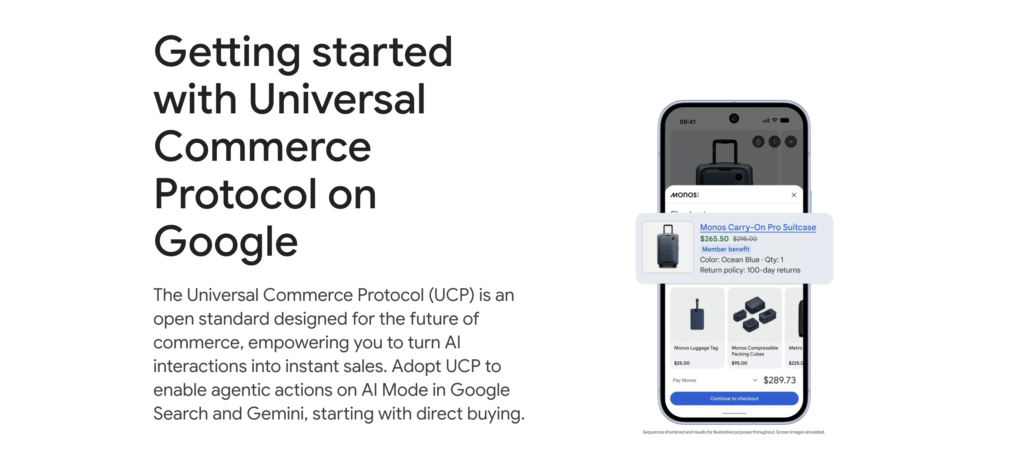
Google launched Universal Cart, a shopping cart powered by Gemini that works across merchants, across Search, YouTube, Gmail, and Gemini.
A customer adds a product while watching a YouTube video. Adds another while browsing Search. The cart tracks price history, finds deals, alerts to restocks, and handles checkout across multiple merchants in one place.
The infrastructure behind it is called the Universal Commerce Protocol (UCP). And Google confirmed it is expanding to Australia in coming months.
I want to be direct about what this means. Google is building itself into the middle of every online transaction.
The customer discovers, compares, and buys without ever visiting your website.
Your Shopify store, your WooCommerce site, your custom e-commerce build – they become fulfilment backends while Google owns the customer relationship.
That sounds alarming.
And for businesses that are going to do nothing… it should be!
But for businesses that integrate early, it is an opportunity.
You get a buy-now button inside AI Mode, YouTube, and Search. Your products become purchasable in the moment of discovery, not after a customer clicks through, loads your site, creates an account, and goes through checkout. The friction drops dramatically.
What we are doing: For our e-commerce clients, we are already auditing Google Merchant Centre feeds, product data accuracy, and structured data readiness for UCP integration. When it launches in Australia, we want our clients ready on day one. The pattern here is identical to Google Shopping feeds. The businesses that connected their feeds early dominated the Shopping tab. The ones that waited 12 months were playing catch-up while competitors took their market share. Do not make the same mistake twice.
The Agent Payments Protocol Is Worth Watching
Google also announced AP2 (Agent Payments Protocol), which lets AI agents make purchases on behalf of users within guardrails – spending limits, category restrictions, approval requirements. The user sets the rules, the agent shops and buys.
This is early days. But picture this in 18 months: a customer tells their Google agent “reorder my usual supplements when they drop below $40” or “book the cheapest direct flight to Melbourne for the second Friday of June.”
The agent monitors, finds the match, and completes the transaction.
The businesses that show up in that agent’s scan are the ones with clean product data, competitive pricing, and UCP integration.
Everyone else does not exist in that transaction.
Google Now Builds Tools Inside Search Results. This Kills a Content Category.
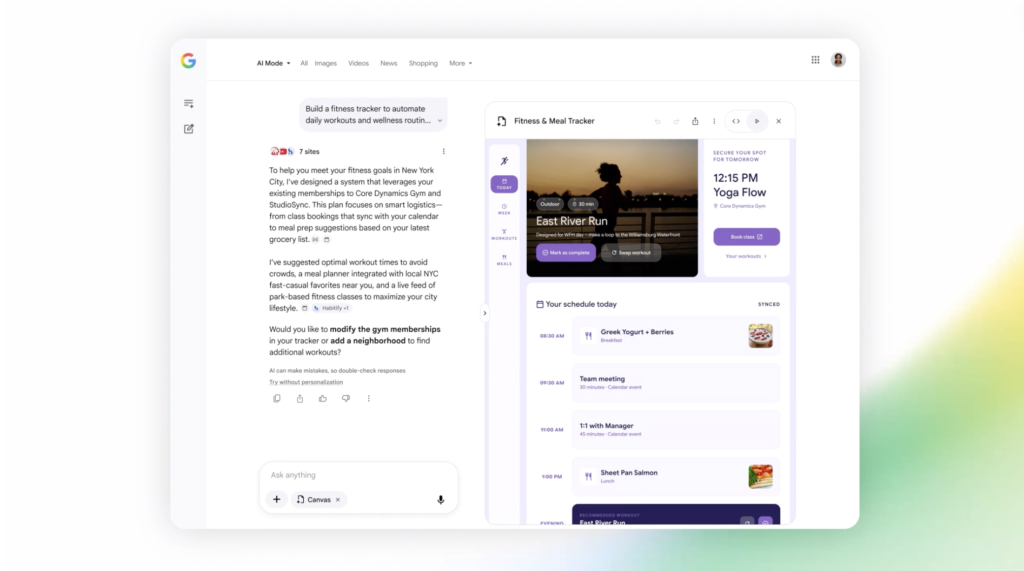
Google is putting code generation directly into Search through a system called Antigravity.
You search for something that would benefit from an interactive tool, and Google builds it for you on the spot.
A wedding planning checklist with venue recommendations from Google Maps, weather data for your date, and local vendor reviews.
A moving budget calculator with real rental data and cost estimates for your area. A fitness tracker that pulls in your data. Custom, interactive, built in seconds. Free for everyone this summer.
I will be honest… this worries me for a category of content we have helped clients produce for years.
Think about the tools and resources businesses publish to attract organic traffic. Budget calculators. ROI estimators. Comparison checklists. “How much does X cost” guides with interactive elements.
If Google can generate a better, more personalised, data-rich version of that tool directly in the search result, the user has no reason to visit your website.
We have already started shifting our content strategy recommendations away from tool-based and template-based content toward content that cannot be generated on the fly:
- Original research with proprietary data (like our 116,918 SERP analysis)
- Real client case studies with specific numbers and context
- Expert opinion that takes a clear position based on experience
- Industry-specific observations from practitioners who manage real campaigns
- Contrarian takes that challenge the conventional wisdom with evidence
- Generic how-to content is going to get eaten alive by Antigravity.
But content that comes from doing the work? That is harder to replicate.
An AI can build you a budget calculator. It cannot tell you what we saw happen to a client’s CPA when they restructured their Google Ads account last quarter.
Personal Intelligence Changes the Retargeting Playbook

Google is rolling out Personal Intelligence globally – 200 countries, 98 languages, no subscription required.
You connect your Gmail, Google Photos, and soon Calendar to AI Mode.
Then you can ask things like
“what was that hotel I stayed at in Melbourne?”
or
“what did I order from that skincare brand last month?”
and Google searches your personal data to find it.
From a marketing perspective, this is subtle but important.
Traditional retargeting is built on the assumption that people forget. They visit your site, leave, and you need to remind them through display ads, remarketing lists, and email sequences.
But if a customer can just ask Google “what was that thing I was looking at?” and Google pulls it from their email receipts and browsing history, the retargeting function partially moves to Google. The user does not need to see your remarketing ad. They do not need to remember your brand name. They ask their AI assistant and it finds you.
This does not mean remarketing is dead.
We still see strong performance from first-party remarketing lists, Customer Match, and server-side tracking. But it does mean the landscape is shifting. Your transactional emails, your order confirmations, your receipts – these become discoverable content that Google can surface to bring a customer back. Making sure your email communications are clear, well-structured, and contain proper product information matters more than it used to.
The Search Box Redesign Changes How Queries Form
The search box itself has been rebuilt. It dynamically expands, accepts images, files, videos, and browser tabs as inputs, and uses AI-powered suggestions that go beyond autocomplete.
You can flow from an AI Overview directly into a conversational AI Mode exchange with your context carrying through.
This matters for keyword strategies in both paid and organic optimisation.
The queries people type are getting longer (long-tail), more specific, and more conversational. Multi-modal queries where someone takes a photo of a product and asks “where can I buy this in Brisbane” are going to become common.
For paid search, this means traditional keyword-based campaign structures need to evolve. We have written about AI Max for Search and how Google is pushing toward intent-based matching rather than keyword matching.
The search box redesign accelerates this. If a user is having a conversation with Google about a purchase decision, the traditional model of bidding on exact match keywords does not capture that interaction.
Campaign structures need to account for conversational, multi-step, multi-modal queries.
For SEO, it reinforces the importance of entity-based optimisation and topical authority over individual keyword targeting. Google is not matching queries to pages anymore. It is understanding intent, context, and conversation. Your content needs to answer the full scope of a topic, not just target one keyword variation.
The Pattern Across Everything Google Is Doing
Step back and look at every major Google announcement this year.
AI Max for Search. Performance Max expansion. Journey-aware bidding. AI Overviews at 48%. Search agents. Universal Cart. Antigravity. Personal Intelligence.
They all point in the same direction.
Google is moving from being a platform that sends people to websites to a platform that keeps people inside Google. It wants to answer the question, complete the task, and close the transaction. Your website becomes the backend. Google becomes the interface.
This is not inherently good or bad. It is a reality you need to build around.
The businesses that will thrive in this environment are the ones that:
- Own their audience directly through email lists, CRM databases, and customer communities that do not depend on Google sending traffic
- Have clean, structured data that AI agents and Google’s systems can read, understand, and surface
- Invest in genuine expertise that produces content, research, and insights an AI cannot generate on its own
- Integrate with Google’s commerce infrastructure so they are present in Universal Cart, AI Mode, and YouTube commerce surfaces
- Feed their ad platforms quality data because automation is getting smarter but it is only as smart as the data you give it
- Build brand strength because branded search is the most insulated channel from AI disruption – people searching for you by name still land on your website
None of this is new advice. We have been saying every one of these things for the last two years. Google I/O 2026 just made it undeniable.
What We Are Doing for Our Clients Right Now
Here is the specific action we are taking across our managed client accounts in response to I/O 2026:
- Structured data audits across all SEO clients.
We are checking schema markup (though there isn’t strong correlations to organic SEO performance as of yet with this… it’s future proofing), product feeds, LocalBusiness data, FAQ schema, and service schema. If an AI agent cannot read it, it needs to be fixed. - UCP readiness for e-commerce clients.
Auditing Merchant Centre feeds, product data accuracy, pricing feeds, and checkout integration readiness for when UCP launches in Australia. - Content strategy pivots.
Shifting production away from generic informational content toward original research, case studies, expert commentary, and opinion pieces. If an AI can generate it, we are not writing it. - SEO reporting evolution.
Adding AI Overview citation tracking, brand search volume monitoring, and entity visibility to our standard SEO reporting alongside traditional rankings and traffic. - Paid search campaign reviews.
Making sure campaigns are configured for AI Mode ad placements (Sponsored Stores, Direct Offers) and conversational search surfaces. Reviewing AI Max migration readiness and journey-aware bidding prerequisites. - First-party data infrastructure.
Pushing CRM integration, offline conversion imports, and Customer Match setup for every client that does not already have it. The competitive advantage across every platform in 2026 is data quality, not campaign cleverness. - Client education.
Sending this article to every client. Having conversations about what these changes mean for their specific business and what needs to shift.
The Uncomfortable Truth and the Opportunity
Here is the uncomfortable truth. If your business relies entirely on Google to send you customers, you are building on rented land and the rent is going up.
Organic traffic from Google will keep declining. The cost of paid traffic will keep rising as ad inventory shifts from traditional search to AI surfaces. The middleman is getting more powerful, not less.
But here is the opportunity. Most businesses are not going to do anything about this. They are going to read articles like this one, nod, and go back to whatever they were doing before. That creates an enormous advantage for the businesses that actually move.
Everything Google announced at I/O 2026 reinforces those fundamentals. The businesses that are built on them have nothing to worry about. The ones that are not should start now.