What Are SEO KPIs (And Why Most Agencies Track the Wrong Ones)?
SEO KPIs (key performance indicators) are the metrics that show whether your SEO investment is actually working – or just burning your marketing budget.
We’re not here to play small, and neither should your measurement strategy be.
At Digital Nomads HQ, we’ve refined our proprietary SearchLight framework through hundreds of campaigns to focus on the KPIs that genuinely move the needle.
These aren’t vanity metrics…
They’re the numbers that demonstrate real ROI to stakeholders and inform smarter strategic decisions.
Here’s the reality: most agencies track surface-level metrics while the game is changing underneath. With AI search experiences, Google’s evolving algorithms, and shifting user behaviour, traditional KPIs alone won’t cut it anymore.
The KPIs we’re covering:
- Core SEO KPIs (the non-negotiables)
- AI-Era SEO KPIs (the competitive edge for 2026)
- Business Impact KPIs (what your board actually cares about)
We froth data-driven marketing, so let’s dive into what you should be tracking.
TL;DR:
Most agencies obsess over rankings while ignoring revenue. Track these 17 KPIs instead:
Core SEO Fundamentals:
- Organic conversions & conversion rate
- Search visibility (beyond single keywords)
- Organic traffic (sessions & users)
- Click-through rate (CTR)
- Keyword rankings & distribution
- Backlink metrics (quality over quantity)
- User engagement (bounce rate, time on site)
- Core Web Vitals (page experience)
AI-Era Metrics (2026 competitive edge):
9. AI search visibility (ChatGPT, Perplexity, AI Overviews)
10. Semantic relevance score
11. AI content quality signals
12. Voice search performance
Business Impact (what stakeholders actually care about):
13. Customer lifetime value (CLV) from organic
14. Cost per acquisition (CPA)
15. Non-branded vs. branded traffic
16. SEO return on investment (ROI)
17. Google Business Profile performance (local)
Bottom line: Stop chasing vanity metrics. Focus on KPIs that correlate with revenue, not just traffic. SEO compounds over time—expect minimal ROI months 1-3, breakeven months 4-6, and strong positive returns from month 7+.
Core SEO KPIs: The Non-Negotiables
1. Organic Conversions & Conversion Rate
What it is: When visitors from unpaid search complete your desired action, whether that’s a online purchase (ecommerce), lead form submission, consultation booking, or a simple email/newsletter signup.
Why it matters: Rankings can ultimately mean nothing if they don’t drive business results.
Your organic conversion rate shows how well your SEO efforts translate into actual outcomes that impact your bottom line.
How to track it:
Set up conversion tracking in Google Analytics 4 (GA4):
- Navigate to Admin > Events
- Mark critical events (purchases, form submissions, calls) as conversions
- Allow 24 hours for data to populate
Digital Nomads HQ tip: Don’t just track macro conversions. Set up micro-conversions (video views, time on page, scroll depth) to understand the full customer journey. Our specialists track multiple conversion layers to optimise the entire funnel.
2. Search Visibility
What it is: How prominently your website appears across search results for your target keyword universe, including traditional rankings, featured snippets, People Also Ask boxes, and local pack placements.
Why it matters: A single keyword ranking doesn’t tell the full story. Search visibility gives you a weighted view of your overall SERP presence across all target queries.
How to track it:
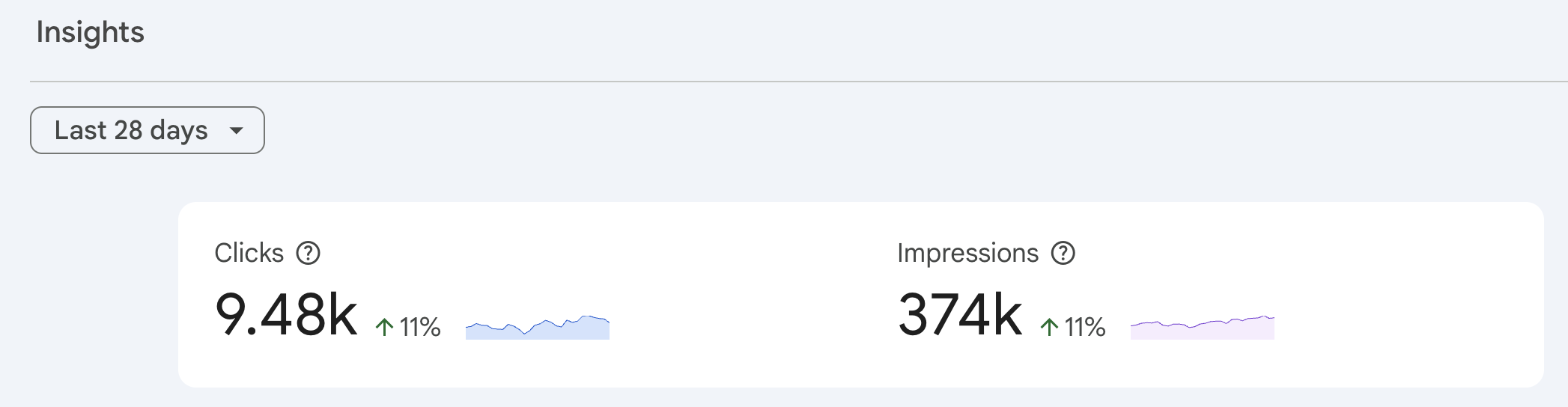
- Google Search Console: Check “Total Impressions” under Performance > Search Results (Example below)
3. Organic Traffic (Sessions & Users)
What it is: Visitors landing on your site from unpaid search results. Track both total sessions and unique users to understand reach vs. engagement.
Why it matters: Growing organic traffic means your content is reaching more potential customers. Combined with conversion data, it shows scalability potential.
How to track it:
- Google Search Console: Performance > Search Results > Total Clicks
- GA4: Reports > Acquisition > Traffic Acquisition (filter by Organic Search)
Track by:
- Landing pages (which content drives traffic?)
- Geographic location (where are visitors coming from?)
- Device type (mobile vs. desktop performance)
- New vs. returning users (audience expansion vs. retention)
4. Organic Click-Through Rate (CTR)
What it is: The percentage of people who see your listing in search results and actually click through to your site.
Formula: (Clicks ÷ Impressions) × 100
Why it matters: High impressions with low CTR? Your titles and meta descriptions aren’t compelling enough, or you’re ranking for irrelevant queries. Strong CTR indicates relevance and persuasive SERP presentation.
How to track it:
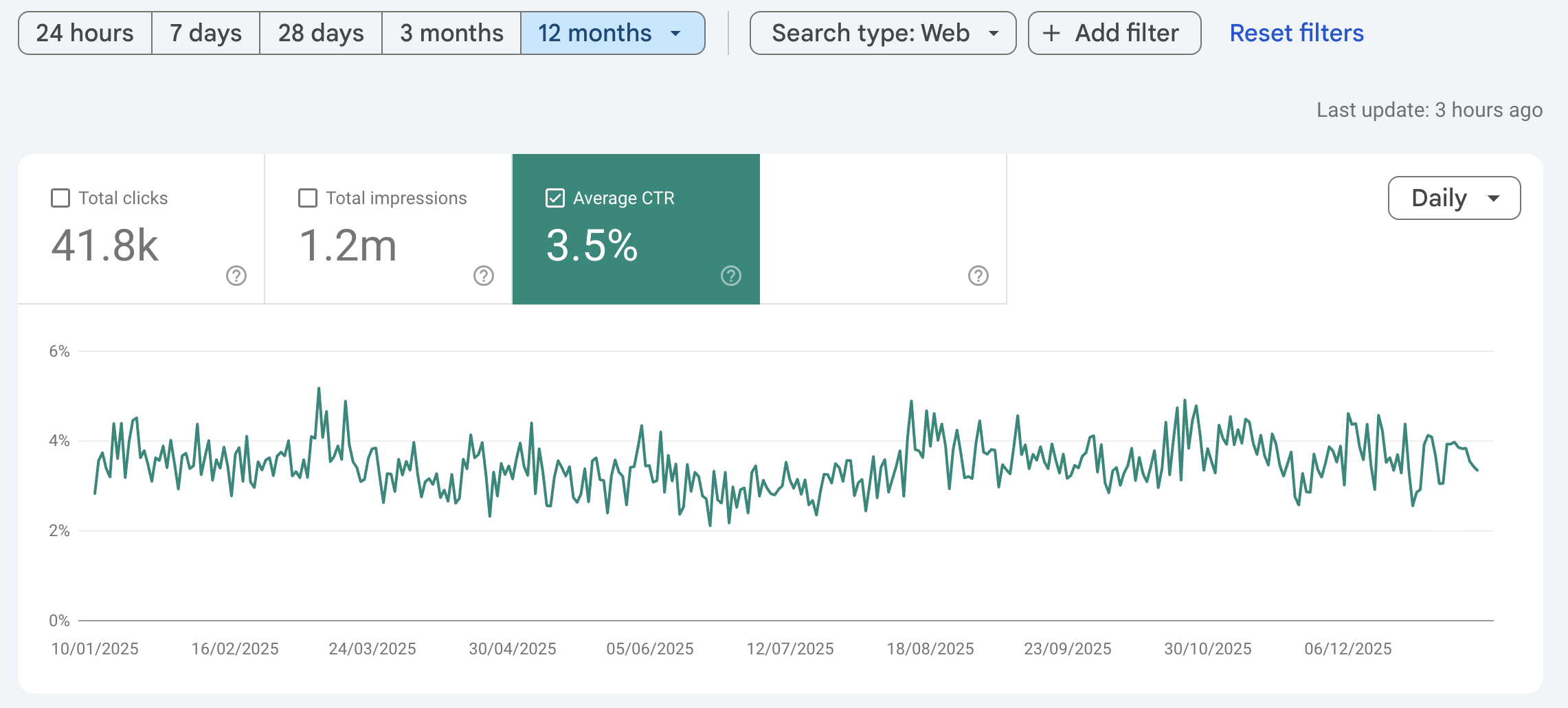
Google Search Console > Performance > Search Results > Average CTR
View by:
- Individual pages (which URLs need optimization?)
- Specific queries (which keywords need better title tags?)
- Position brackets (are you getting expected CTR for your rankings?)
Benchmark: Position 1 typically achieves 25-35% CTR, Position 2-3 around 10-15%, Position 4-10 drops to 2-5%.
5. Keyword Rankings & Ranking Distribution
What it is: Where your pages appear in search results for target keywords. More importantly: how your ranking distribution is evolving.
Why it matters: Rankings directly impact visibility and click-through rates. But tracking the movement of rankings from positions 11-20 into the top 10, or from positions 4-10 into top 3, shows momentum and helps prioritise optimisation efforts.
How to track it:
Use rank tracking tools to monitor:
- Current positions for all target keywords
- Ranking changes (daily/weekly trends)
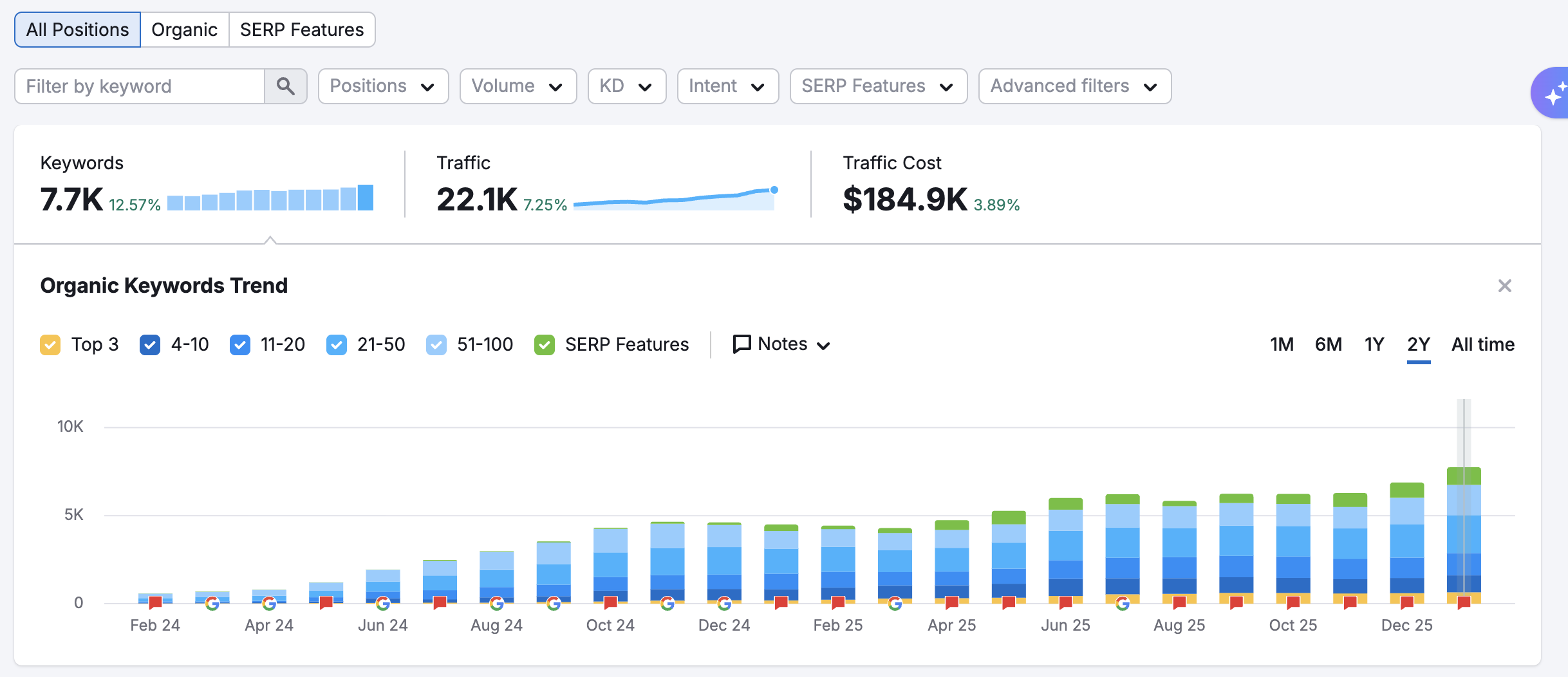
- Ranking distribution (how many keywords in positions 1-3, 4-10, 11-20, 21-50, 51-100)
- SERP feature ownership (featured snippets, local pack, etc.)
Our agency approach: We don’t just chase high-volume keywords, especially a new business. Our specialists identify keyword clusters that balance search volume, conversion intent, and competitiveness to maximise ROI.
We utilise SEMrush for our organic position tracking and ranking distribution for SEO KPIs – along with our Agency SEO rankings dashboard.
6. Backlink Metrics
What it is: Incoming links from other websites to yours. Quality beats quantity—one link from a .edu or authoritative industry publication outweighs 50 directory links.
Track these metrics:
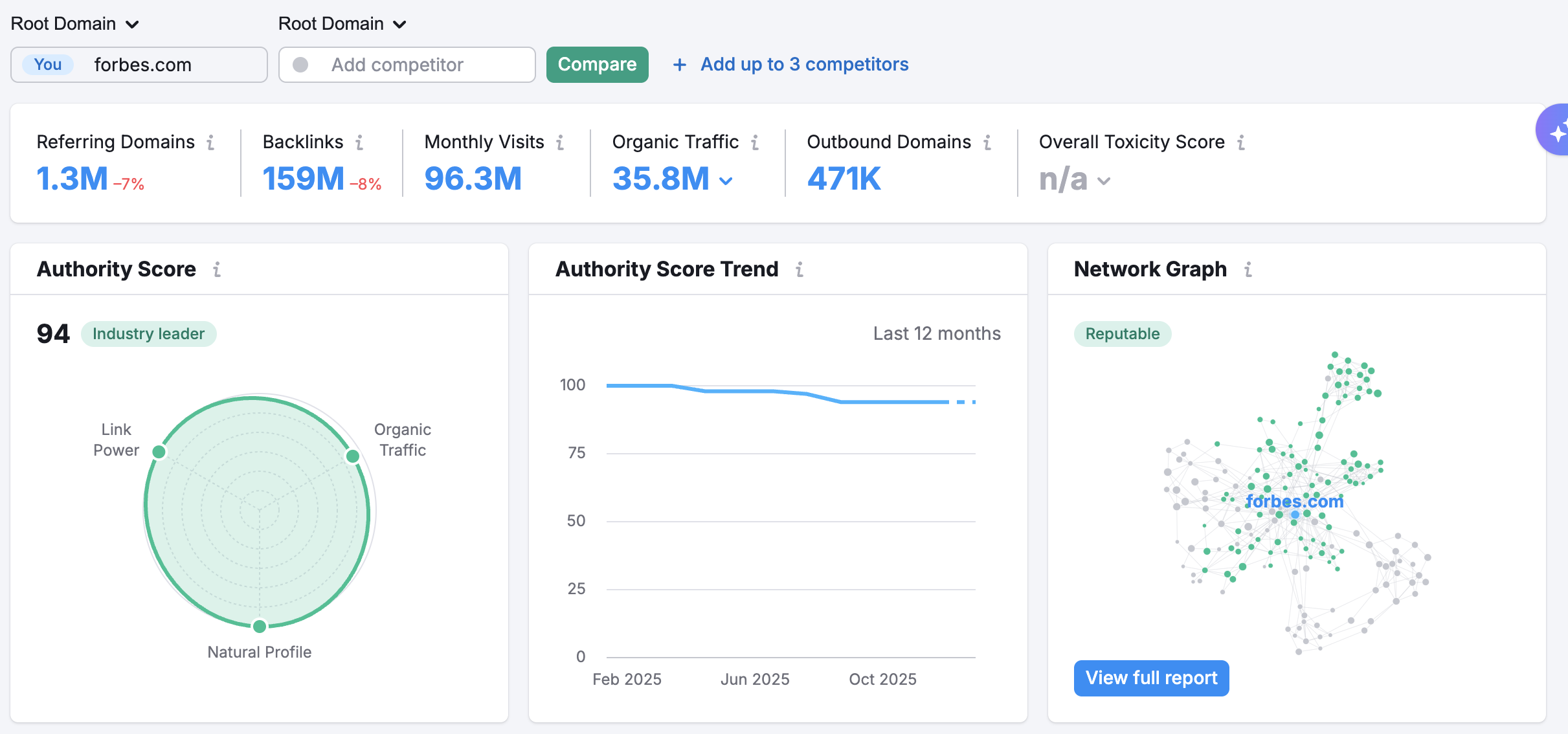
- Total referring domains
- Total backlinks
- Domain authority/quality of linking sites
- New backlinks acquired
- Lost backlinks
- Toxic backlink ratio
Why it matters: Backlinks remain a critical ranking factor. They signal authority, trust, and relevance to search engines.
How to track it:
Use backlink analysis tools to monitor:
- Link acquisition rate
- Link quality scores
- Competitor backlink gaps
- Toxic links requiring disavowal
7. User Engagement Metrics
What it is: How visitors interact with your site once they land on it.
Key engagement KPIs:
Bounce Rate: Percentage of visitors who leave within 10 seconds without interaction
- Ideal: Under 40% for most pages (lower for landing pages, higher acceptable for blogs)
- Signals: content relevance, page experience, alignment with search intent
Average Engagement Time: How long users actively interact with your site
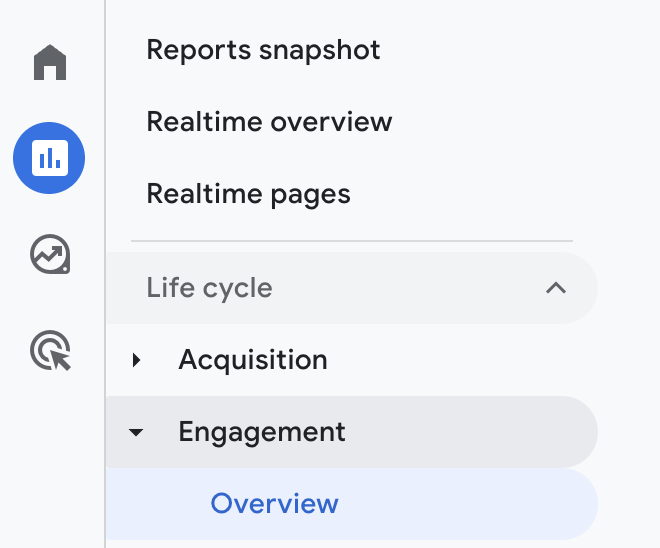
- Track in GA4: Reports > Engagement > Overview
- Longer engagement suggests valuable, compelling content
Pages Per Session: Average number of pages viewed per visit
- Higher = better internal linking and content discoverability
- Benchmark: 2-4 pages for most business sites
Return Visitor Rate: Percentage of traffic that’s returning vs. new
- Growing return rate = building audience loyalty
- Balance needed: new visitors for growth, returning for retention
Why it matters: Google’s algorithm increasingly factors user satisfaction signals. Poor engagement can suppress rankings over time.
8. Page Experience Metrics (Core Web Vitals)
What it is: Google’s technical performance metrics measuring loading speed, interactivity, and visual stability.
The three Core Web Vitals:
- Largest Contentful Paint (LCP): Loading performance
- Good: Under 2.5 seconds
- First Input Delay (FID) / Interaction to Next Paint (INP): Interactivity
- Good: Under 200ms (INP)
- Cumulative Layout Shift (CLS): Visual stability
- Good: Under 0.1
How to track it:
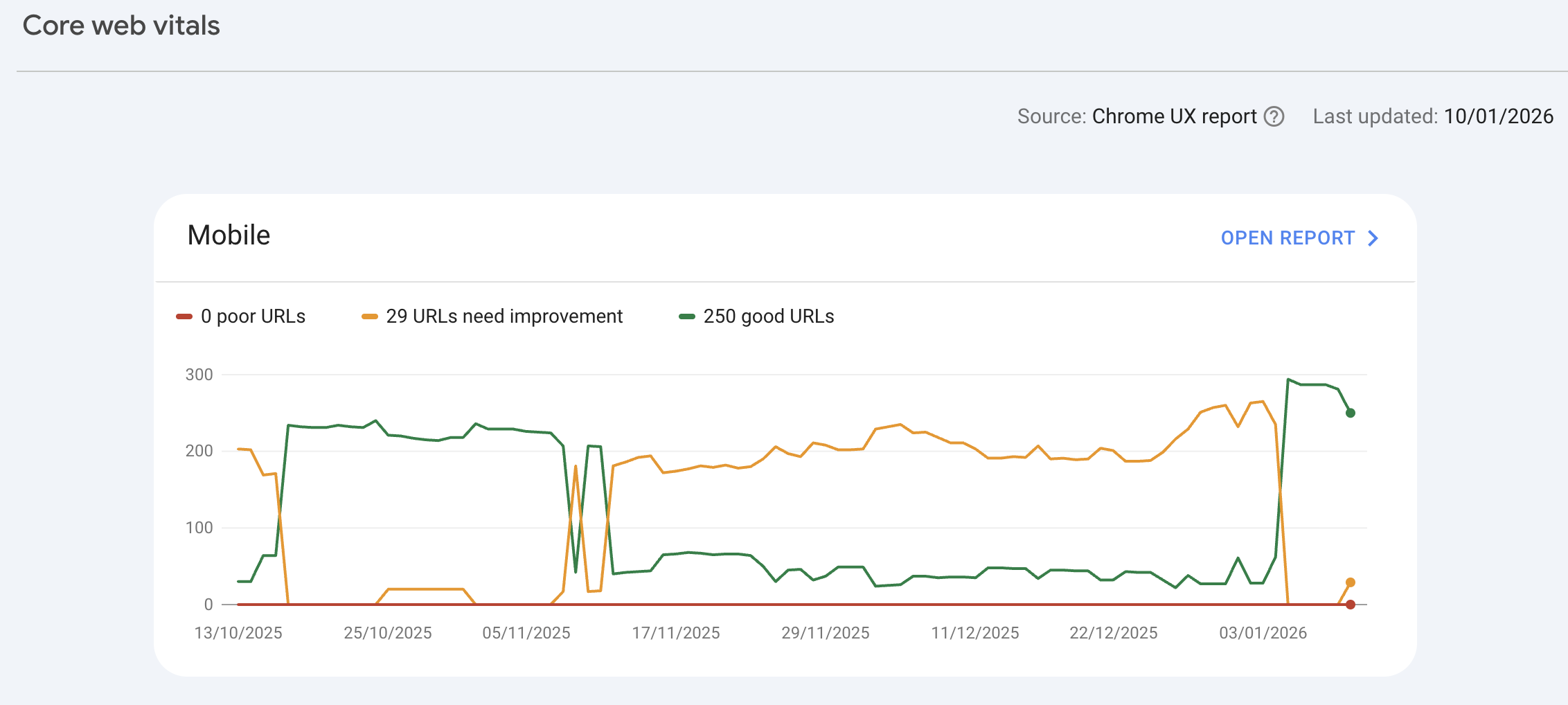
- Google Search Console: Experience > Core Web Vitals
- PageSpeed Insights: Test individual URLs
- GA4: Can be configured to track these metrics
Why it matters: Page experience is a confirmed ranking factor. Poor performance costs you visibility AND conversions (users abandon slow sites).
AI-Era SEO KPIs: The 2026 Competitive Edge
The SEO game changed fundamentally with AI. Here’s what forward-thinking agencies (like us) are now tracking:
9. AI Search Visibility
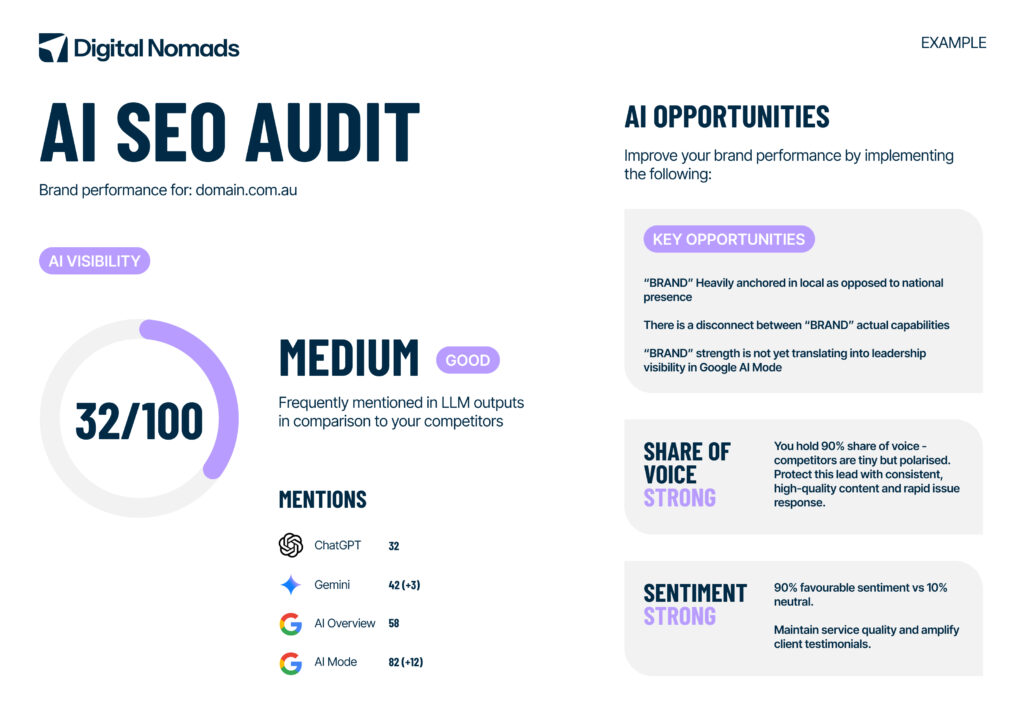
What it is: Your presence and citation frequency in AI-powered search experiences like Google’s AI Overviews (formerly SGE), ChatGPT search, Perplexity, and Bing Copilot.
Why it matters: By 2026, an estimated 25-40% of searches are answered through AI-generated summaries rather than traditional blue links. If you’re not visible in AI results, you’re missing a massive chunk of opportunity.
How to track it:
- Manual monitoring: Search your target queries in ChatGPT Search, Google AI Overviews, Perplexity
- Tracking tools: Emerging platforms like BrightEdge and seoClarity now include AI visibility metrics
- Citation tracking: Monitor how often your brand/content is cited in AI responses
Track:
- Visibility rate (% of target queries where you appear in AI results)
- Citation positioning (are you the primary or secondary source?)
- Competitor displacement (are you cited instead of competitors?)
Digital Nomads HQ approach: Our team collaboratively monitors traditional + AI search to ensure comprehensive visibility. We optimize content structure, schema markup, and E-E-A-T signals specifically for AI crawlers.
10. Semantic Relevance Score
What it is: How well your content aligns with the semantic intent and context of target queries—beyond exact keyword matching.
Why it matters: Google’s algorithms are now sophisticated enough to understand topic relationships, context, and intent. AI can read content like humans do. Keyword stuffing is dead; topical authority is everything.
How to track it:
- Content optimization tools: Use platforms that analyze semantic coverage and topic depth
- Entity analysis: Track mentions of relevant entities (people, places, concepts) and their relationships
- Topic clustering: Measure how well your content covers related subtopics
Metrics to monitor:
- Topic authority scores
- Entity coverage vs. top-ranking competitors
- Semantic keyword coverage (related terms, synonyms, context phrases)
- Content depth scores
11. AI Content Quality Scores
What it is: With AI-generated content flooding the web, search engines are getting better at identifying low-quality AI content. This KPI measures content authenticity and quality signals.
Why it matters: Using AI for content is fine (we do it). Publishing unedited, generic AI content is not. Search engines are penalizing thin, AI-generated pages that don’t add unique value.
Track these indicators:
- AI detection scores: Use tools like Originality.AI or GPTZero to benchmark your content
- E-E-A-T signals: Experience, Expertise, Authoritativeness, Trustworthiness
- Unique value adds: Original research, case studies, expert quotes, proprietary data
- Content freshness: Regular updates and refinements
Digital Nomads HQ standard: We use AI to scale content production, but every piece is refined by our specialists with industry expertise, original insights, and on-brand voice. Because algorithm updates punish generic content.
12. Voice Search & Conversational Query Performance
What it is: Rankings and traffic from voice-activated searches and natural language, conversational queries (typically longer, question-based).
Why it matters: Voice search is growing, and conversational queries are now dominant (especially with AI assistants). These searches have different optimization requirements than traditional short-tail keywords.
How to track it:
- GA4: Analyze landing page traffic from long-tail, question-based queries
- GSC: Filter for question keywords (who, what, where, when, why, how)
- Voice search tools: Monitor featured snippet ownership (voice assistants often read these)
Optimization focus:
- FAQ-style content
- Natural language optimization
- Featured snippet targeting
- Local SEO (many voice searches are local: “near me” queries)
Business Impact KPIs: What Your Stakeholders Actually Care About
13. Customer Lifetime Value from Organic (CLV)
What it is: The total revenue a customer acquired through organic search generates over their entire relationship with your business.
Why it matters: Not all traffic is equal. If your organic channel attracts high-value, loyal customers, it deserves more investment—even if cost per acquisition is higher initially.
How to calculate:
CLV = (Average Purchase Value) × (Purchase Frequency) × (Customer Lifespan)
Example:
Average order: $150
Orders per year: 4
Customer retention: 3 years
CLV = $150 × 4 × 3 = $1,800
Track by channel: Compare CLV of customers acquired through organic search vs. paid ads vs. social media. You might find organic customers have 2-3x higher lifetime value.
14. Cost Per Acquisition (CPA)
What it is: What it costs to acquire one converting customer through SEO.
Why it matters: ROI isn’t just about revenue—it’s about profit. CPA shows efficiency of your SEO investment relative to results.
How to calculate:
CPA = Total SEO Costs ÷ Total Conversions
Include all costs:
- Agency fees or in-house salaries
- Content creation and production
- SEO tools and software
- Link building and outreach
- Technical development
Example:
Monthly SEO investment: $8,000
Monthly organic conversions: 120
CPA = $8,000 ÷ 120 = $66.67 per conversion
Trend to watch: CPA should decrease over time as SEO compounds. If it’s rising, there’s a problem with strategy or execution.
Reality check: SEO isn’t instant. Track CPA over 6-12 month periods, not month-to-month.
15. Non-Branded vs. Branded Traffic
What it is:
- Branded traffic: Searches including your company/product name
- Non-branded traffic: Searches for industry terms, solutions, problems—without your brand
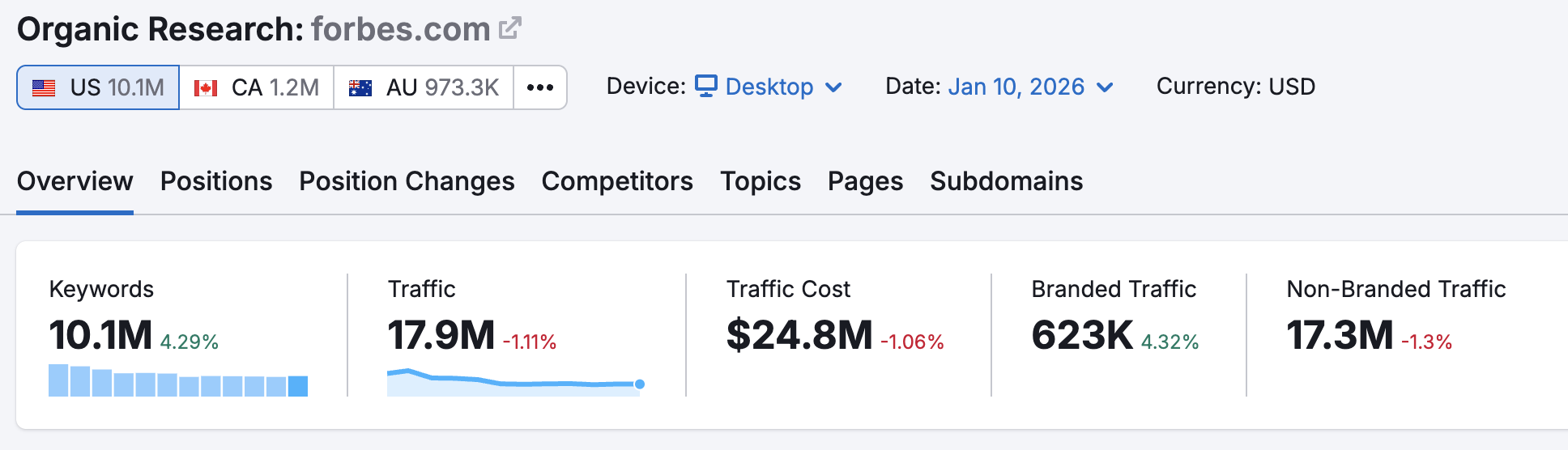
Why it matters: Branded traffic shows awareness but doesn’t prove SEO effectiveness. Non-branded traffic demonstrates you’re capturing new market share and reaching users who don’t know you yet.
How to track:
Use keyword tracking tools to segment:
- Brand keyword performance
- Non-brand keyword performance
- Traffic and conversion rates for each
Ideal scenario: Both growing, but non-branded traffic increasing faster shows market expansion.
Digital Nomads HQ insight: We focus heavily on non-branded growth because that’s where competitive advantage lives. Our specialists identify high-intent, low-competition queries your competitors miss.
SEMrush and similar tools allow you to measure Branded vs Non-Branded Traffic;
16. SEO Return on Investment (ROI)
What it is: The ultimate KPI. How much revenue did you generate compared to what you spent?
Why it matters: Everything else is secondary to this. Positive ROI justifies SEO investment. Negative ROI demands strategy changes.
How to calculate:
ROI = [(Revenue from SEO – Cost of SEO) ÷ Cost of SEO] × 100
Example:
SEO investment: $10,000/month
Revenue generated: $45,000/month
ROI = [($45,000 – $10,000) ÷ $10,000] × 100 = 350%
For every $1 spent on SEO, you’re generating $4.50 in revenue.
Track both:
- Short-term ROI (current month/quarter)
- Cumulative ROI (since SEO program launch)
Expectation management: SEO typically shows minimal ROI in months 1-3, breakeven in months 4-6, and strong positive ROI from month 7+ as rankings compound.
Try our SEO ROI Calculator to help you set your KPIs;
17. Google Business Profile Performance (Local SEO)
What it is: For local businesses, your GBP metrics show how customers discover and interact with your listing in Google Search and Maps.
Why it matters: Local searches drive massive commercial intent. “Near me” queries and map searches convert at higher rates than general web searches.
How to track:
Set up Google Business Profile Insights to monitor:
- Discovery: How customers find you (direct search, discovery search, maps)
- Total searches: Impressions in local search
- Profile views: Clicks to view full business profile
- Actions taken:
- Website clicks
- Direction requests (huge intent signal)
- Phone calls
- Messages
- Booking clicks
Local SEO KPIs:
- Local pack rankings (positions 1-3 in map pack)
- Review quantity and average rating
- Review response rate
- Photo views and engagement
Sunshine Coast advantage: Digital Nomads HQ specializes in local SEO for Australian businesses. We understand the unique competitive dynamics in regional markets.
How to Start Tracking Your SEO KPIs
1. Define Your Objectives
What are you trying to achieve? More leads? More revenue? Brand awareness? Different goals require different KPI priorities.
2. Set Up Your Tech Stack
Essential tools:
- Google Analytics 4 (free)
- Google Search Console (free)
- Rank tracking software
- Backlink analysis tool
- AI search monitoring (new)
3. Establish Baselines
Before you can measure improvement, you need to know where you started. Document current performance for all chosen KPIs.
4. Create Reporting Cadence
- Weekly: Quick health checks on traffic, rankings, technical issues
- Monthly: Full KPI dashboard review
- Quarterly: Strategic reviews with stakeholder reporting
5. Benchmark Against Competitors
Track your performance relative to key competitors—not just in isolation.
Stop Tracking Vanity Metrics. Start Driving Results.
Look, most agencies will dazzle you with traffic graphs and ranking improvements while your actual revenue stays flat. That’s not how we operate.
At Digital Nomads HQ, our team of specialists—not generalists—focuses on the KPIs that correlate with real business outcomes. We’ve built our SearchLight framework on 25+ years of combined experience, hundreds of campaigns, and award-winning results.
We track:
✓ The core fundamentals (traffic, rankings, conversions)
✓ The AI-era metrics (semantic relevance, AI visibility, voice search)
✓ The business impact numbers (ROI, CLV, CPA)
And we report it all transparently, because integrity is one of our core pillars.
We’re not here to play small. And neither should your SEO strategy be.
Ready to Track KPIs That Actually Matter?
If you’re done with agencies that report on vanity metrics while your competitors eat your lunch, let’s talk.
Digital Nomads HQ is proudly based on the Sunshine Coast but works with businesses across Australia. Our specialists deliver measurable results across SEO, Google Ads, Web Design, Social Media, and the full digital marketing suite.