Pest Control Digital Marketing Playbook for 2026
Why Most Pest Control Businesses Lose 70% of Their Emergency Calls (And How to Fix It in 30 Days)
Let’s be direct: When someone searches “termite inspection near me” at 10 PM, they’re not comparison shopping.
They’ve just found damage in the skirting board. They’ve seen a rat in the kitchen. They’re stressed, and they need an expert now.
This is your market. High-intent customers who will pay premium rates for fast, professional service. They’re searching right now in Parramatta, Perth, and every suburb in between.
The problem?
Most pest control businesses market themselves like they’re selling furniture.
Slow websites, vague messaging, no clear path to booking etc etc etc
and don’t get me started on the lead to sale response times…
Meanwhile, your direct competitor with a worse service but better Google ranking is answering their phone.
Here’s what the data shows:
- 78% of local mobile searches result in a purchase within 24 hours (Google, 2024)
- 70% of consumers who find a local business on Google visit within 5km (BrightLocal)
- The average pest control customer calls 1.3 businesses before booking—not 5 or 10
Translation: If you’re not in the top 3 results or now present in AI overviews or any similar AI search models when they search, you don’t exist.
At Digital Nomads HQ, we’ve audited over 1000 pest control businesses in the years we have marketed and see very similar language, opportunities and repetitive mistakes…
What hurts us (and you) most, is that many are bleeding leads because of basics, and fixable mistakes.
Here’s a blueprint from some of the key areas we commonly see to stop losing customers to your competitors down the road.
1. The Map Pack: Your 24/7 Sales Representative
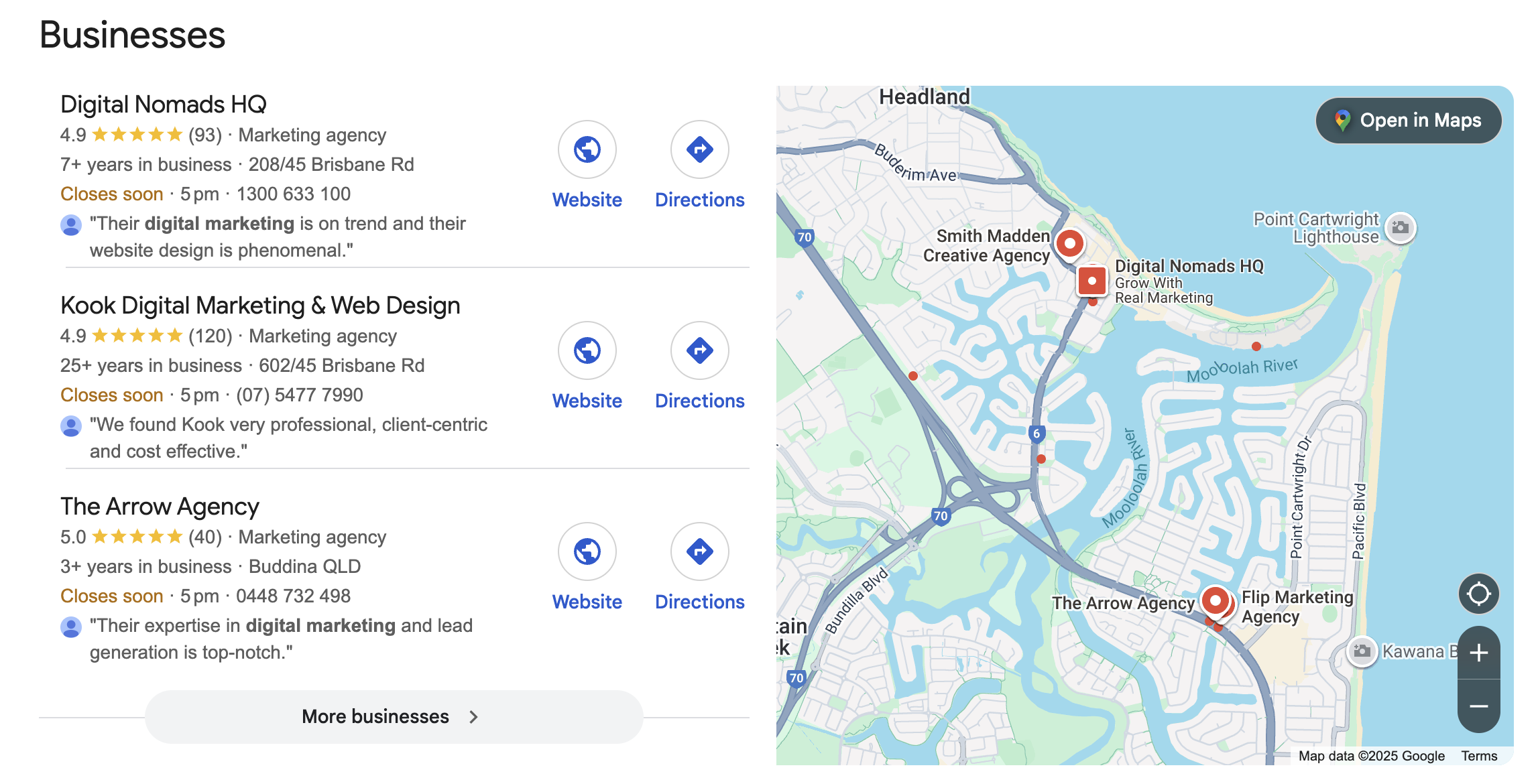
Quick test: Open Google on your phone right now and search “pest control [your suburb].”
See those three businesses with the map pins at the top? That’s the Local Map Pack, and it’s worth more than any billboard you’ll ever buy.
The stakes:
- Position #1-3 in Map Pack: ~70% of all local clicks
- Position #4+: You’re basically invisible
- Cost to your business: ~$47,000/year in lost revenue (based on average pest job value of $350 × 2.7 jobs/week)
So why are you sitting at #6 while your competitor with 4 Google reviews ranks above your 23?
Mistake #1: The Category Trap
Most pest controllers tick “Pest Control Service” and call it done. Google’s algorithm sees you as one-dimensional.
The fix: Add every relevant sub-service as its own category:
- Pest Control Service (primary)
- Bird Control Service
- Termite Inspection Service
- Insulation Contractor (if you do roof void work)
- Rodent Control Service
Why it works: When someone searches “bird removal Sydney,” Google prioritises businesses that explicitly list bird control as a service category.
Time to implement: 5 minutes
Impact: We’ve seen clients jump 3-5 positions in Map Pack rankings within 2 weeks
Mistake #2: Treating Your Profile Like a Business Card
An inactive Google profile tells Google (and customers) you’re not busy. Dead businesses don’t get priority.
The Weekly Activity System:
Every Monday morning:
- Upload 1 photo from last week’s jobs
- Geotag it with the specific suburb (e.g., “Termite barrier installation, North Lakes”)
- Add a 1-line description: “Pre-purchase termite inspection for family moving into their first home”
Time investment: 3 minutes per week
Result: Google sees your business as active in that specific location.
Mistake #3: The "We Service Everywhere" Fantasy
Hard truth: You can’t rank in a suburb 40km from your HQ just by listing it on your “Service Areas” page.
Google’s proximity algorithm prioritises:
- Businesses physically located in the search area
- Businesses with strong location-specific content
- Everyone else (you)
The “Location Page” Strategy:
Create individual pages for your 10 highest-value suburbs:
- URL: yoursite.com.au/termite-control-north-lakes (See Flick with their Sydney Pest Control Page example below)

- Embed a Google Map of that specific area
- Include suburb-specific content: “We’ve treated over 300 properties in North Lakes since 2019. Most common issues: subterranean termites due to high water table…”
- Add 2-3 customer testimonials from that suburb (with photos of the actual property if possible)
- Local landmarks: “Servicing North Lakes, including areas near Westfield North Lakes, Mango Hill Station…”
Why it works: You’re creating location-specific relevance signals that Google can’t ignore.
2. Google Ads: Stop Paying for People Who'll Never Call You
PPC is the fastest way to get leads. It’s also the fastest way to burn $2,000/month on people who have zero intention of booking.
The biggest leak we see when auditing pest control accounts?
You’re paying $12-18 per click for people searching:
- “Bunnings ant sand” (DIYers looking for $9 solutions)
- “What do termites look like” (Information seekers, not buyers)
- “Pest control jobs” (People looking for employment)
- “How to get rid of…” (YouTube tutorial hunters)
The Negative Keyword Shield
Here’s our battle-tested negative keyword list for pest control:
Block immediately:
- bunnings, diy, homemade, natural, recipe, spray, powder
- job, jobs, career, hiring, employment, salary
- how to, what do, can I, is it possible
- free, cheap, cheapest, discount (unless you compete on price)
- pictures, images, photos, video
The ROI shift:
One Sydney client was spending $4,200/month on Google Ads with a 19% conversion rate (call to booking). After implementing our negative keyword strategy, spend dropped to $2,800/month but conversion rate jumped to 34%.
Same leads. 33% less cost.
Bid High on Urgency, Block Everything Else
High-intent keywords to dominate:
- Emergency + [pest type]
- [Pest] removal + [urgent/today/now]
- [Pest] inspection
- [Pest] treatment
- Exterminator near me
Why “exterminator”? Americans search this term, but so do Aussies who watch too much US TV. It’s lower competition and converts beautifully.
Pro tip: Set up separate ad campaigns for “Emergency” keywords with higher bids ($20-30/click). These people book same-day at premium rates. Your ROI justifies the cost.
Want to get a better understanding of the cost of your next Google Ads campaign? check out our Google ads cost guide…
3. Your Website: The "3-Second Rule"
If your website takes longer than 3 seconds to load on mobile, you’re losing 40% of potential customers before they even see your content.
Test your site right now: Google PageSpeed Insights (free tool)
Quick fixes:
- Compress all images (use TinyPNG)
- Remove unnecessary plugins
- Enable browser caching
- Use a CDN (Cloudflare free tier works)
Not technical? Ask your web developer to implement these. If they say “it’s fine,” find a new developer.
Mobile Speed Kills (Your Business)
Your website has one job: Get the phone to ring.
Stop trying to win design awards. Stop the auto-playing videos. Stop making customers hunt for your phone number.
The brutal truth: 68% of mobile visitors leave a website if they can’t find contact info within 3 seconds (Stanford Web Credibility Research).
Anatomy of a Converting Pest Control Website
Header (visible at all times… Like ours):
- Phone number in large text (click-to-call on mobile)
- “Book Online” button in high-contrast color
- Trust badges top-right: AEPMA member, Licensed, Insured logos… like below;
Hero Section (what they see immediately):
- Clear headline: “Termite Inspections & Emergency Pest Control | [Your Suburb]”
- Sub-headline: “Same-Day Service Available | 15+ Years Experience”
- Prominent “Call Now” or “Get Free Quote” button
- Photo of YOUR actual truck/technician (not stock images)
The Trust Stack (fold 2):
- Google star rating with review count
- “As Seen In” logos if you’ve been in local media
- Simple 3-step process: “1. Call Us → 2. We Inspect → 3. Problem Solved”
The No-BS Quote Form:
Don’t ask for:
- Street address (not needed yet)
- Property type and size (you’ll assess on-site)
- Long dropdown menus
Only ask for:
- Name
- Phone number
- Suburb/postcode
- “What’s the pest?” (dropdown: Termites, Rodents, Cockroaches, Spiders, Other)
- Optional: “When do you need service?” (Urgent/This Week/Next 2 Weeks)
Why this works: Every field you add reduces conversions by ~11%. Keep it simple.
4. Reviews: The System Your Competitors Don't Have
Let’s address the elephant: You can’t buy reviews. Google will ban you.
But you can build a system that generates authentic reviews on autopilot.
The Service Excellence Follow-Up
Here’s what works (and is 100% compliant):
Step 1: Train your technicians on customer service excellence
- Leave the site cleaner than you found it
- Explain what you did and why
- Give prevention tips
- Answer all questions patiently
Step 2: Send a follow-up SMS within 2 hours of job completion
“Hi [Name], this is Dave from [Business]. Just checking the termite treatment went smoothly today. If you have any questions, call me directly on [number]. If you were happy with our service, we’d really appreciate a review – it helps other families find us: [Google Review Link]”
Step 3: Send an email 3 days later (if no review)
Keep it personal. Include a photo of the technician who did the job. Make it about helping other customers, not about boosting your business.
Responding to Reviews (Even Bad Ones)
5-star reviews:
Thank them personally. Mention the technician by name. Keep it brief.
“Thanks Sarah! Dave will be thrilled to hear this. We’re always here if you need us.”
1-2 star reviews:
Never argue. Never make excuses.
Acknowledge their experience, offer to make it right (publicly), then take it offline.
“We’re disappointed we didn’t meet your expectations, John. This isn’t the standard we hold ourselves to. I’d like to understand what happened and make it right. Please call me directly on [number] – [Your Name], Owner”
Why this matters: 89% of consumers read review responses. How you handle criticism shows future customers who you really are.
5. Local Service Ads: The Premium Lead Channel You're Ignoring
If you haven’t set up Google Local Service Ads (the ones with the green “Google Guaranteed” tick), you’re leaving money on the table.
Why LSAs Are Different
Traditional Google Ads:
You pay per click ($15-25)
Could be a DIYer, competitor, or someone just browsing
You eat the cost either way
Local Service Ads:
You pay per lead ($25-50)
Only pay when someone calls or messages
Can dispute spam/irrelevant leads for refunds
You appear above all other ads
The Google Guaranteed badge tells customers: “Google has verified this business’s license, insurance, and background checks.”
The Barrier to Entry (Why Your Competitors Aren’t There)
Setting up LSAs requires:
- Business license verification
- Insurance documentation upload
- Background checks for business owners
- Minimum review threshold (varies by region)
This scares off 70% of pest control operators. The dodgy ones can’t qualify. The lazy ones don’t want the hassle.
For you? This is an advantage. Less competition = lower cost per lead.
Real numbers: A Sydney pest controller spends $1,800/month on LSAs and gets 45-60 qualified leads. That’s $30-40 per lead vs. $80-120 per lead on traditional Google Ads.
6. The "But I'm Too Busy" Objection
Here’s the paradox: The busier you are, the more these systems matter.
Because being busy today doesn’t mean you’ll be busy next month.
Pest control is seasonal. Summer is gangbusters. Winter is quiet (except for rodents and spiders). If you’re not building your digital presence during peak season, you’ll starve during the slow months.
The compound effect:
- Month 1: Implement systems → see 10% lead increase
- Month 3: Google starts favoring your more active profile → 25% increase
- Month 6: Review volume crosses threshold → you rank for more suburbs → 60% increase
- Month 12: You’re the default choice in 5 suburbs → competitors now copy you
This isn’t a quick fix. It’s infrastructure.
What To Do Right Now
Week 1 Priorities:
- Audit your Google Business Profile (add categories, upload photos)
- Test your website on mobile (is the phone number easy to find?)
- Set up Google Ads negative keywords (block DIY terms)
Week 2-3:
4. Create 3-5 location pages for your highest-value suburbs
5. Implement the review follow-up system (SMS + email templates)
Week 4:
6. Apply for Google Local Service Ads
7. Run PageSpeed test and fix load time issues
The Investment:
If you’re doing this yourself: ~10 hours over 4 weeks
If you’re outsourcing: $2,500-4,500 one-time setup
The Return:
15-40% more leads within 90 days, with no increase in ad spend.
The Real Question
You didn’t start a pest control business to become a marketing expert.
You started it because you’re good at solving problems, you know how to run a tight operation, and you want to build something that lasts.
But here’s the reality: The best technician doesn’t win. The most visible one does.
Your competitors aren’t better than you. They’re just easier to find.
Let’s Look Under the Hood
We’ve worked with 200+ pest control businesses across Australia. We know what good looks like—and what’s costing you leads.
Free 15-Minute Audit:
We’ll show you exactly where you rank, what you’re missing, and the 3 highest-ROI fixes for your business. No sales pitch. No obligations.