If you’ve been in business for more than five minutes, someone’s told you that you need a marketing funnel. And they’re right. But here’s the problem… most of the advice floating around treats the funnel like a textbook diagram instead of what it actually is: a practical framework for understanding how real people go from “I’ve never heard of you” to “take my money.”
The marketing funnel isn’t new. The concept dates back to 1898 when an American advertising strategist named Elias St. Elmo Lewis created the AIDA model (Awareness, Interest, Desire, Action). Over a century later, the core idea still holds up.
People don’t buy from businesses they’ve never heard of, and they don’t buy instantly either. They move through stages… and your marketing needs to meet them at each one.
In this guide, we’ll break down how the marketing funnel works, what each stage actually means for your business, how it differs for B2B and B2C, and (most importantly) how to build one that converts… with real examples and practical steps you can start using today.
What Is a Marketing Funnel?
A marketing funnel is a visual framework that maps the journey a potential customer takes from first discovering your brand to making a purchase (and ideally, becoming a loyal repeat customer). It’s called a “funnel” because at the top, you’re reaching a broad audience.
As people move through the stages, some drop off… and the pool narrows until you’re left with those who actually buy.
Think of it this way. If 10,000 people see your Facebook ad, maybe 2,000 click through to your website. Of those, maybe 500 explore your services. And maybe 50 actually enquire or purchase. That narrowing? That’s the funnel in action.
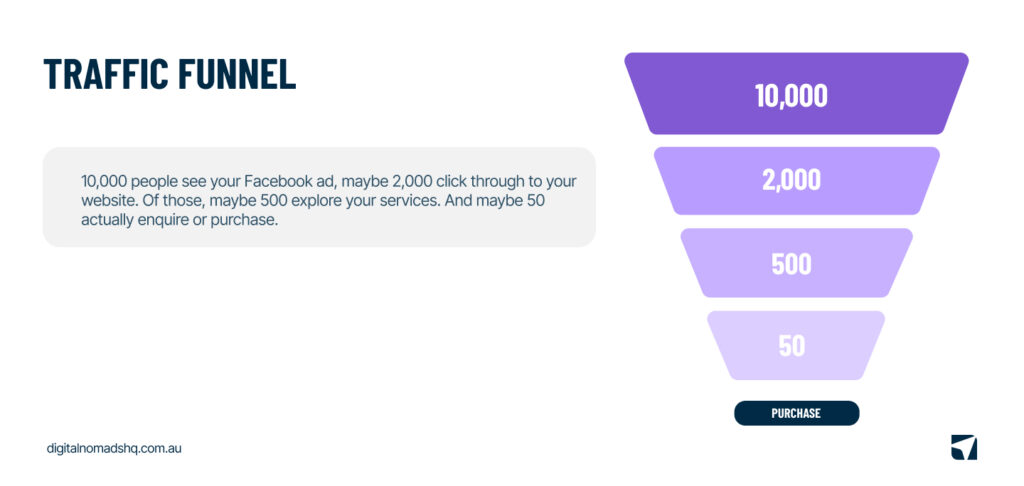
The goal isn’t to eliminate the narrowing (that’s impossible… not everyone is your customer). The goal is to make the funnel as efficient as possible, so fewer qualified people drop off at each stage.
PRO TIP: A common mistake is obsessing over the top of the funnel (getting more traffic) while ignoring the middle and bottom (where conversions actually happen). If your website gets 10,000 visitors a month but only converts at 0.5%, fixing the funnel will do more for your revenue than doubling your traffic.
Marketing Funnel vs Sales Funnel vs Conversion Funnel: What’s the Difference?
These terms get thrown around interchangeably, but they’re not quite the same thing. Here’s the short version:
Marketing funnel: Focuses on attracting and nurturing leads from awareness through to the point they’re ready to buy. Owned primarily by marketing teams. The emphasis is on content, advertising, SEO, social media, and email nurture.
Sales funnel: Picks up where the marketing funnel hands off. Focuses on converting qualified leads into paying customers through proposals, demos, negotiations, and closing. Owned primarily by sales teams.
Conversion funnel: A broader, more technical term. Describes the specific path a user takes on your website (or app) from landing to completing a desired action… whether that’s a purchase, a form submission, or a sign-up. Often used in eCommerce and UX contexts.
In practice?
For most small and medium businesses in Australia, marketing and sales funnels overlap significantly.
Unless you have a dedicated sales team running outbound calls, your marketing IS your sales funnel. Your website, your content, your ads, your email sequences… they’re doing the selling.
The Stages of a Marketing Funnel (And What to Do at Each One)
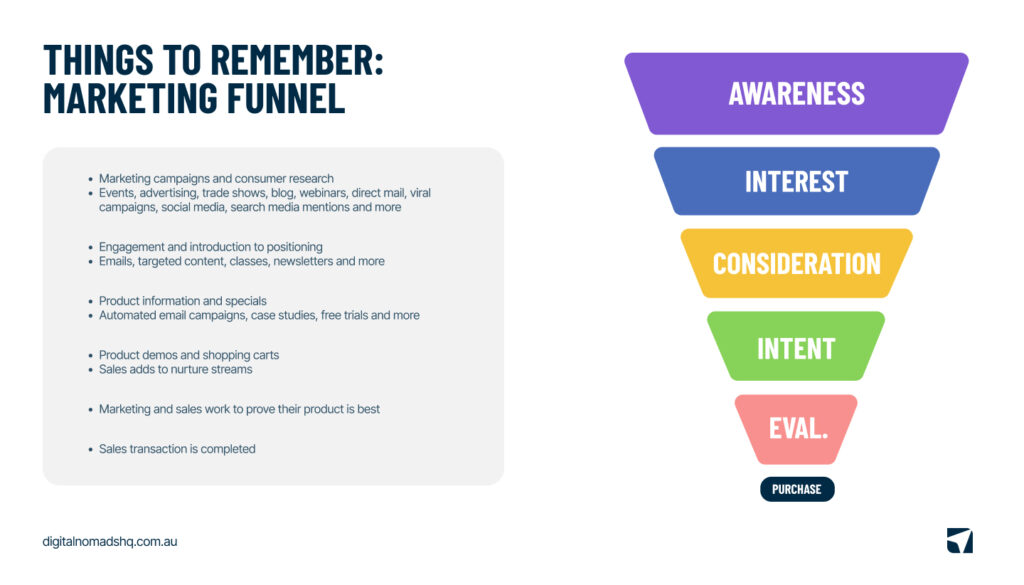
Top of Funnel (TOFU): Awareness & Interest
This is where it all starts. Your potential customers know they have a problem or a need… but they haven’t found the solution yet.
They might not even know your business exists.
Your job at TOFU is to get noticed and earn attention.
At this stage, people are searching broadly.
They’re Googling things like “how to get more customers” or “why isn’t my website getting traffic.” They’re scrolling social media. They’re watching YouTube videos. They’re consuming content… not comparing providers.
TOFU channels and tactics:
SEO-driven blog content and educational guides, social media posts and short-form video (Reels, TikTok, YouTube Shorts), paid social ads (brand awareness campaigns), podcast appearances and guest articles, infographics and shareable resources, Google Display and YouTube pre-roll ads.
TOFU metrics to track: Impressions, reach, website sessions, new users, social engagement, video views.
Middle of Funnel (MOFU): Consideration & Evaluation
Now your audience knows you exist and they’re interested. But they’re not ready to buy yet. They’re comparing options, reading reviews, looking at case studies, and trying to figure out who they trust enough to hand over their money.
This is the stage most businesses neglect. They pump money into awareness (TOFU) and obsess over closing (BOFU), but the middle… the bit where trust is built… gets left with a couple of generic service pages and a hope for the best.
MOFU channels and tactics:
Email nurture sequences, case studies and client success stories, comparison guides and “vs” content, webinars and live Q&A sessions, detailed service or product pages, retargeting ads to website visitors, free tools or calculators, downloadable resources (templates, checklists, eBooks).
MOFU metrics to track: Email open and click rates, time on page, return visits, resource downloads, webinar sign-ups, retargeting click-through rates.
EXPERT TIP: Your MOFU content should answer the question “why you over the competition?” without being salesy about it. Case studies are your best friend here. A well-written case study that shows a real Australian business getting real results does more selling than any amount of “we’re the best” copy ever will.
Bottom of Funnel (BOFU): Decision & Purchase
This is the pointy end.
Your prospect has done their research, narrowed down their options, and is ready to make a decision. Your job at BOFU is to remove the last barriers and make it easy to say yes.
BOFU channels and tactics:
Free consultations or strategy sessions, tailored proposals and quotes, product demonstrations or trials, testimonials and social proof, limited-time offers or guarantees, clear and compelling calls to action, remarketing ads with direct conversion intent.
BOFU metrics to track: Conversion rate, cost per acquisition (CPA), proposals sent, close rate, revenue attributed to organic or paid channels.
Worked Example: Say you run a physiotherapy clinic. A patient Googles “should I see a physio for lower back pain” (TOFU… they read your blog post). A week later, they come back and read your “What to expect at your first appointment” page (MOFU… they’re considering you).
Then they see a retargeting ad offering a free initial assessment (BOFU… they book). That’s a funnel. It’s not complicated. It’s just intentional…
Marketing Funnel Calculator
Plug in your numbers to see estimated revenue and find your biggest funnel leak.
Adjust to match your business
Your Funnel Results
Biggest drop-off: TOFU → MOFU
You're losing 92% of visitors before they become leads.If you improved that stage by 50%...
Post-Purchase: Loyalty & Advocacy
Most funnel guides stop at the sale. That’s a mistake. The most profitable customers aren’t the ones who buy once… they’re the ones who buy again, leave reviews, and refer their mates.
Post-purchase tactics:
Onboarding emails and welcome sequences, loyalty programs and exclusive offers, review and testimonial requests, referral incentives, ongoing content that keeps your brand top of mind, community building (social groups, newsletters, events).
PRO TIP: Acquiring a new customer costs roughly 5 to 7 times more than retaining an existing one. If you’re spending all your marketing budget on awareness but nothing on retention, you’re leaving money on the table. A simple post-purchase email sequence can dramatically increase repeat business and lifetime value.
B2B vs B2C: How Marketing Funnels Differ
B2B vs B2C Marketing Funnels
Same concept. Very different execution. Here's how they compare.
B2C marketing funnels are typically shorter. One person makes the buying decision (sometimes influenced by friends, family, or online reviews).
The sales cycle might be minutes, hours, or days. Emotional triggers, social proof, and convenience play a huge role. Think impulse purchases, flash sales, and Instagram ads that lead directly to checkout.
B2B marketing funnels are longer and more complex. Multiple stakeholders are involved in the decision.
The average B2B buying group involves 5 to 6 people. The sales cycle can stretch over weeks or months. Content needs to be more detailed, more evidence-based, and more ROI-focused. Think whitepapers, webinars, proposals, and multi-touch email sequences.
The key takeaway?
Your funnel should reflect how your customers actually buy… not how you wish they would. A local trades business doesn’t need a 12-email nurture sequence. An enterprise SaaS company probably does.
The Funnel Isn’t Really a Funnel (And That’s OK)
Let’s be honest…
No customer has ever woken up, entered the top of your funnel, and marched obediently through each stage until they bought. That’s not how real life works.
People skip stages. They enter at the middle because a friend referred them. They loop back to the consideration stage after nearly buying. They research on their phone at 11pm, forget about you for two weeks, and then convert after seeing a retargeting ad. The modern customer journey is messy, non-linear, and multi-device.
So why use a funnel at all? Because even though the journey isn’t perfectly linear, the funnel gives you a framework for making sure you have the right content, the right messaging, and the right touchpoints ready for wherever your customers enter and whatever path they take.
EXPERT TIP: Think of the funnel less as a rigid process and more as a coverage check. Ask yourself: do we have content for people who’ve never heard of us? Do we have content for people comparing us to competitors? Do we have a clear, frictionless way for people to buy or enquire? If any of those answers is “no,” you’ve found your gap.
How to Build a Marketing Funnel (Step by Step)
Define Your Customer’s Buying Journey
Map Content to Each Stage
Set Up Your Channels
Implement Tracking
Test, Measure, Optimise, Repeat
How to Find (and Fix) Leaks in Your Marketing Funnel
A “funnel leak” is anywhere you’re losing potential customers unnecessarily. Every funnel has drop-off… that’s normal. But the difference between a high-performing funnel and a broken one is knowing where the leaks are and fixing the ones that matter most.
TOFU Leak: You’re Getting Traffic but No Engagement
This usually means your content is attracting the wrong audience, or it’s not compelling enough to hold attention. Check your bounce rate and average session duration in GA4. If people are landing and leaving within seconds, your content isn’t matching their search intent.
Fix: Audit your top-landing pages. Are the titles matching what’s on the page? Is the content actually answering the question the user searched for? Tighten the alignment between your keywords and your content.
MOFU Leak: People Visit but Don’t Come Back
This means you’re losing them in the consideration stage. They were interested enough to visit, but nothing compelled them to return or go deeper.
Fix: Add lead capture (a newsletter, a free resource, a quiz). Set up retargeting ads so you stay visible after they leave. Strengthen your case studies and social proof. Make your services pages more detailed and benefit-focused.
BOFU Leak: People Are Interested but Don’t Convert
The most frustrating leak. They’re on your site, they’ve read your content, they might even be on your contact page… but they don’t pull the trigger.
Fix: Simplify your forms (fewer fields = more submissions). Add trust signals near your CTAs (reviews, guarantees, privacy reassurance). Test your CTA copy… “Get a Free Strategy Session” will almost always outperform “Submit.” Check your page speed. A slow-loading contact page is a conversion killer.
7 Marketing Funnel Mistakes We See Australian Businesses Make
1. All traffic, no conversion strategy. Pouring money into SEO or ads to drive traffic, but having no lead capture, no nurture, and a weak CTA on the landing page.
2. Skipping the middle of the funnel. Expecting people to go from “I just heard of you” to “take my money” in one step. Build the consideration stage.
3. Using the same message at every stage. Someone who’s never heard of you needs education. Someone comparing you to competitors needs proof. Someone ready to buy needs a clear path to purchase. Different stages = different messaging.
4. Not tracking conversions properly. If you don’t have GA4 conversion events set up for form submissions, phone calls, and purchases, you’re guessing. Stop guessing.
5. Ignoring post-purchase entirely. Your existing customers are your cheapest source of new revenue. Retention, upselling, and referrals should be part of the funnel… not an afterthought.
6. Building the funnel around how YOU want to sell. Instead of how your customers actually buy. Talk to your customers. Look at your data. Let buyer behaviour dictate your funnel structure.
7. Set and forget. A marketing funnel isn’t a one-time project. Markets change, competitors shift, customer behaviour evolves. Review and refine your funnel at least quarterly.