Have you ever wondered how Google decides which websites to rank higher in search results – One of the key tools Google leverages it their E-E-A-T (quality guidelines). This in 2026, our agency see the EEAT framework as one of the more important aspects in our SEO services and with the recent Dec Core Update looking to have further emphasised its importance.
But what exactly is E-E-A-T?, and how can you demonstrate first-hand experience to improve your website’s ranking?
What is Google E-E-A-T?
Understanding Google’s ranking factors is crucial for online success. E-E-A-T stands for Experience, Expertise, Authoritativeness, and Trustworthiness, and it plays a significant role in determining a website’s credibility.
To optimise your website for Google’s E-E-A-T algorithm, it’s important to understand what it entails and how you can demonstrate first-hand experience. By implementing the right strategies, you can improve your website’s visibility and attract more organic traffic. In this article, we will delve into the concept of E-E-A-T and provide practical tips on how to showcase your expertise and build trust with your audience.

Why is this important?
Search has become noisy, with “expert-sounding” content being able to be generated in a matter of seconds by leveraging AI tools… how does Google distinguish actual quality & credibility from the vast content.
It follows its EEAT guidelines.
Experience
First-hand experience on the topic or subject matter allows you to provide content with experience, examples of this would be;
- Tried-and-tested examples or advice
- Authentic insights
- Unique, individual experience
So, it’s often crucial in creating quality content to ensure extensive research, interviews or thought leaders in your segment are included.
This allows your content to be more insightful and unique for your industry.
Expertise
Expertise refers to your knowledge, skills, and credentials.
For example, if you are a medical professional – referencing your certifications & degrees is a great way to demonstrate expertise.
The goal of expertise is to deliver content that is deemed to create trust – and demonstrating expertise on a subject matter is a great way to do this.
Authoritativeness
Authoritativeness is your brand’s reputation as a reliable source.
Google gauges authoritativeness by accessing your backlink profile (these are links from other sites linking back to you).
High-quality backlinks from reputable sources, your quantity of links and link relevancy all contribute to the authoritativeness of your brand/business.
Trustworthiness
Trustworthiness is influenced by experience, expertise, and authoritativeness, but it also entails safeguarding visitors from potential risks and instilling confidence in your website and content. Therefore, you should ensure that:
- Your website is secure
- Your content is accurate, honest, and current
- Users can easily access assistance when needed
- You possess relevant certifications, credentials, and qualifications.
Strategic Pillars for E-E-A-T in 2026
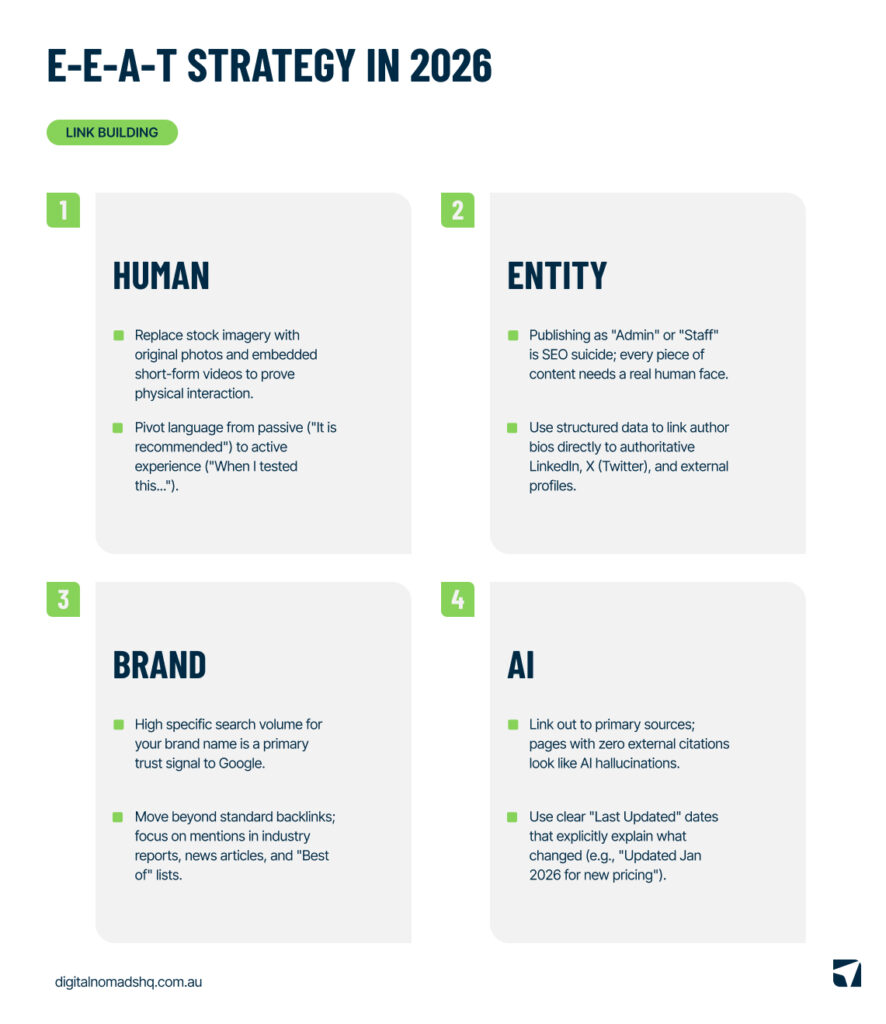
“Proof of Human” Content
Text alone is often assumed to be AI-generated until proven otherwise – You must inject “unfakeable” human elements… like this 👍
Visual Evidence: Use original photos (not stock), or create infographics within brand, along with adding short-form video embedded in your articles.
First-Person: Pivot from “It is recommended…” to “When I or we tested this”…”
Negative Reviews: AI tends to be overly neutral or positive. Honest, critical feedback signals real human usage… its not all “good”
The “Entity” Profile (Author Authority) – Who are you…
Google’s Knowledge Graph must understand who your authors are. An “Admin” or generic “Staff” byline is SEO suicide in 2026.
The “SameAs” Schema: Use structured data to link your author’s bio to their LinkedIn, X (Twitter), and other authoritative profiles.
Cross-Platform Consistency: Ensure your experts are publishing or being interviewed on other sites (links). Google validates your expertise by seeing if others trust you and seeing this not only within your platforms of control.
Brand as the Ultimate Authority
Brand Search Volume is a massive factor for E-E-A-T. If people search for your brand specifically, Google will improve its trusts in you.
Digital PR: Move beyond link building. Focus on getting your brand mentioned in industry reports, news articles, and “Best of” lists.
Community Signals: Active discussions about your brand on Reddit, Quora, or niche forums are mined by Google to verify real-world popularity.
Technical E-E-A-T: Speaking to the AI
You must make your E-E-A-T easy for machines to parse.
Organisation Schema: deeply nested schema that connects your Organisation – Brand – Person (Author) – Citation (Credential).
Citation Hygiene: Link out to primary sources. A page with zero external citations looks like an AI hallucination.
“Last Updated” & History: Display clear “Last Updated” dates and explain what changed. (e.g., “Updated Jan 2026 to include new pricing model”).
"The best way to demonstrate trustworthiness is to become a recognised source of reliable information in your niche."
Source: https://www.google.com/
EAT
(Expertise, Authoritativeness, and Trustworthiness) was first introduced in Google’s Search Quality Rater Guidelines in March 2014. It is a set of criteria that Google uses to assess the quality of content on websites. Websites with high EAT are more likely to rank well in Google search results.
EEAT
(Experience, Expertise, Authoritativeness, and Trustworthiness) was first introduced in December 2022. It is an updated version of EAT that places more emphasis on the experience of the content creator. This is especially important for topics where first-hand experience is critical, such as medical advice or financial planning.
Examples of EAT & EEAT
EAT
A medical website written by a doctor with a PhD in medicine is likely to have high EAT. The website would demonstrate expertise, authoritativeness, and trustworthiness.
EEAT
A medical website written by a patient who has experienced a particular medical condition is likely to have high EEAT. The website would demonstrate experience, expertise, authoritativeness, and trustworthiness.
Both EAT and EEAT are important factors for SEO. However, EEAT places more emphasis on the experience of the content creator.
EEAT is especially important for topics where first-hand experience is critical. By clearly indicating who created the content, you’re signalling to Google that you’re committed to providing high-quality information.
“Interactive experiences go beyond traditional marketing by actively involving the audience in the content. ”
Ashley Paine, SEO Account Manager at Digital Nomads HQ
How was the content produced?
The “How” of content creation is also important. Google wants to see that content is created responsibly and ethically.
This means using credible sources, avoiding plagiarism, and being transparent about your research process – Creating unique and high quality content that is engaging for users is a must!
By considering the “Who, How, and Why” of your content  , you can ensure that it’s aligned with Google’s E-E-A-T guidelines and on a path to success.
Why was the content produced?
Here are 5 top tips for creating E-E-A-T friendly content:
- Write about topics that you’re knowledgeable and passionate about.
- Back up your claims with credible sources.
- Be transparent about your research process.
- Write clear, concise, and informative content.
- Avoid making misleading or unsubstantiated claims.
You can also look at the following factors to assess the EEAT of a website:
- Reputation: Does the website have a good reputation? Is it known for providing accurate and reliable information?
- Transparency: Is the website transparent about its ownership and operations? Does it have a clear contact page and privacy policy?
- Security: Is the website secure? Does it use HTTPS encryption to protect user data?
How Google’s E-E-A-T is important with the upcoming release of SGE
Google’s Search Generative Experience (SGE) or recently updated to “AI overviews” is a new feature that uses artificial intelligence (AI) to generate responses to search queries at the top of the SERPS. AI Overviews is still under development but is expanding its reach again this week, it has the potential to revolutionise the way we interact with the web.
What AI Overviews means for you
This new service offering from Google is related to their introduction of the first E in EEAT, as it demonstrates Google’s commitment to delivering accurate search results.
The E-E-A-T principles help AI Overviews to identify and prioritise the most authoritative and trustworthy sources of information that demonstrate a level of personal experience, like what you see with product reviews and product blog posts.
This helps to ensure that the responses generated by AI Overviews are accurate, informative, and trustworthy. These principles are important for AI Overviews because they help to ensure that the AI model is generating responses that are based on high-quality information. AI Overviews uses a variety of sources to generate its responses, including websites, books, and academic journals.
However, not all sources are created equal. Some sources are more authoritative and trustworthy than others. By applying E-E-A-T principles to the sources used by AI Overviews, Google can ensure that only high-quality and relevant information is presented as part of its search responses. This helps to create a better user experience and improves the accuracy of the results.