On the second day of Google’s March 2026 core update rollout, I pulled rankings on three of our clients in the same category.
One had jumped four positions on its main commercial query.
Two of the agencies we’d been competing against on that exact term had fallen six and eight places respectively.
Same query, same intent, same fortnight.
The only thing that had changed during this timeframe was the algorithm.
I spent the next three weeks pattern-matching that result against our other accounts and against agencies in our own competitive set.
The pattern was the same everywhere I looked.
The sites that climbed were the ones that read as run by real, named, accountable humans operating under a real brand, drawing on real first-hand experience.
The sites that fell were the ones that didn’t.
That pattern is the framework I now use internally with our team and with clients.
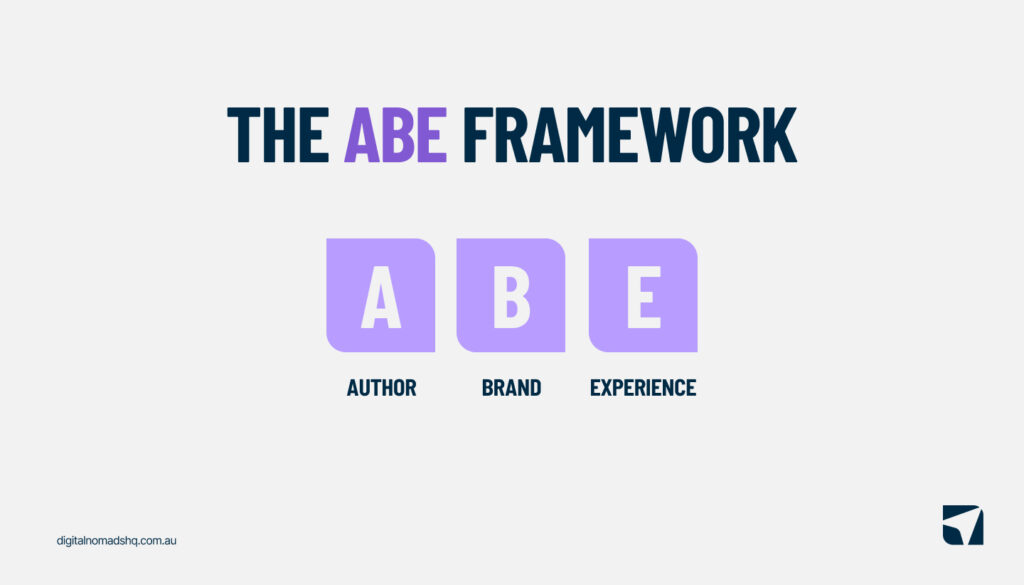
We call it ABE: Author, Brand, Experience.
It is not a new theory.
It is what good agencies and good publishers have done for years. What changed in March 2026 is that Google has now made it pass-fail.
Author
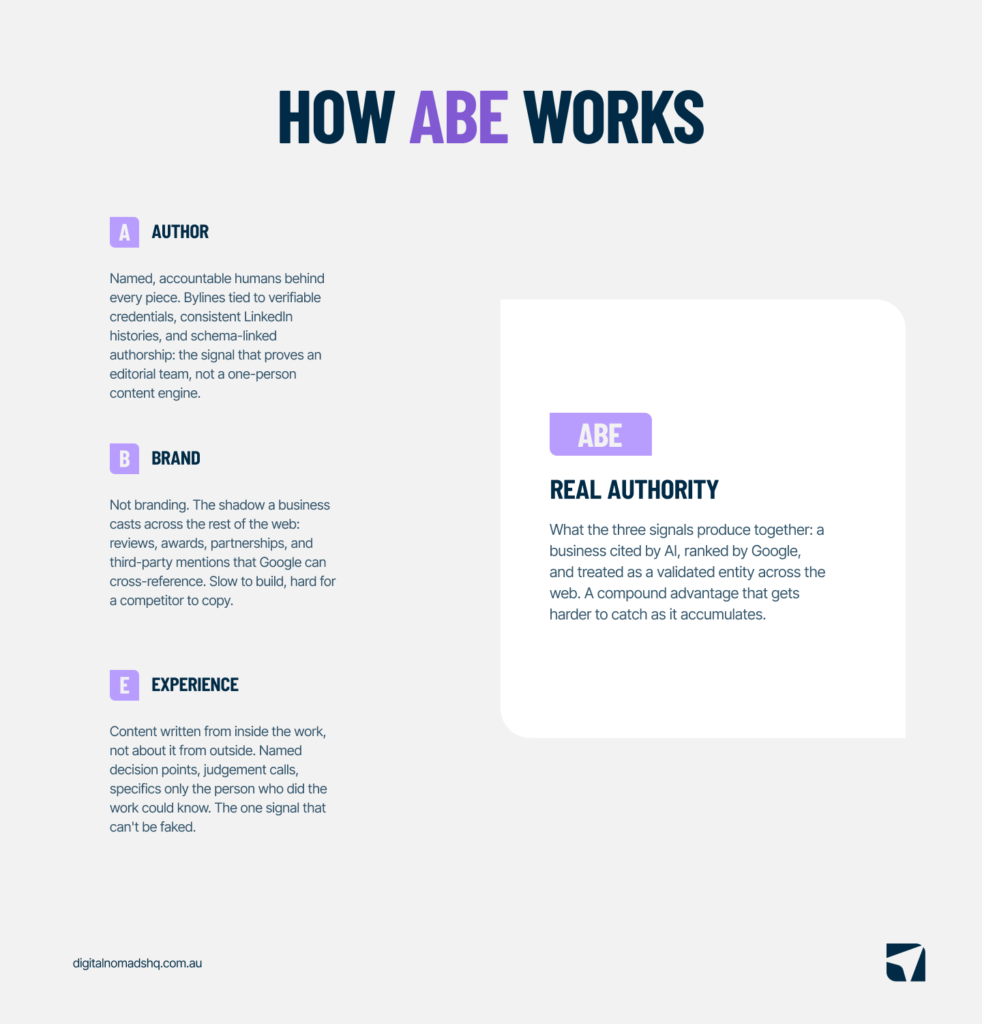
The first signal is the easiest one to fake and the easiest one for Google to detect when you do.
For most of the last five years, the prevailing pattern in agency content was the founder byline.
Every blog post by the founder. Every guide by the founder.
Every methodology by the founder.
We were not immune to this.
For a long time, I was the byline on roughly 90% of what we published.
The reasoning seemed sound: I was the most credentialed voice on the team, I had a decade on the bench, I held the AMI CPM, and I’d worked on the campaigns being written about.
What I missed is what that signal actually communicates to a quality system designed to detect single-author content engines.
A two hundred post archive bylined entirely to one person reads to Google as one person operating a content production line.
It does not read as an editorial team.
The fix isn’t backfilling fake bylines.
It is letting the people who actually do the work put their names on the work going forward.
Hayden, who runs our development side, knows more about Core Web Vitals than I do, and a piece on web vitals belongs under his name, not mine.
Daniel, who heads our strategy team, understands campaign architecture in ways my founder lens cannot match. Their bylines are not a marketing decision.
They are a truth-in-attribution decision.
The deeper test of Author is whether the named human exists outside the byline.
A LinkedIn profile with three years of consistent posting on the topic. A history of comments on industry threads.
A speaking history. Verifiable credentials linked through schema. Real authors leave a trail across the web. Manufactured ones don’t.
Brand
The second signal is the one most agencies underrate because they confuse brand with branding.
Branding is the logo, the colour palette, the tone of voice on the homepage.
Brand is something different and harder to manufacture: it is the shadow your business casts across the rest of the web.
It is what other people, places, and platforms say about you when you are not in the room.
When the March update rolled out, I noticed that DNHQ’s strongest brand signals were not the ones we’d worked hardest on.
The Toyota, Lexus, and LifeFlight client logos on our homepage are real, but Google does not just see those logos: it sees the cross-references between our domain and those entities elsewhere on the web.
It sees our 165 Google reviews.
It sees the TITAN Business Awards page that lists me as 2026 Future Marketing Leader of the Year.
It sees the partnership pages and directories we are listed on.
The work I had assumed was overhead, the awards entries, the partnership applications, the review collection process, turned out to be the highest-leverage SEO work we were doing.
None of it was filed under SEO at the time.
All of it was quietly teaching the algorithm that DNHQ is a real, validated business with external corroboration, not a domain pretending to be one.
The instructive thing about Brand is that it is the slowest signal to build and the hardest one for a competitor to take from you. A competitor can clone your service page in an afternoon. They cannot clone six years of accumulated reviews, awards, partnerships, and third-party citations.
Experience
The third signal is the one that separates content written about a topic from content written from inside it.
I notice the difference now in the same way a chef notices the difference between a menu written by someone who cooks and a menu written by someone who consulted. The vocabulary is the same. The detail is not.
When we put together an audit recently for an Australian law firm with multiple capital city offices, the audit drew on years of accumulated work in the legal vertical: which directories actually drive enquiries in regional cities versus which ones look authoritative but do nothing, where the canonical issues bite hardest on multi-location firms, which schema patterns return real impressions in Search Console versus which ones return zero.
None of that came from a guide.
It came from having been wrong about every one of those things at some point in the last decade and remembering why.
Experience as a signal is what makes the audit specific to the situation rather than a template applied to a brief.
It is what makes a case study credible: not just the result, but the named decision points, the things that nearly went wrong, the calls that were judgement rather than process.
It is the part of the work that cannot be summarised by a tool because it lives in the gap between what the tool says and what actually works.
For a quality system trying to distinguish content drawn from real practice from content assembled from other content, Experience is the highest-confidence signal of the three.
It is also the easiest to demonstrate honestly: tell the story of the work, with the specifics that only the person who did it knows.
The Compound Advantage
ABE is not a hack and it is not a checklist.
It is the description of what a real, accountable, experienced business looks like to systems that have been trained to detect the difference between one and a website pretending to be one.
The reason it matters now is that the cost of pretending has gone up sharply.
In the years before March 2026, an aggressive content engine could outrank a real expert on volume alone.
After March, that arbitrage is closing.
The sites that ranked through volume have lost six and eight positions respectively in our own observed accounts.
The sites that ranked through Author, Brand, and Experience held position or gained.
The good news for any agency willing to operate under their actual names, with their actual reputation, drawing on their actual experience, is that ABE is a compound advantage.
Every named author you put up is one Google did not see last quarter.
Every review and award and partnership you accumulate is a brand signal a competitor cannot copy.
Every piece of work you do is one more page of Experience nobody else can write.
The agencies who lost ground in March are the ones who tried to scale around these constraints. The ones who gained are the ones who scaled into them.
That is the framework I’ll be writing about, working from, and benchmarking us against for the next twelve months.